Trump Administration Advances New Crypto Rules as Clarity Act Stalls in Congress
Key Takeaways
- •President Trump pressed Congress to break the Senate deadlock on the Clarity Act, a bill that would divide digital-asset oversight between the SEC and CFTC but is stalled over disputed ethics language.
- •The Clarity Act passed the House in July 2025, while Senate Democrats have pushed for stronger conflict-of-interest rules, citing the Trump family's crypto ventures including World Liberty Financial and its USD1 stablecoin.
- •Acting Comptroller Jonathan Gould announced the OCC plans to finalize federal stablecoin rules by November under the GENIUS Act and will begin processing crypto license applications starting in January.
- •The OCC has received 40 applications for new bank charters over the past 18 months, more than half involving digital-asset activity, marking an eightfold increase from the prior administration.
- •The SEC proposed rules that would let startups raise capital through tokens without triggering traditional securities registration, a shift from its earlier enforcement-heavy approach.
The Trump administration is pressing ahead with executive actions to bolster the cryptocurrency industry even as comprehensive regulatory legislation remains stalled in the Senate. Since returning to office, Trump has signed a series of digital-asset executive orders — including one establishing a Strategic Bitcoin Reserve — recasting the federal government's posture toward a sector that spent much of the prior administration fighting regulators in court.
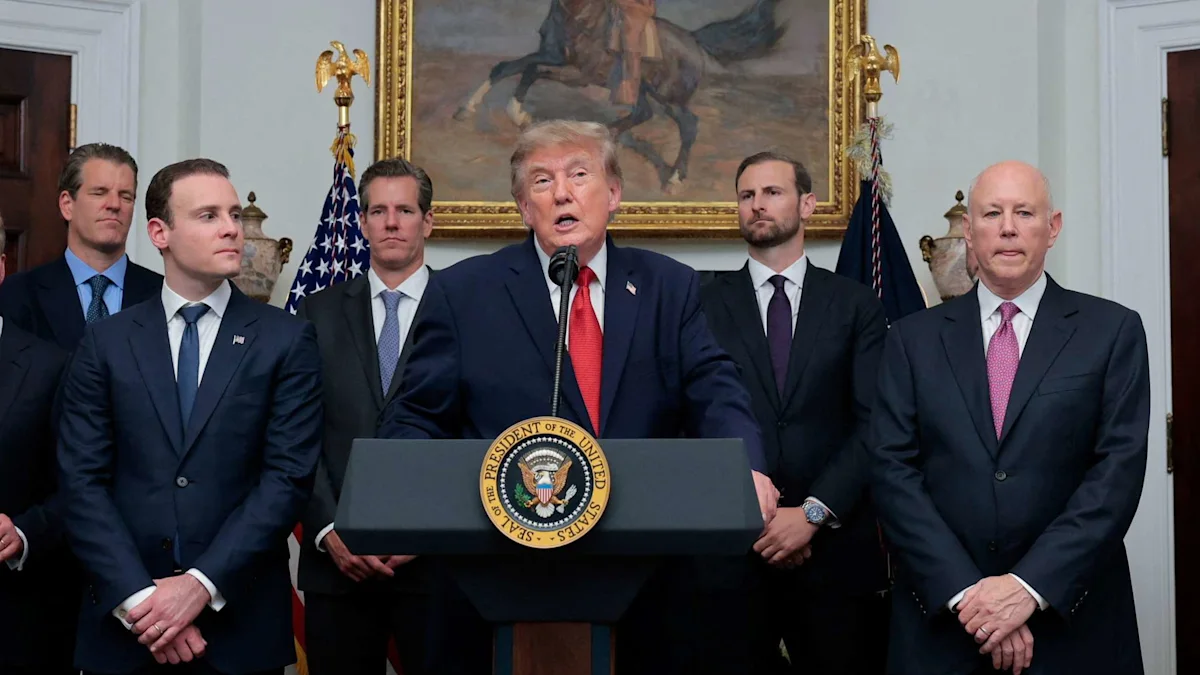
At a White House meeting with crypto executives on Wednesday, President Trump urged Congress to break its deadlock on the Clarity Act, a key bill that remains hung up over disputed ethics language designed to prevent government officials from profiting off digital assets. The president also called on industry executives to work with regulators to move the sector forward. The Clarity Act, which would divide oversight of digital assets between the SEC and the CFTC, passed the House in July 2025 but has since bogged down in the Senate, where Democrats have pressed for stronger conflict-of-interest rules, pointing to the Trump family's own crypto ventures, including World Liberty Financial and its USD1 stablecoin.
Roughly two dozen attendees joined the session, including Securities and Exchange Commission Chair Paul Atkins, Commodity Futures Trading Commission Chair Mike Selig, and the chief executives of Coinbase (COIN) and Robinhood (HOOD) — whose shares were up 8.20% and 13.70%, respectively, at the time of publication — as well as Tyler and Cameron Winklevoss. (Disclosure: Yahoo Finance has a partnership with Coinbase.)
The White House meeting coincided with an accelerating regulatory timeline at the Office of the Comptroller of the Currency, the regulator that charters and supervises national banks. Speaking at the Wyoming Blockchain Summit on Wednesday, Acting Comptroller Jonathan Gould announced plans to finalize federal rules for stablecoins by November, with the agency set to begin processing crypto license applications starting in January.
The forthcoming framework stems from the GENIUS Act, passed in July 2025, which established the first federal regulatory framework for stablecoins — digital tokens pegged to the US dollar and backed one-to-one by high-quality liquid assets such as cash and short-term Treasurys. The law also bars issuers from paying interest to stablecoin holders, and it brings federal rules to a market that has already grown to hundreds of billions of dollars in circulation, led by Tether's USDT and Circle's USDC — the de facto currencies of crypto trading and, increasingly, a payment rail in their own right.
"This is critical for payment stablecoin issuance," TD Cowen analyst Jaret Seiberg said of the OCC's upcoming rule. He added that the rules could be positive for banks. The OCC has proposed preventing stablecoin companies from using loopholes to pay interest to their users, in line with the GENIUS Act's ban on paying yield to holders.
"We are working with great speed here," Gould said at the Wyoming Blockchain Summit. "We very much appreciate the comments that we received on our proposal … we heard you, and we will make changes and have made changes accordingly in the final rule to reflect some of the comments."
Gould noted that over the past 18 months, the OCC has received 40 applications for new bank charters, with more than half involving some form of digital asset activity. That marks an eightfold increase from the prior administration.
"It is becoming ordinary course to involve and integrate payment stablecoins, etc. in the business plans that we are now seeing presented to the OCC for consideration," Gould said.
"Crypto is part of the business of banking, and we have been making sure that that is the case through our actions, both on the chartering front and through legal interpretations," he added.
The OCC's push coincides with broader regulatory shifts across Washington. Also this week, the SEC proposed rules that would allow startups to raise capital through tokens without triggering traditional securities registration — a sharp break from the agency's earlier enforcement-heavy approach, which treated many token sales as unregistered securities offerings.
"This is positive and long overdue in the crypto space," Seiberg said. "It provides a roadmap not just for how one can use tokens to raise capital but also how tokens can lose their designation as securities if the project becomes decentralized."
Together, the developments set a tight near-term calendar for crypto policy — a final OCC stablecoin rule by November, the start of crypto license processing in January, and a Senate decision on whether the Clarity Act's ethics standoff can be broken — leaving the executive branch, for now, as the industry's primary rulemaker.
Reporting by Jennifer Schonberger for Yahoo Finance.

