Trump's Kennedy Center Name Push Edges Toward 'Constitutional Crisis' as Demolition Threat Defies Courts, Report Warns
Key Takeaways
- •President Trump threatened to demolish the Kennedy Center after courts determined that adding his name to the building would require congressional approval.
- •A federal judge issued an order barring demolition of the Kennedy Center without 30 days' notice, though many observers believe may move forward with bulldozers anyway.
- •Georgetown Law professor David Super said the Kennedy Center's founding statute permits the board to build and maintain the facility but not to raze it, so Congress would have to amend the law for demolition to be lawful.
- •The Washingtonian report argues that demolishing the center would constitute a fiduciary breach, noting that Congress has already appropriated repair funds and that consultant reports and renovation plans contradict claims the building is beyond repair.
- •Enforcement of a contempt ruling is complicated because the U.S. Marshals Service is an executive branch agency, and Super warned that ignoring the court order could encourage violations of rulings on issues such as mail-in voting, tariffs, and Federal Reserve independence.
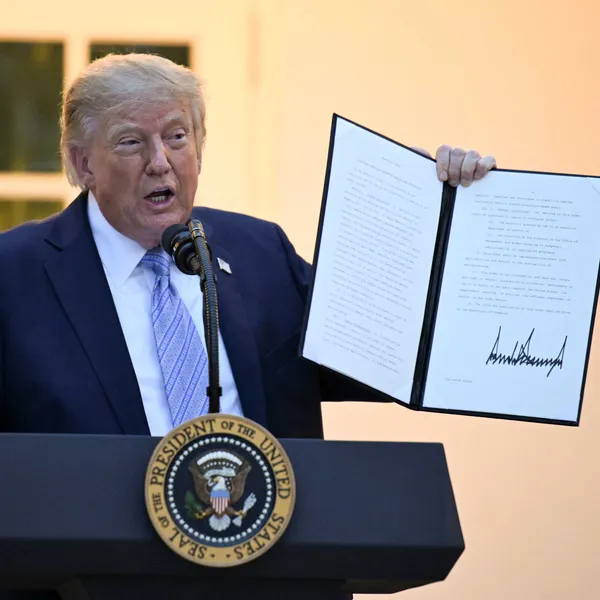
President Donald Trump's push to place his name on the Kennedy Center, the congressionally chartered performing arts center in Washington, D.C., has so far been blocked by a series of judicial orders — but as the president grows increasingly willing to defy the courts, the standoff is poised to tip into a full-blown constitutional crisis.
That assessment comes from a new report published Friday by The Washingtonian and highlighted by Alternet, which declared: "If Trump demolishes the Kennedy Center, we have problems."
Months of pressure, then a threat
According to the report, Trump has spent months trying to have his name added to the Kennedy Center by any means possible. After the courts made clear that this cannot be done without congressional approval, Trump issued a threat: put my name on the building, or I'll tear it down.
Then on Thursday, after it became apparent that he intended to follow through on that promise, the court issued an order barring him from demolishing the center without giving 30 days' notice. Even so, many observers have suggested Trump may send in bulldozers anyway.
"In this situation, tearing down the Kennedy Center would be 100 percent illegal," the Washingtonian notes. "It would be a direct and flagrant violation of an order by a federal judge." And even if Trump did provide notice, he would not be able to proceed until a judge determined the plan was lawful.
Two legal barriers to demolition
The report lays out several reasons to doubt such a determination would ever come. First, the Kennedy Center's founding statute, as laid out by Congress, authorizes the board to construct and maintain the building — but it does not authorize trustees to unilaterally tear it down. Georgetown Law professor David Super, an expert in administrative law, said that for a Kennedy Center demolition to be lawful, Congress would have to modify the statute. So far, it has not. That statute stretches back to the Center's origins: chartered by Congress in 1958 as the National Cultural Center and renamed a living memorial to President John F. Kennedy in 1964, the building opened in 1971 and today houses the National Symphony Orchestra while playing host to the annual Kennedy Center Honors.
Second, the Washingtonian argues, demolishing the Kennedy Center would amount to "an eye-popping fiduciary breach." Members of the board have a legal obligation to act responsibly and in the institution's best interest. The Trump administration would probably argue that the building is in such terrible disrepair that tearing it down makes more sense than fixing it — but the court already has evidence to the contrary, including consultant reports and renovation plans, and Congress has already appropriated the money for repairs. "It would be very hard, in this context, to demonstrate that tearing down the Kennedy Center benefits the institution," the report states.
Contempt of court — and a slow remedy
If Trump defied the order, "then and everyone who helped him do it — from the leadership of the Kennedy Center to the operators of the bulldozers — could be held in contempt of court," the Washingtonian explains. But according to Super, a contempt hearing would take time, during which the building would likely already have been torn down.
"If the Trump administration starts bulldozing the Kennedy Center, he believes they're likely to finish the job," the report elaborates. "Once they start, they've already decided that they're going to disregard the judge, and disregarding two judicial orders does not really different legal consequences from disregarding one." In other words, once demolition has begun, those involved have probably concluded they no longer care about contempt. "At the end of the day," Marotta writes, if Trump truly wants to tear down the Kennedy Center, "there's only so much that lawyers can do."
An enforcement problem at the heart of the crisis
While there are a number of potential consequences for defying the court, it remains uncertain that any would actually be applied. Presumably, U.S. Marshals would be tasked with jailing relevant offenders for contempt — but there is one "significant wrinkle" in that scenario: "The US Marshals Service is an executive branch agency, and if the head of the executive branch—the President—ordered the Marshals not to enforce a court order, then we'd be in fairly treacherous constitutional waters."
That outcome, the Washingtonian explains, "would be a classic constitutional crisis."
Nor would the consequences stop at the Kennedy Center. Violating a court order over the building, Super warned, "could open the floodgates to all kinds of other illegal actions — like violating court orders on mail-in voting, or tariffs, or the independence of the Federal Reserve." The crisis, as he put it, would be that "the courts have stopped mattering and everything's on the table. They can do anything they want."

