Trump Adopts Dual Economic and Military Strategy to Pressure Iran
Key Takeaways
- •The Trump administration's 'Operation Economic Outcast,' launched last week to sever Iran's remaining trade ties, has so far sanctioned only one Egyptian bank branch in the UAE.
- •Ship transits through the Strait of Hormuz remain far below pre-war levels, with 102 last week versus 130 or more per day before the war began, according to Lloyd's List Intelligence.
- •Trump said the conflict would not last much longer and dismissed concerns that the war's unpopularity and high gasoline prices would hurt Republicans in November's midterm elections.
- •A regional diplomat said negotiations cannot progress without addressing Israel, the initial catalyst of the war, and expressed skepticism about the new U.S. sanctions plan.
- •Iran's leadership is divided between moderates like President Masoud Pezeshkian, who favor a negotiated solution, and hardliners who appear to have gained the upper hand.
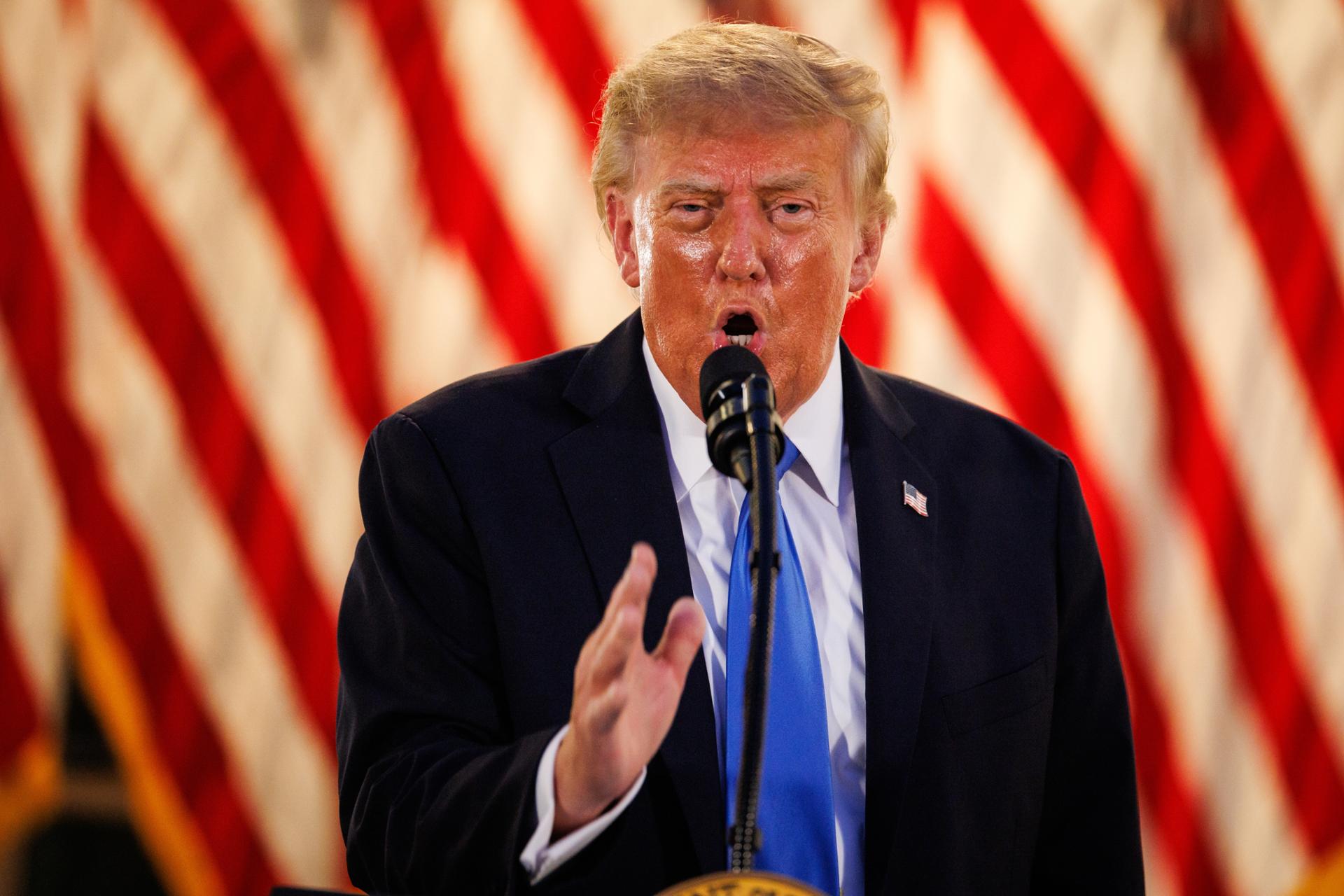
U.S. President Donald Trump speaks during an End of Summer BBQ event with Republican lawmakers in the Rose Garden of the White House in Washington, DC, Wednesday. EPA-Yonhap
WASHINGTON — Facing an Iranian government that has refused to yield even under a massive military campaign, President Donald Trump appears to have settled on a two-track strategy that pairs economic pressure with the possibility of a devastating escalation in force.
The Trump administration launched "Operation Economic Outcast" last week in an effort to sever Iran from its remaining global trade partners, and in recent days it has also resumed strikes — prompting Iranian retaliation and renewed fears of an all-out regional war.
Yet the combination of already-harsh sanctions and an intermittent bombing campaign, ongoing since the war began more than six months ago, has not broken the Iranian leadership, leaving the administration struggling to find a path to winding down the conflict. Tehran has dug in its heels — to Trump's frustration — as energy prices climb, the global economy churns, and poll numbers on the administration's handling of the war slip ahead of November's midterm congressional elections.
The standoff carries stakes well beyond the two adversaries. The war has disrupted a chokepoint that the world's oil market depends on, and the longer the conflict drags on, the more pressure it places on fuel costs and shipping routes that connect producers to consumers worldwide.
Trump said Wednesday that he did not think the conflict would last "much longer," but he again dismissed suggestions that its unpopularity, along with high gasoline prices caused by Iran's chokehold on the Strait of Hormuz, would hurt Republicans in the elections.
"It doesn't matter. And I'm not affected by the election," he told reporters. "I'm not running. But my party is running, and I'm going to help my party. But I think my party respects the fact that we're not allowing Iran to have a nuclear weapon."
A regional diplomat briefed on the matter described the standoff between Tehran and Washington as a reflection of both countries' domestic priorities: the midterm elections for Trump and Republicans, and the internal crises within Iran.
Domestic considerations are a critical reason neither side is willing to blink first, said the diplomat, who spoke on condition of anonymity to discuss sensitive negotiations.
The diplomat said negotiations — whether between Iran and Oman or even Iran and the U.S. — will not progress without addressing the initial catalyst of the war: Israel. The diplomat was also skeptical of the Trump administration's new sanctions plan, saying the threats require more explanation than the U.S. has provided so far.
Economic isolation campaign off to a slow start
The administration's new push to isolate Iran economically was announced last week with great fanfare and a stark warning that all remaining countries must cut financial and trade ties with Iran or face U.S. retaliation — but the campaign has so far fallen flat.
Only one branch of an Egyptian bank in the United Arab Emirates has been targeted to date. For sanctions to truly bite, experts agree, they must apply to Iran's main trading partners: chiefly China, but also India and Russia. That is a high bar: U.S. sanctions on Iran have been built up over years across multiple administrations, and enforcement against large economies with deep commercial ties to Tehran has historically been difficult. Trump, however, is reluctant to target China, especially as he prepares to host President Xi Jinping later this month — a summit that will be watched for any sign of how far Washington is willing to push Beijing over Iranian oil purchases.
Trump also insists that the U.S. has control over the Strait of Hormuz, through which one-fifth of the world's oil transited before the war began. The strategic waterway has been a key pressure point for Iran, and fully reopening it has become one of the U.S. administration's prime objectives.
Ship traffic through the strait remains far below pre-war levels because vessels that do not comply with an Iranian vetting regime near its coastline risk attack — a sharp contrast to the unhindered navigation that existed before the war. There were 102 transits last week and 126 the week before, according to shipping data company Lloyd's List Intelligence, compared with 130 or more per day before the war. Weekly transit figures like these have become one of the clearest barometers of whether the waterway is genuinely returning to normal.
"As President Trump said, the strait is open and all mines have been cleared," White House spokeswoman Anna Kelly said Thursday. "The naval blockade remains in full force and effect, and Operation Economic Outcast is underway to sever every remaining economic lifeline sustaining the regime."
The White House has repeatedly touted the sanctions' economic toll on Iran, pointing to rampant inflation and the sharp depreciation of its currency. U.S. officials have described Iran's financial system as "one big house of cards."
Looking ahead, Secretary of State Marco Rubio said "the price" Iran will pay will be primarily economic, "but we reserve the right ... to take military action when necessary — not just to protect ourselves but to prevent them from being able to threaten others as well."
"They're going to continue to feel the squeeze," he told Fox News host Brian Kilmeade in an interview that aired Wednesday.
Treasury Secretary Scott Bessent this week likened Iran to a snake that has been decapitated but whose body is still writhing.
"We are burying the head of the Iranian snake," he said Tuesday. "The snake doesn't know it's dead yet, but it will stop wiggling when the sun goes down. And so the Iranian regime — they are in demise, and they will figure it out."
Combining military force and sanctions 'is the only option,' analyst says
Complicating matters for the U.S., Iran's leadership has shown signs of division between moderates more open to a diplomatic resolution and hardliners pressing for a more confrontational course. Which faction prevails in Tehran is likely to shape whether any diplomatic opening becomes possible.
President Masoud Pezeshkian is among the most prominent voices still calling for a negotiated solution. But the hardliners appear to have gained the upper hand, and Iran shows no sign of backing down. Tehran continues to strike at U.S. interests and allies across the region in response to military strikes.
"This kind of a hybrid approach — the combination of military force, blockade and economic pressure — that is the only option that seems to be available to the United States at this moment," said Hamidreza Azizi, consulting senior Iran analyst for the International Crisis Group.
Still, he said, "it's been for a long time, but now maybe more than ever, a battle of endurance between the two sides."
Amr Hamzawy, director of the Middle East program at the Carnegie Endowment for International Peace, cited two main reasons for the deteriorating situation.
"One, none of the two parties is satisfied with the outcome — meaning that the current situation does not serve U.S. interests well, and it does not serve Iranian interests well," Hamzawy said.
The second reason concerns how leaders on both sides are perceived at home.
"The Trump administration is afraid of being portrayed in the U.S. as an administration that failed to end a military campaign successfully, and that's going to impact the midterm elections," he said. "And the Iranians, especially the Revolutionary Guard, are quite afraid of appearing as if they are submitting to U.S. sanctions with no actions on their side, which might hurt them domestically."

