Revisiting the Primerica Household Budget Index, Once EJ Antoni's Go-To Gauge of Consumer Finances
Key Takeaways
- •The Primerica Household Budget Index measures middle-income purchasing power using only essential goods and services such as food, housing, transportation, and healthcare.
- •Middle-class purchasing power remains well below its pre-pandemic growth trend according to the index.
- •Prices of essential goods have been rising faster than overall inflation, with housing costs increasing at nearly twice the official inflation rate.
- •A recent study by a major American bank found that over a quarter of middle-income earners, including households earning more than $150,000 annually, are living paycheck to paycheck.
- •Essentials-focused indexes like Primerica's can diverge from official inflation statistics because housing carries a heavier weight in essential-spending measures.
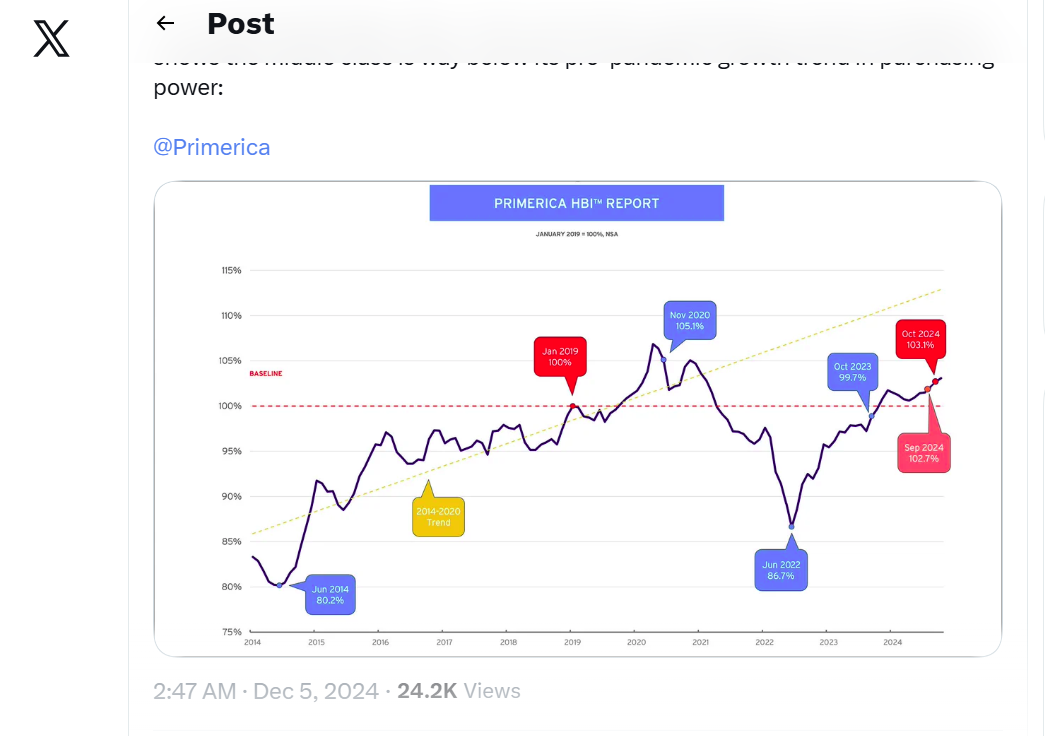
At the end of 2024, EJ Antoni was citing the Primerica Household Budget Index as an indicator of consumer conditions, pointing to it in posts such as this one on X.
A recent study by a major American bank showed that over a quarter of middle-income earners are living paycheck to paycheck — including households making more than $150,000 per year. As households shift toward purchasing only necessities, the prices of those essentials become more significant to their budgets. These essential prices have been rising faster than overall inflation, with the annualized increase in housing costs running at nearly twice the "official" inflation rate.
The Household Budget Index, which tracks only essential consumer purchases, shows that the middle class remains well below its pre-pandemic growth trend in purchasing power: @Primerica (https://x.com/Primerica)
The Primerica Household Budget Index is published by Primerica, a financial services company focused on middle-income households, and measures the purchasing power of these consumers by focusing on the cost of essential goods and services — such as food, housing, transportation, and healthcare — rather than the broader basket used in headline consumer price measures. This essentials-only framing addresses a long-standing criticism of aggregate price indexes: because headline measures average across all spending categories, they can understate the effective inflation experienced by lower- and middle-income households, whose budgets are concentrated in necessities. Housing, in particular, carries a heavier weight in essential-spending measures than in the broader consumer price basket, which is one reason the two gauges can diverge during periods when shelter costs rise quickly. For readers tracking the debate over consumer health, comparisons between essentials-focused indexes like this one and official inflation statistics — along with future Primerica releases showing whether the gap to the pre-pandemic trend narrows — offer a way to assess how household purchasing power is actually recovering.

