Psychologist Warns Trump Is Incapable of Backing Down After Historic Midterm Losses
Key Takeaways
- •Dr. Vince Greenwood stated that President Trump meets the diagnostic criteria for clinical psychopathy, a rare condition affecting roughly half of one percent of the population that he characterized as intractable.
- •Trump and the MAGA Republican Party lost control of both the House and Senate by historic margins in the midterms, along with key governor's races and state legislative contests, including in Texas.
- •Following the losses, Trump announced Stephen Miller as his new chief of staff, publicly cast doubt on the midterm results, and said on 60 Minutes that he will never forgive his personal enemies.
- •Greenwood said his conclusions rest on a forensic, evidence-based evaluation using life-history information rather than in-person clinical examination, an approach that contrasts with the American Psychiatric Association's Goldwater Rule for psychiatrists.
- •Greenwood rejected speculation about a 'lame duck' presidency or narcissistic collapse, asserting that Trump lacks critical self-reflection and will bring a dominant, self-interested mindset to future situations.
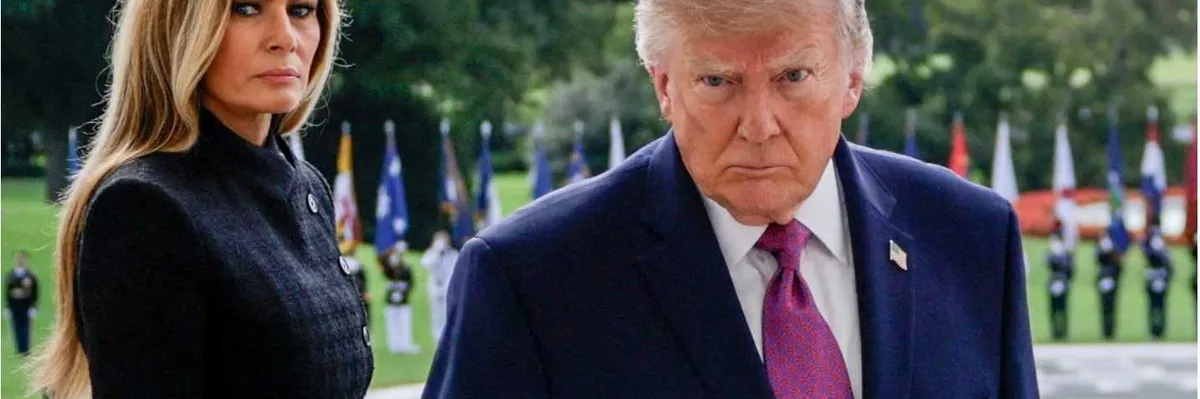
A clinical psychologist is warning that President Donald Trump's historic losses in last week's midterm elections will do nothing to curb his behavior, arguing that the president meets the diagnostic criteria for a rare condition — clinical psychopathy — that he describes as effectively immutable.
Dr. Vince Greenwood, executive director of the Washington Center for Cognitive Therapy and author of Puppet on A String: Trump Is Ruled by an Ominous Psychological Condition, shared the assessment in a conversation with politics writer Chauncey DeVega published by Alternet. In Greenwood's view, Trump is motivated by a will to dominate and to win in all areas of life, is incapable of critical self-reflection, and will not be stopped by the midterms or other attempts to constrain his behavior.
A rout at the ballot box
Trump and his MAGA Republican Party were wrecked by the blue wave that hit them in last Tuesday's midterm elections. By a historic margin, they lost control of the House and the Senate to the Democrats — a result that hands the opposition the committee chairmanships, subpoena power and agenda-setting authority that come with majorities in both chambers. They also suffered key losses in governor's races and state legislatures across the country, including in Republican strongholds such as Texas.
Pundits have been announcing that Trump is now a "lame duck" — significantly weakened, if not broken — and that the tide has decisively turned against his MAGA movement, which the author characterizes as "American fascism."
Trump, however, refuses to be cowed and remains on the attack, according to the essay. He has announced that Stephen Miller, whom the author describes as a "demonstrated hatemonger and white nationalist," will be his new chief of staff — traditionally the White House's central gatekeeping role, controlling access to the president and the flow of policy decisions. He has sown doubt about the results of last week's midterms. And he told CBS News correspondent Ross Douthat on 60 Minutes that he will never forgive his personal enemies, even if that might keep him out of heaven.
For Greenwood, none of this aggressive behavior comes as a surprise.
A forensic, evidence-based assessment
Note: the conversation has been edited for clarity and length.
Interviewed several days after the historic midterms, in which Trump and the Republicans were routed, Greenwood said he had "a real sense of relief and fundamentally felt very happy" — while acknowledging the interviewer's description of lingering anxiety over what Trump might do next. "The vigilance rushes in pretty quickly, though," he said. "I appreciate that you are still sounding the alarm. I'm afraid I have to reinforce that message as well."
Greenwood explained that his particular focus has been on Trump's apparent psychopathology, assessed through what he called a rigorous, gold-standard evaluation process for clinical psychopathy. The assessment can be administered without a clinical interview: it requires life-history information rather than a series of in-person clinical sessions. That method touches on a long-running debate within the mental-health professions: the American Psychiatric Association's ethics code — the so-called Goldwater Rule, adopted in 1973 after Fact magazine polled psychiatrists about Barry Goldwater's fitness for office during the 1964 campaign — instructs psychiatrists not to offer professional opinions on public figures they have not personally examined. Greenwood, a psychologist, maintains that a forensic, evidence-based evaluation of this kind can rest on life-history information rather than an in-person examination.
"Trump clearly meets those criteria. It is very rare," Greenwood said.
"One of the defining qualities of that severe condition is that it is intractable," he continued. "Conditions may change, but I am afraid that his destructive set of traits is going to continue to require vigilance and pose a threat to the republic. Again, they are immutable."
Greenwood emphasized that his conclusions rest on evidence rather than hyperbole or opinion. "This is a forensic evaluation. It is evidence-based," he said. His conclusions about Trump's mind and behavior, he added, "go beyond mere informed opinion" and are "closer to a formal assessment, given the huge amount of evidence available." Trump is "probably the most well-chronicled celebrity in history," Greenwood noted, meaning the life-history information required for this kind of forensic evaluation is widely available.
Psychopath versus sociopath
Greenwood drew a distinction between the two commonly invoked labels. Sociopathy, he said, is typically "a somewhat broader category," with a prevalence rate of three to four percent of the general population. Clinical psychopathy — "a more precisely and narrowly defined set of traits" — is seen in about one half of one percent of the population. Neither term is a standalone diagnosis in the DSM, the American Psychiatric Association's diagnostic manual, whose closest category is antisocial personality disorder; researchers studying the psychopathy construct typically measure it with structured instruments such as the checklist developed by psychologist Robert Hare.
'Honest in his own world'
Perhaps counterintuitively, Greenwood does not consider Trump a liar in the conventional sense. "I do not believe that Donald Trump is a liar. He is actually one of the most honest politicians in American history," he said. "Trump is utterly transparent. That does not mean that anything he says is factually true."
"Trump is very honest in his own world. That does not mean that he is telling the truth," Greenwood continued. "We know that he is a world-class liar."
He pointed to one of the earliest books to explore Trump's psychology, The Strange Case of Donald Trump, published in 2015 by Dan McAdams, a Northwestern University psychologist whom Greenwood described as "a very esteemed colleague." McAdams has developed a framework called narrative identity, which holds that a key part of human identity is a story about one's life — a beginning, a middle, and an end; essentially a plotline.
Trump, by contrast, "does not appear to have any kind of narrative arc," Greenwood said. "He lives moment to moment; he is pure id." The president's consciousness, he argued, is dominated by two questions: "What's in it for me, and how do I win the moment?"
"In that sense, he is genuine and honest," Greenwood said. "And therein lies the paradox: his genuineness is built on a series of lies."
No 'narcissistic collapse'
Contrary to what much of the mainstream media and punditry have been announcing, Greenwood does not believe Trump is experiencing a narcissistic collapse.
"The emotional life of a malignant narcissist is very truncated," he explained. "Such individuals generally do not experience self-awareness or self-criticism."
"I believe that Trump is feeling anger. But he is not dwelling on it. He's not shattered," Greenwood said. "How do I win the next moment? How do I sell the next moment? What's in it for me? Those are the questions I believe that he is asking himself. Even in the midst of this political tsunami, Trump's intractable mind is simply going to march forward."
He dismissed the wave of speculation that the midterm defeat has permanently weakened the president. "There is all this misplaced 'lame duck' talk about President Trump," he said. "This man is not going to be restrained."
Greenwood declined to predict Trump's specific next moves, saying that depends on what triggers him and the situations that arise. "But what you can take to the bank is that Trump's remorseless, predatory, 'what's in it for me?' consciousness will be brought to any situation," he said. "His urge to dominate is key."
For readers weighing that assessment against the prevailing "lame duck" narrative, the reference points ahead are concrete rather than predictive: a Congress now under Democratic control, a White House reorganizing around a new chief of staff in Stephen Miller, and Trump's own public doubt-casting about the midterm results. In Greenwood's framing, these are not tests Trump might pass or fail — they are simply the next situations to which the same consciousness he describes will be brought.
About the author
Chauncey DeVega is a politics and opinion writer and a former senior politics writer at Salon. His essays, commentary, interviews and other writing have been cited by The New York Times, The Washington Post, the BBC, NPR, The Atlantic and other leading publications. He hosts two podcasts, The Chauncey DeVega Show and The Truth Report. An expanded version of this essay is available on his Substack, Indomitable.

