Trump’s $5,000 Dividend Promise Draws Impeachment Criticism
Key Takeaways
- •Trump proposed a $5,000 payment for every adult citizen conditional on Republican victories in the House and Senate.
- •The article says major federal payment programs generally require congressional approval, which Trump did not address in his proposal.
- •Estimated payments to roughly 245 million adults would exceed $1.2 trillion and add substantially to the federal deficit.
- •Republicans in competitive races largely avoided the Dallas convention, whose audience and programming were heavily focused on Trump.
- •Previous proposals for DOGE, tariff, and ACA-related payments described in the article were not implemented.
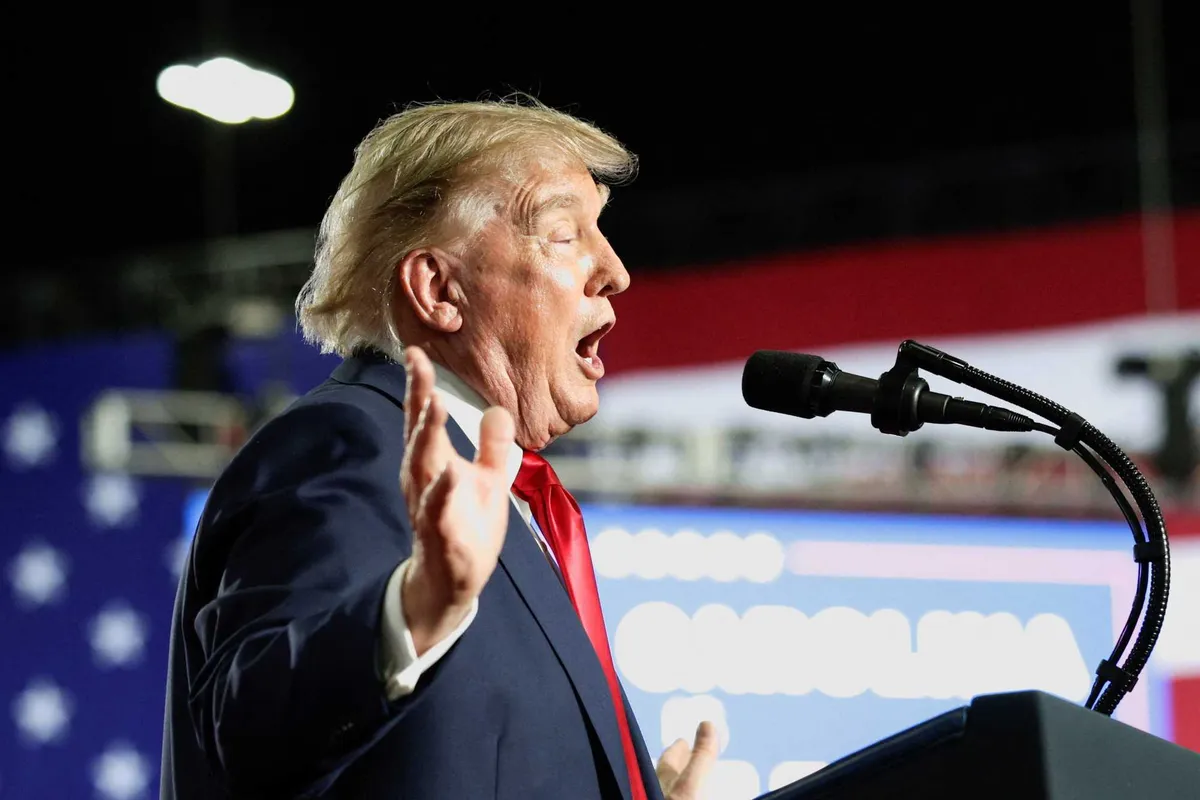
A midterm convention in Dallas intended to present the results of Donald Trump’s second term as “The Great American Comeback” instead became a showcase for the president and a $5,000 payment proposal that critics say could raise legal and fiscal questions.
Republicans running in competitive races largely stayed away from the event, which the article describes as an embarrassing failure. Speakers praised Trump so extensively that the convention resembled one of his televised Cabinet meetings. The audience, both at home and in the arena wearing sequined Trump merchandise, appeared to consist primarily of MAGA loyalists rather than the moderate and undecided voters Republicans need to attract.
Democrats considered holding a competing convention but decided against it. Instead, they allowed Trump to remain in the spotlight, following the theory that repeated exposure could weaken his support among voters. The article argues that this was the correct decision.
A $5,000 payment proposal
Trump served as the keynote speaker on both nights. During his appearances, he portrayed high fuel and energy costs, an unresolved war of choice, and repeated divorce papers from U.S. allies as accomplishments. The article characterizes that presentation as an example of political spin replacing factual accountability.
Although Trump is not running for office, the convention focused heavily on him. The article argues that his political objective is continued avoidance of accountability. It says that if Democrats regain control of the House and Senate, terms including “impeach,” “corruption,” and “Emoluments Clause” could return to the center of national political debate as Congress reexamines federal governance and the rule of law.
Trump spoke for nearly two hours in a speech that was widely criticized as rambling. Near its conclusion, he said: “If the Republicans win the House of Representatives and the United States Senate, … I will issue a dividend to every adult citizen in the United States of America for $5,000.”
He compared the proposed payments to a corporate cash distribution to shareholders and to the $1,776 payment that he said he had given members of the military the previous year.
The article rejects both comparisons. It argues that corporations do not generally make bonus distributions when earnings are falling and the company carries $40 trillion in debt. It also says Trump did not personally provide the $1,776 military payment because Congress had already funded a $2.9 billion military housing allowance in July 2025, from which the money was drawn. Trump renamed the payment a “Warrior Dividend” and presented it as his own gift, according to the article.
Questions about congressional authority
The article says analysts criticized Trump’s $5,000 proposal as either an election-year inducement or, potentially, an illegal bribe. It identifies a broader concern: after nearly six years in office, Trump still appeared not to understand the legislative process required to authorize a major federal payment program.
Trump did not say that he would work with a Republican-controlled Congress to authorize the payments or help pass legislation implementing them. Instead, he said he would issue the checks if Republicans performed well in the midterm elections. The article notes that large direct-payment programs generally require fast-track legislation or formal congressional approval.
It also reviews several earlier payment proposals that did not materialize. Trump had promised $5,000 stimulus checks described as “DOGE dividends.” That proposal was officially abandoned after the Department of Government Efficiency, or DOGE, shut down on July 4, 2025, after failing to produce a substantial portion of the savings it had promised.
Trump also promised $2,000 “tariff dividend” checks. Those payments never materialized. The Supreme Court struck down Trump’s tariffs, according to the article, while financial experts said that distributing $2,000 to every non-high-income American would cost between $450 billion and $600 billion. Annual tariff revenue was estimated at roughly $200 billion to $300 billion, substantially below the projected cost of the payments.
A further proposal called for payments of between $1,000 and $1,500 funded through expiring Affordable Care Act, or ACA, subsidies. The article says Republicans scheduled health care cuts to take effect after the midterm elections and that a promised Health Savings Account intended to reduce the impact never materialized. It also says Republicans reduced Medicaid and other health care benefits for 10 million people but did not establish a mechanism to redirect the resulting federal savings to those losing coverage.
Fiscal and economic concerns
Citing the Census Bureau, the article estimates that the United States has approximately 245 million citizens over the age of 18. A $5,000 payment to each adult citizen would therefore cost more than $1.2 trillion and add substantially to the federal deficit. The article compares that amount with the $7 trillion annual U.S. budget for 2025, arguing that the proposal would add about 20% of that figure to the national debt.
It further argues that Trump’s comments reflected either a lack of understanding of the relationship among federal debt, the bond market, and interest rates or indifference to those relationships. The article makes a similar argument about tariffs, saying Trump has not demonstrated an understanding of who ultimately bears their costs.
Trump also said the proposed dividend would have to be spent in the United States. “The only caveat I have is that the dividend that we’re making must be spent in the United States of America...” he told the audience.
The article argues that such a restriction would be difficult to enforce in a capitalist economy because currency generally moves freely and there is no ordinary mechanism for tracking where cash is spent. It speculates that enforcing the condition would require specially marked currency restricted to domestic use. The article then sarcastically suggests that Trump could issue $5,000 “Trump coins” usable only to purchase products from Trump.com.
The author links Trump’s position on domestic spending to what she describes as his attempt to influence voting access by controlling the mail and his apparent belief that the government can simply print money. The article says these positions help explain why Trump is seeking a Republican victory in the midterms.
During the convention speech, Trump urged voters to “pretend that he is on the ballot.” The article concludes that Democrats should repeat that statement on billboards across the country.
Sabrina Haake is a political analyst and federal trial attorney with more than 25 years of experience who specializes in First and Fourteenth Amendment defense. She writes the free Substack newsletter The Haake Take.
Source: Alternet

