Agricultural Trade Overhaul Needed to Strengthen Food Security
Key Takeaways
- •The Philippines has sourced about 30% of its rice needs from imports since 2022, compared with under 10% roughly a decade earlier.
- •The Department of Agriculture has introduced a P50-per-kilogram ceiling for 5% broken rice and is working to expand exports of bananas, mangoes, and pineapples.
- •Industry groups argue that reduced tariffs and increased imports have hurt farmer incomes without delivering significantly lower retail food prices.
- •Farm organizations oppose tariff cuts on products such as pork and chicken unless agreements include effective safeguards for domestic producers and food security.
- •Proposals include greater public disclosure of trade deals and directing agricultural exports toward nearer markets that would not require tariff changes.
By Marron Joshua F. Mendoza
Farm imports have long been used to address food shortages and declining productivity caused by crises such as El Niño, as well as rising fuel and fertilizer costs.
In recent months, the Department of Agriculture (DA) has stepped up efforts to manage trade in ways that limit the impact of imports on farmers. It has also sought to promote agricultural exports, including bananas, mangoes, and pineapples, in new markets such as Canada, New Zealand, Saudi Arabia, the United Arab Emirates, and the European Union (EU).
Rice is the main imported commodity being targeted by the DA. The agency has imposed a P50-per-kilogram price cap on 5% broken-grain varieties.
During his fifth State of the Nation Address (SONA), President Ferdinand R. Marcos Jr. highlighted the potential of the ASEAN Plus Three Emergency Rice Reserve (APTERR), a regional food security agreement involving the Association of Southeast Asian Nations (ASEAN), China, Japan, and South Korea. The agreement guarantees an emergency rice supply if domestic production falls short.
The debate over agricultural trade therefore involves both immediate food supply and the longer-term ability of local producers to remain productive. The positions raised by industry groups focus on how tariffs, safeguards, and export opportunities can be managed together rather than treating imports as the sole response to supply gaps.
Overreliance on imports
In an analysis released before the President’s address to Congress, Leonardo Q. Montemayor, chairman of the Federation of Free Farmers (FFF) and a former agriculture secretary, said the Philippines had become overly dependent on imports to meet consumer demand.
Mr. Montemayor said the country had imported about 30% of its rice requirements since 2022, compared with less than 10% a decade earlier.
“Today, the country has the dubious distinction of being the biggest rice importer in the world,” Mr. Montemayor said in a statement.
He said low tariff rates on rice, corn, pork, and poultry, along with the resulting increase in overseas shipments, had not significantly lowered retail prices. Instead, he said, they had reduced producers’ incomes and discouraged planting and production.
“The drastic drop in tariff collections (some P44 billion for rice alone) has deprived farmers of funding for improving their productivity and competitiveness,” Mr. Montemayor said.
Jayson H. Cainglet, executive director of the Samahang Industriya ng Agrikultura (SINAG), said further tariff reductions under new free trade agreements would significantly affect the agriculture industry unless adequate safeguards for domestic producers were provided.
“The Philippine agricultural sector has already borne the heavy consequences of unprecedented imports of staple commodities,” Mr. Cainglet told BusinessWorld via Viber.
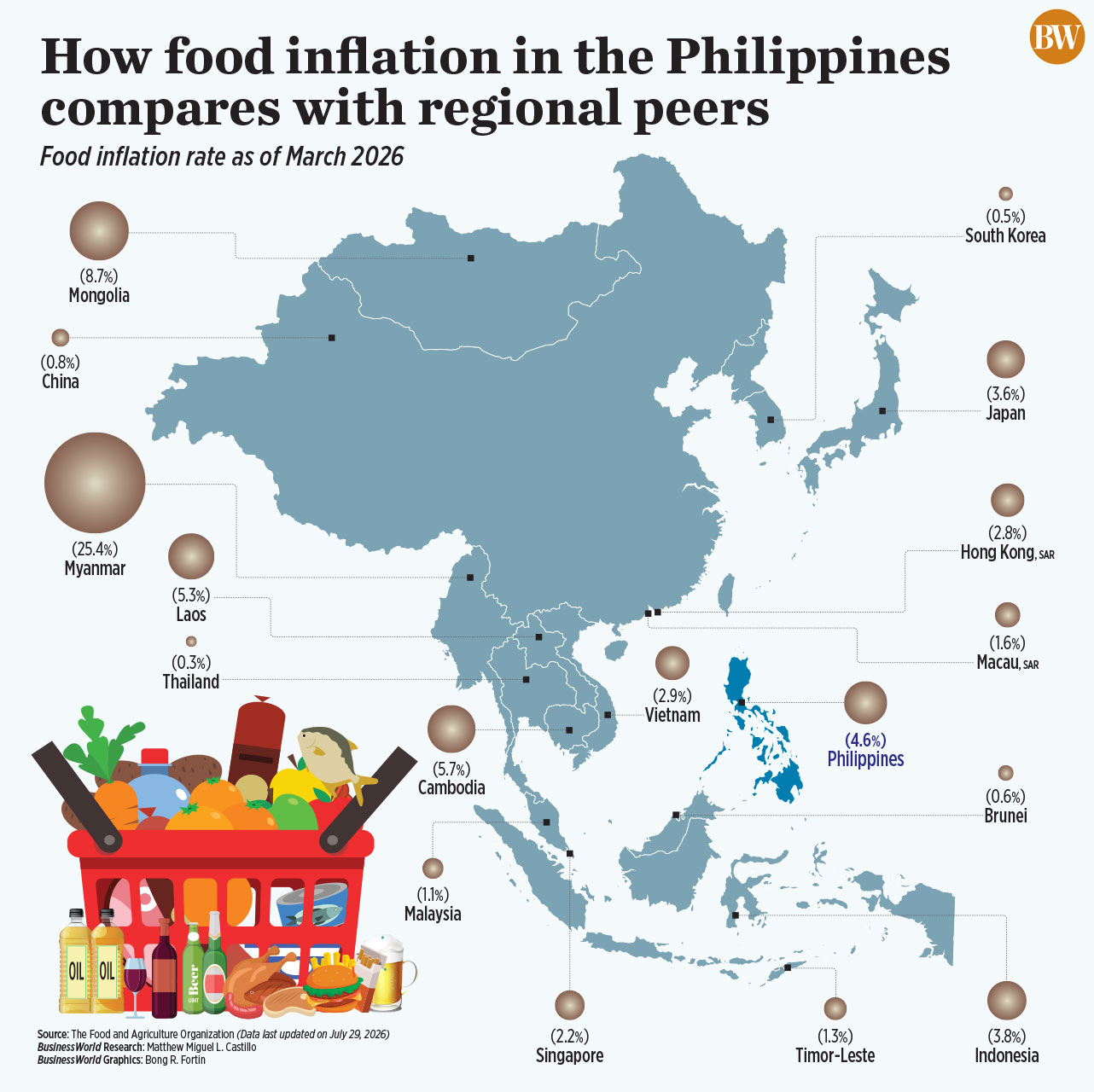
“Many farmers have lost livelihoods or seen their incomes diminished. Yet despite increased imports and lower tariffs over the years, Filipino consumers continue to face high food prices,” he added.
Mr. Cainglet said trade liberalization should not come at the expense of farmers, fisherfolk, or overall food security.
“Any agreement must ensure a level playing field, preserve policy space to support producers, and strengthen—rather than weaken—our capacity to feed our own people,” Mr. Cainglet said.
SINAG Chairman Rosendo O. So said the Philippines imported more agricultural commodities than it exported.
“We really lost in that trade,” Mr. So told BusinessWorld via Viber.
He said high import volumes and lower tariffs could affect food security, citing the EU’s request for zero tariffs on pork and chicken.
“If the tariff is lowered, our local produce will be affected. The EU is asking for zero tariffs on pork and chicken, which doesn’t favor us because we would depend more on imports,” Mr. So said.
He called for stronger protections for the agriculture industry and said tariff reductions for the EU and other trading partners should not cover pork, chicken, and other agricultural commodities that could affect domestic producers.
“We need to protect our local industry because we need to strengthen our local production,” Mr. So said.
Proposals
Mr. Cainglet called for greater transparency regarding the administration’s trade agreements with Canada, Chile, and the EU. He said this would allow the public to better understand the proposed deals, particularly provisions involving tariff reductions on agricultural commodities.
Mr. So, meanwhile, said the DA should focus on exporting more agricultural products to countries closer to the Philippines so that tariffs would not need to be changed.
“We think that without adjusting the tariff, if we’re going to export, they should go to countries that are closer than the ones that are far away and would need tariff adjustments,” Mr. So said.
These proposals make the details of the trade agreements and the safeguards for domestic producers important areas to watch. They also underscore the need to assess agricultural trade not only by import volumes or tariff levels, but by whether it supports local production while maintaining access to food.
Source: BusinessWorld

