Treasury Proposal Could Require US Crypto Exchanges to Audit or Delist Foreign Stablecoins
Key Takeaways
- •The Treasury proposal, published in the Federal Register on August 18, 2026, would force U.S. exchanges to audit foreign stablecoins or delist them.
- •The rulemaking stems from the GENIUS Act, which created the first federal licensing and reserve framework for payment stablecoin issuers in the United States.
- •Widely used dollar stablecoins like Tether's USDT are issued outside the U.S. and could be directly affected by the new requirements.
- •Treasury has separately proposed a July 18, 2028 cutoff for offshore stablecoins serving U.S. customers.
- •The measure is still a proposal, with a public comment period ahead and details subject to change before any final rule takes effect.
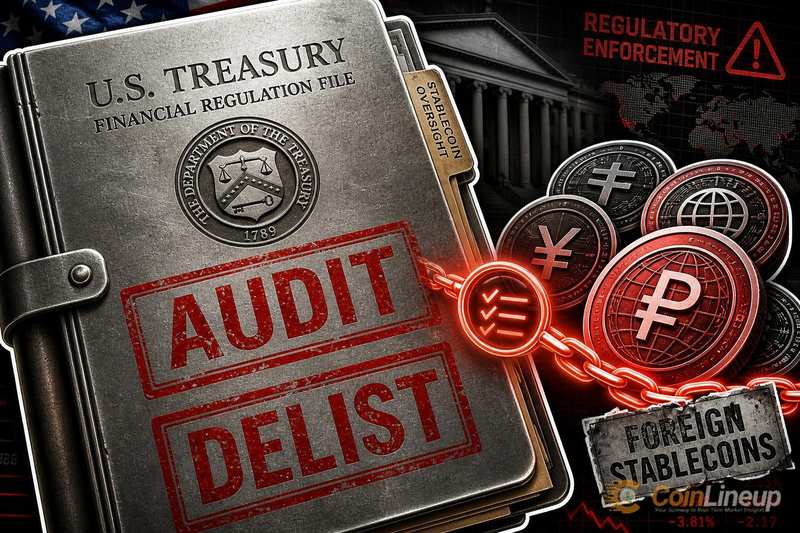
A U.S. Treasury proposal tied to the GENIUS Act could push American crypto exchanges to audit foreign stablecoins or remove them from their platforms. The idea targets stablecoins issued outside the United States and would force exchanges into a straightforward choice: verify that the token meets U.S. standards, or delist it.
The proposal appears in a Treasury rulemaking published in the Federal Register on August 18, 2026. It sets out how payment stablecoins can be issued, offered, and sold under the new law.
A stablecoin is a crypto token designed to hold a steady value, usually pegged to the U.S. dollar. In this context, a "foreign" stablecoin simply means one issued by a company based outside the United States. The stakes are high because some of the most widely used dollar stablecoins, such as Tether's USDT, are issued by companies based outside the U.S., meaning the rules could touch tokens at the center of global crypto trading rather than marginal ones.
What the Treasury proposal could require from US exchanges
The core idea is a gatekeeping role for exchanges. If a foreign stablecoin cannot demonstrate that it meets U.S. rules, the exchange would have to stop listing it, CryptoSlate reported.
Two distinct jobs are involved here. Auditing a token issuer means checking that its dollar reserves and disclosures are real. Reviewing listing compliance means the exchange itself confirms the token is legally allowed on its platform. In practice, this would formalize a vetting role that exchanges already perform informally when they decide which tokens to list, but with regulatory consequences for getting it wrong.
The GENIUS Act created this framework. The full text of the law is published on the government's public law archive, and it is the legal basis for the Treasury's new stablecoin rules. The Act established the first federal licensing and reserve regime for payment stablecoin issuers in the United States, and this proposal is part of translating that statute into enforceable rules.
Why foreign stablecoin listings could get harder to keep
Law firm Freshfields described the plan as gatekeeping rules that still leave a path open for foreign issuers, in its analysis of the proposal. That path, however, comes with conditions issuers must satisfy.
Checking reserves and compliance across borders is expensive. Exchanges would likely need additional staff, reporting, and due diligence to keep a foreign token listed.
Overseas issuers that cannot or will not meet U.S. expectations would face the highest risk, and smaller or less transparent stablecoins are the most likely to be dropped. The Treasury has separately proposed a July 18, 2028 cutoff for offshore stablecoins serving U.S. customers.
What it could mean for traders and the stablecoin market
For a regular holder, a delisting means fewer trading pairs. If an exchange removes a foreign stablecoin, the holder may need to swap it for an approved one before trading easily.
Higher standards could favor well-documented, U.S.-aligned stablecoins. Liquidity — meaning how easily a token trades — could concentrate in a smaller group of major coins.
The proposal fits a wider pattern of U.S. policymakers tightening crypto rules, from new tax proposals aimed at DeFi to state-level crypto bills. It also follows comparable moves abroad: the European Union's MiCA regulation already requires stablecoin issuers to be authorized in the bloc to serve EU users, showing that extraterritorial stablecoin rules are becoming a global norm rather than a U.S. exception.
One important caveat: this is a proposal, not a finalized rule. Treasury rulemaking includes a public comment period, and the details can change before anything takes effect. The Treasury Department oversees this process. The milestones to watch are the close of the comment period, the publication of any final rule, and how the proposed 2028 cutoff for offshore stablecoins survives the process.
The practical takeaway: if you hold a dollar-pegged stablecoin issued outside the U.S., watch for exchange notices. Nothing has changed yet, but the direction of travel favors stablecoins that can prove their reserves and compliance to U.S. regulators.
Disclaimer: This article is for informational purposes only and does not constitute financial or investment advice. Cryptocurrency and digital asset markets carry significant risk. Always do your own research before making decisions.
