US Government Sells $638 Billion in Treasury Bills This Week as 10-Year Yield Dips After Major Yen Intervention
Key Takeaways
- •Outstanding Treasury bills reached $7.0 trillion at the end of July, an increase of $1 trillion from one year earlier.
- •Total marketable Treasury securities grew by $2.5 trillion year-over-year to $31.4 trillion, driven by federal deficits exceeding $1.5 trillion annually.
- •The United States and Japan conducted a coordinated currency intervention in which the US sold euros and bought yen to support the Japanese currency's exchange rate.
- •The 10-year Treasury yield fell 10 basis points to 4.65% following the joint intervention, which eased market concerns about Japan potentially selling its Treasury holdings.
- •The 6-month Treasury yield declined to 3.96% after the FOMC held rates steady, though expectations of a future rate hike have shifted to the September meeting.
Treasury Bills Outstanding Rise $1 Trillion Year-Over-Year to $7 Trillion; Total Marketable Securities Jump $2.5 Trillion
The US government sold $638 billion in Treasury bills this week, with maturities ranging from one month to one year, spread across seven auctions. The majority of these sales were to replace maturing T-bills. Three of the auctions each exceeded $100 billion, while a fourth reached $99 billion — among the largest individual auctions on record.
Notably, no auctions for Treasury notes (2-year to 10-year) or Treasury bonds (20-year and 30-year) were scheduled during the week. The concentration in short-term issuance underscores the Treasury's ongoing reliance on T-bills to finance a widening federal deficit, a pattern that has accelerated as annual deficit spending continues to grow regardless of which party controls the White House or Congress.
Short-Term Yields Ease After FOMC Decision
Short-term Treasury yields edged lower following the Federal Open Market Committee's decision at the end of July to hold rates steady, at a time when the bond market had already priced in the likelihood of a rate hike at either that meeting or the September meeting.
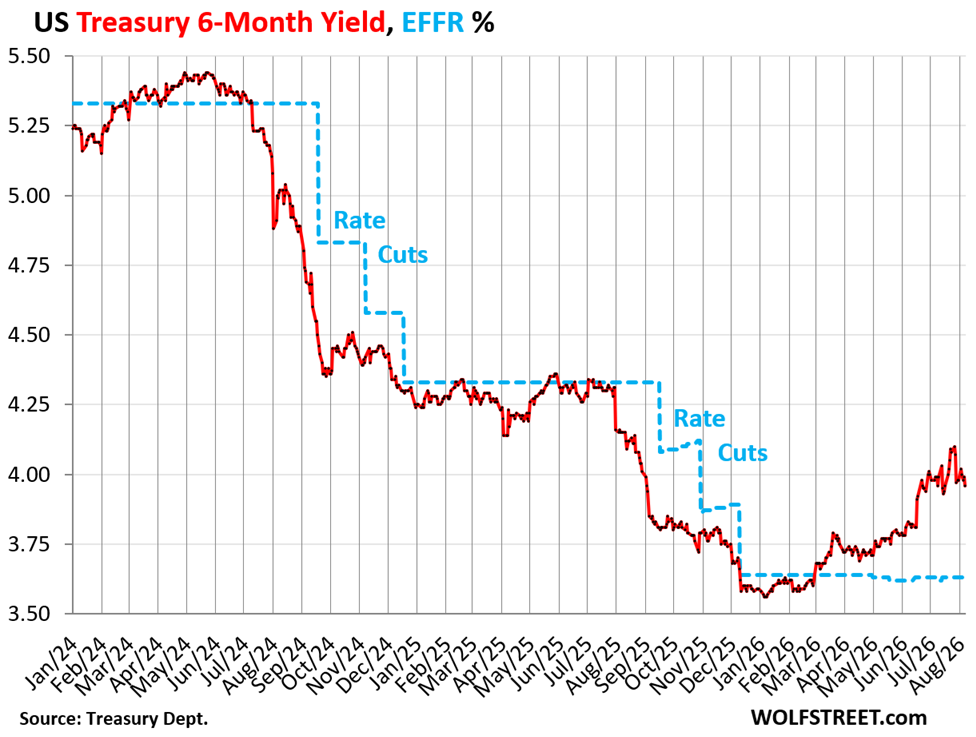
The 6-month T-bills sold at auction on Monday carried a high yield of 3.855%, equivalent to an investment rate of 3.986%. That represented a decline of roughly 10 basis points from the auction held just before the FOMC meeting, when 6-month T-bills had sold at an investment rate of 4.08%.
In the secondary market, the 6-month Treasury yield edged down approximately 2 basis points to 3.96% by late Friday afternoon, according to Treasury Department calculations. The yield had briefly spiked ahead of the July FOMC meeting to reflect expectations of a rate hike, then retreated afterward.
The 6-month yield currently sits 33 basis points above the Effective Federal Funds Rate (EFFR) of 3.63%, which the Fed targets through its policy rates. Expectations of a rate hike have persisted but shifted to the September FOMC meeting, making the next round of T-bill auctions and economic data releases — particularly inflation and labor market reports — key signals for whether that pricing holds.
Long-Term Yields Decline Following Coordinated Currency Intervention
Long-term Treasury yields declined after the joint US-Japanese intervention in currency markets, during which the United States sold euros and purchased yen to support the Japanese currency's exchange rate, alongside Japan's own yen-buying operations. The intervention caused the yen to surge sharply. Japan is one of the largest foreign holders of US Treasury securities, which is why the prospect of Tokyo selling Treasuries to fund intervention carries has drawn close attention from bond market participants.
The Treasury Department's actions were aimed at capping longer-term Treasury yields, driven by concerns that Japan's selling of US Treasuries — which would be necessary to obtain dollars for yen purchases — could push long-term yields even higher. The Treasury Secretary, as the world's foremost bond issuer, is tasked with keeping yields as low as possible to minimize the government's interest expenses. Treasury Secretary Bessent faces considerable challenges on this front.
The 10-year Treasury yield fell 10 basis points during the week to 4.65%, following the large-scale intervention that at least temporarily alleviated bond market concerns about Japan potentially liquidating Treasury holdings.
However, inflation concerns remain. Higher yields allow the bond market to tolerate higher inflation, as the elevated yields would more than compensate bondholders for the anticipated loss of purchasing power over the securities' term. Market participants hold differing inflation expectations over the next decade, which is reflected in ongoing price discovery.
Inflation has been elevated for more than five years. The Fed cut rates in both 2024 and 2025, with the final three rate cuts occurring while inflation was re-accelerating. This pattern suggests a Federal Reserve that has opted to allow the economy to run hot — generating more nominal growth and inflation — as a mechanism for managing the growth of the nation's enormous Treasury debt.
During the FOMC press conference, Warsh — described as a lifelong inflation hawk — made repeated efforts to dispel this theory through rhetoric rather than through concrete actions such as a rate hike or an announcement of accelerated balance sheet reduction. A robust majority of FOMC voting members remain aligned with the approach of letting the economy run hot. This strategy is a logical debt management tool, given that Congress and successive administrations have made no meaningful effort to reduce the deficit to a sustainable level.
T-Bill Outstanding Reaches $7 Trillion
The surge in T-bill issuance pushed the total amount of T-bills outstanding to $7.0 trillion by the end of July, an increase of $1 trillion from a year earlier, according to Treasury Department monthly data. This week's large auctions are not yet reflected in these figures.
At the same time, issuance of Treasury notes and bonds has also surged. Total marketable Treasury securities outstanding ballooned by $2.5 trillion year-over-year to $31.4 trillion at the end of July. The share of T-bills has held steady at approximately 22% of total marketable Treasury securities for nearly three years, rising to 22.2% in July. The sustained $2.5 trillion annual increase in total marketable debt reflects federal deficits that have remained above $1.5 trillion in recent fiscal years, driven by mandatory spending growth and rising net interest costs on the debt itself.
30-Year Yield Retreats from Two-Decade High
The 30-year Treasury yield declined by 8 basis points during the week to 5.19% on Friday, pulling back from a two-decade high reached the prior week.
The 30-year yield is of comparatively less concern to the Treasury Secretary, as issuance at that maturity is relatively small — roughly half that of 10-year notes — and it lacks the benchmark status of the 10-year yield. Markets use the 10-year Treasury yield as the primary reference for pricing other instruments, including mortgage rates and corporate bonds. A significant increase in the 10-year yield drives up long-term borrowing costs across the private-sector economy. The 30-year yield does not serve that function, and there were extended periods when the United States did not issue 30-year bonds at all.
Should the 10-year yield cross the 5% threshold at auction, it would pose a significant concern for the Treasury Secretary. The 30-year yield, by contrast, is unlikely to cause similar alarm.
