Why Trading Platforms and Settlement Chains Need to Work Together
Key Takeaways
- •Trading platforms and settlement chains perform different jobs: the platform handles order authentication, matching, margin, and liquidation decisions, while the chain maintains the authoritative record of collateral and finalized transfers.
- •Execution confirmation is not the same as settlement finality, and conflating the two can create hidden credit exposure when a fill's proceeds are used before settlement completes.
- •Arc's design targets deterministic, irreversible settlement in under one second and designates USDC as its gas token, supporting USDC-denominated margin and settlement for edgeX's perpetual markets.
- •Faster finality reduces provisional state and settlement exposure but does not eliminate risk, requiring controls such as transaction simulation, oracle validation, rate limits, and circuit breakers to move earlier in the workflow.
- •edgeX plans new FX perpetuals alongside its existing markets, with the Arc mainnet launch scheduled for September 16, 2026, though availability, markets, and launch details may change.
Quick Answer
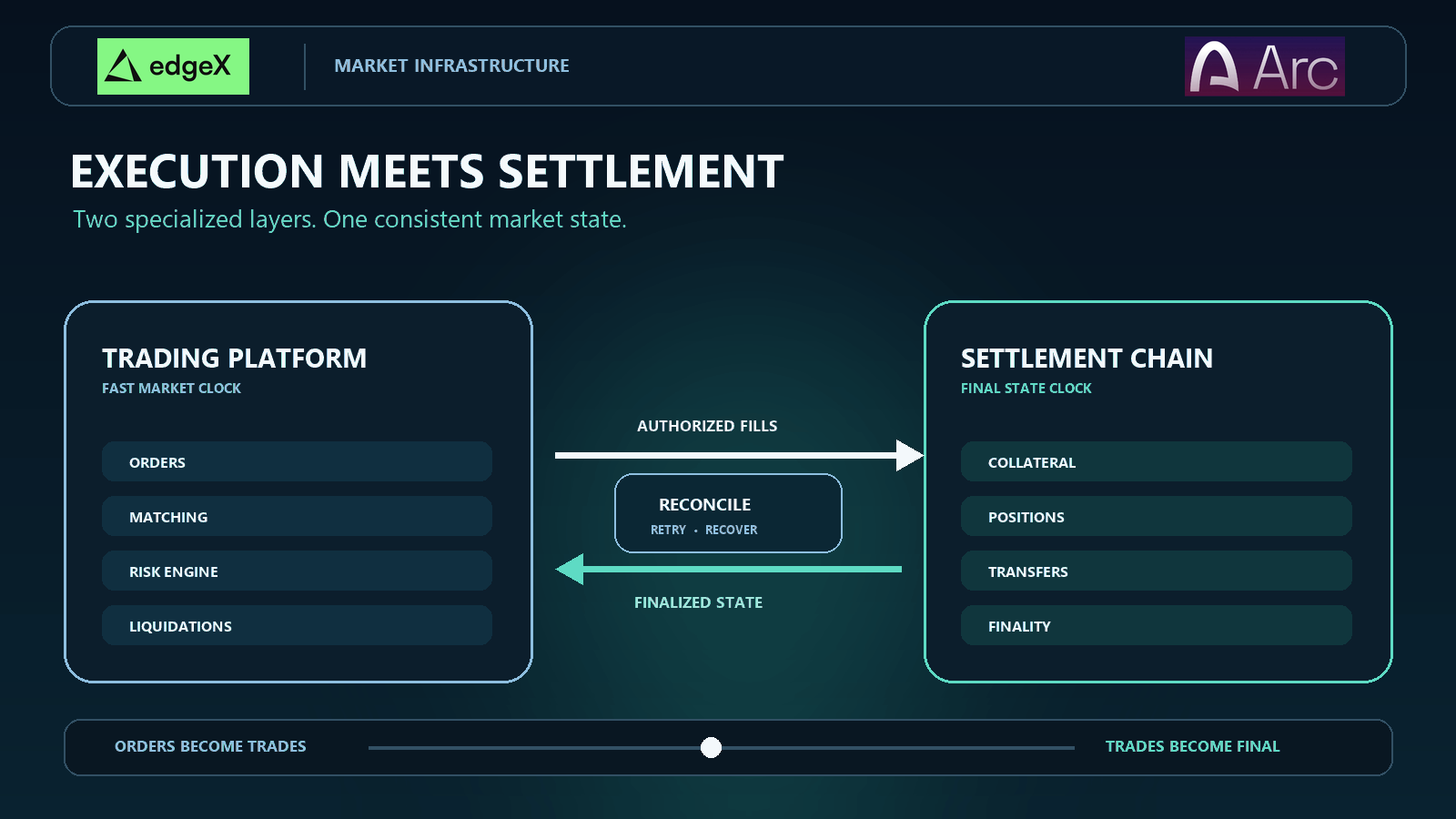
Trading platforms and settlement chains need to work together because they solve different parts of the same transaction. The platform handles market access, orders, price discovery, matching, margin decisions, and liquidations. The chain provides a shared record for collateral and completed transfers. If those layers disagree, a trader can see a fill that cannot settle, a balance that is temporarily wrong, or a liquidation based on stale state. A reliable design therefore needs explicit rules for when a trade becomes binding, how chain finality updates account balances, and what happens when either layer slows down or fails.
Trading and Settlement Are Different Jobs
A market transaction looks like one action: press buy, receive a fill, and see the position update. Underneath, the platform accepts the order, checks margin, finds a match, calculates fees, and updates the position. Settlement then makes the resulting transfer or obligation final.
This separation is not unique to crypto. Traditional markets distinguish execution venues from clearing agencies, central counterparties, securities depositories, custodians, and payment systems. The CPMI-IOSCO Principles for Financial Market Infrastructures treat settlement finality, liquidity risk, operational risk, governance, and default management as specific infrastructure responsibilities.
Blockchain markets change the arrangement, but those responsibilities remain. IOSCO’s DeFi policy recommendations describe designs in which a decentralized exchange sends a matched order for execution and settlement on a blockchain. Finding a match and completing the resulting state transition can occur in connected but separate components.
The trading platform organizes intent
Orders express intent rather than final ownership. A limit order says that a trader is willing to transact at a specified price. The platform must authenticate that instruction, apply market rules, rank it against other orders, and decide whether a match exists. For derivatives, it must also check collateral and position limits before accepting additional risk.
These jobs benefit from low latency. An order book processes cancellations, partial fills, and repricing more often than users move assets through settlement. Making every intermediate message wait for chain finality could slow the market without improving the final transfer.
The settlement chain makes state authoritative
The settlement chain answers a different question: which asset and collateral changes have become irreversible according to the network’s rules? It orders transactions, executes smart-contract instructions, and gives applications a canonical state from which to continue.
Arc’s system overview illustrates this separation inside a chain. Its Reth execution layer processes transactions and maintains state, while its Malachite consensus layer orders and finalizes blocks. A trading application adds another layer above that infrastructure.
| Function | Trading platform responsibility | Settlement-chain responsibility | Coordination requirement |
|---|---|---|---|
| Orders | Authenticate, validate, rank, cancel, and match | Usually does not process every order message | A fill must map to an authorized settlement instruction |
| Collateral | Calculate available margin and reserve buying power | Hold or record authoritative collateral balances | Reserved and settled balances must reconcile |
| Positions | Update exposure and unrealized profit or loss | Record contract state or final account changes | Position updates must use an agreed transaction order |
| Liquidations | Detect breaches and execute risk rules | Finalize collateral transfers and contract changes | The liquidation engine must know which chain state is final |
| Withdrawals | Check account status and request transfer | Execute and finalize the asset movement | Funds cannot be counted as both withdrawn and available |
Why the Two Layers Use Different Clocks
Markets react in milliseconds, while blockchains finalize batches of transactions according to consensus rules. Even a fast settlement chain has a block-production and finality cycle. A trading platform therefore operates with at least two clocks: the rapid sequence of orders and fills, and the chain’s sequence of finalized state changes.
Execution confirmation is not settlement finality
An execution confirmation means the platform matched an order. Settlement finality means the resulting transfer can no longer be reversed through the ordinary operation of the settlement system. Confusing the two creates hidden credit exposure.
Suppose a platform lets a trader use proceeds from a fill immediately. If the settlement transaction later fails, the platform has effectively advanced credit against an unsettled result. That may be an intentional design, but it needs limits, reserves, and a recovery process. Merely labeling the venue “on-chain” does not remove the gap.
Finality determines when state can be reused safely
Arc’s current finality documentation describes the network design as providing irreversible settlement in under one second. Deterministic finality gives an application a clear point at which it can treat a transaction as completed, rather than waiting through a probabilistic confirmation policy.
That property can shorten the period during which the platform must manage provisional state. It does not eliminate application errors, contract vulnerabilities, invalid oracle data, or a trader’s market loss. Finality makes an accepted state durable; it does not guarantee that every instruction entering that state was economically wise.
Market continuity requires a degraded mode
A platform also needs rules for moments when the chain is congested, unavailable, or producing unexpected responses. Continuing to match orders while settlement is delayed can accumulate obligations. Halting immediately can protect balances but disrupt price discovery and prevent traders from reducing risk.
A venue may reduce position limits, disable withdrawals, move to cancel-only operation, widen risk buffers, or pause particular markets. What matters is that the transition is defined before an incident and communicated consistently to users.
What a Reliable Integration Must Coordinate
The interface between execution and settlement is not a single transaction submission. It is a state machine that must keep several facts aligned: what the trader deposited, what the platform reserved, what orders filled, what fees accrued, what positions remain open, and what the chain has finalized.
Every settlement instruction needs replay protection and a unique identity so a retry cannot settle the same fill twice. Transaction ordering must also preserve dependencies: a withdrawal should not finalize before the deposit or profit that funds it. Failed transactions need explicit resolution rather than silent retries.
The risk engine may reserve collateral against open orders even though the chain balance has not moved. The interface should distinguish total and available collateral, pending transfers, and funds committed to margin. One undifferentiated balance invites double spending and confusing liquidations.
| Integration question | Why it matters | Failure if handled poorly |
|---|---|---|
| When is a fill binding? | Defines the point at which market risk transfers | Users dispute trades or the venue carries unintended exposure |
| Which balance is authoritative? | Prevents the same collateral from supporting incompatible actions | Double spending, failed withdrawals, or under-margined positions |
| How are retries identified? | Makes transaction submission idempotent | One trade or withdrawal settles more than once |
| How are oracles synchronized? | Keeps margin and liquidation decisions tied to valid prices | Stale prices trigger unfair liquidations or leave losses uncovered |
| What happens during an outage? | Limits the growth of unsettled obligations | Execution continues while settlement risk compounds |
| How is recovery reconciled? | Restores one agreed state after service returns | Platform records and chain balances remain permanently inconsistent |
How Finality Changes Platform Risk
Shorter finality can reduce the window in which one party has performed while another obligation remains incomplete. It can also make collateral reusable sooner and reduce the number of provisional records the platform must reconcile.
Faster is not automatically safer, however. A flawed liquidation, compromised key, or erroneous contract call also becomes final quickly. Controls must move earlier in the workflow: transaction simulation, authorization, rate limits, oracle validation, withdrawal policies, and circuit breakers become more important when there is little time to intervene after submission.
Settlement design also affects liquidity. DTCC has warned in its discussion of blockchain clearance and settlement that real-time gross settlement can remove netting benefits and require transactions to be funded individually. A platform must decide which obligations should settle immediately, which can be netted, and where credit or liquidity buffers are appropriate.
Why Shared Settlement Assets Matter
Coordination becomes simpler when fees, collateral, and settlement use assets with compatible accounting. If a trader posts one asset, pays gas in another, and settles profit and loss in a third, the platform must manage conversion, price volatility, and minimum balances across all three.
Arc documentation identifies USDC as the network’s gas token and presents Arc as a stablecoin-native Layer 1; these are design claims, not evidence of live application performance. Its gas and fee documentation explains the network’s USDC-denominated fee design. For a USDC-margined market, that can reduce one operational mismatch between the application and chain.
It does not make total trading cost fixed. Spreads, price impact, funding, liquidation penalties, application fees, and USDC access costs remain separate. Shared denomination reduces accounting friction; it does not remove market risk or guarantee low-cost execution.
Architecture Choices and Trade-Offs
Putting more logic on-chain can make rules and state transitions easier to inspect, but it exposes the application to block capacity, transaction ordering, and network fees. Specialized execution can respond faster and support sophisticated order types, but users must understand who operates it, how messages are authorized, and how its records can be reconciled with the chain.
The BIS/CPMI tokenisation report emphasizes that tokenized arrangements still require sound governance, risk management, and interoperability. Modularity is useful only when the modules share clear standards and responsibility. Otherwise it moves complexity into the interfaces, where failures can be harder to see.
What Can Break Between Execution and Settlement
The most dangerous failures often occur at the boundary. A delayed indexer can show an old collateral balance. A duplicate message can submit the same action twice. A chain reorganization or finality assumption can cause the platform to recognize a deposit too early. An oracle can update on one layer before the other. A software release can change rounding or fee logic on only one side.
A credible system publishes the practical consequences of failure: whether trading pauses, whether cancel-only mode is available, how pending withdrawals are treated, who can activate emergency controls, and how the final state is independently verified.
Investor Summary
Trading platforms and settlement chains are complementary infrastructure. The platform turns orders into market outcomes. The chain turns authorized state changes into a durable shared record. Neither layer can be evaluated in isolation.
Investors and traders should examine execution quality, liquidity, collateral controls, finality assumptions, oracle design, withdrawal rules, governance, and incident recovery as one system. The best architecture is not necessarily the one that puts every action on-chain. It is the one that makes each responsibility clear and keeps the layers consistent under both normal and stressed conditions.
Final Takeaway
A trading platform can make markets fast, but only a reliable settlement process can make completed obligations final. A settlement chain can make state durable, but it cannot decide whether an order book is liquid, a price is fair, or a liquidation policy is sound.
The two layers work when execution produces authorized, ordered obligations and settlement returns a timely, unambiguous state that the platform can safely reuse. That coordination, including what happens when it fails, is the real infrastructure behind an on-chain trading experience.
Trade Perpetual Markets on edgeX With Arc Settlement
Put your USDC to work across a market layer built for active traders. edgeX brings an order-book trading experience to perpetual markets across crypto, U.S. stocks, commodities, and FX, with its white paper describing the execution stack behind the platform. Arc is designed to provide the stablecoin-native settlement environment underneath. The announced integration is designed to keep margin and settlement in native USDC, so the trading workflow and the settlement asset work together instead of being split across disconnected systems.
Ready to trade beyond a single market? Explore edgeX to find the platform and available perpetual markets. For the Arc-specific path, see edgeX on Arc and follow the announced rollout. edgeX has announced plans for new FX perpetuals alongside its existing markets, with the Arc mainnet launch scheduled for September 16, 2026. Availability, markets, and launch details may change.
Perpetuals are built for traders who want flexible, always-on market access, but they are not passive products. Leverage, funding rates, oracle design, liquidity, and liquidation can all affect results. Review the product terms and risk controls before trading.
Frequently Asked Questions
What is the difference between trade execution and settlement?
Execution occurs when buy and sell instructions match under a platform’s market rules. Settlement completes the resulting transfer, collateral update, or contractual obligation. They may happen close together, but they are not the same event.
Does an order book need to run directly on a blockchain?
No. A platform can process some order messages in a specialized execution layer and settle authorized results on a blockchain. The design should disclose who operates each component, how orders are authorized, and how platform records reconcile with final chain state.
Why does blockchain finality matter to a trading platform?
Finality tells the platform when a deposit, withdrawal, collateral transfer, or contract update is irreversible under the chain’s rules. Faster deterministic finality can reduce provisional state, but the platform still needs controls for invalid instructions, outages, and application-level failures.
Does faster settlement reduce every kind of risk?
No. It can reduce settlement exposure and reconciliation, but it may increase prefunding needs and make erroneous transactions final sooner. Liquidity, smart-contract, oracle, custody, governance, and operational risks remain.
Why use USDC for both margin and settlement?
Using one settlement denomination can simplify collateral accounting and reduce conversions between a volatile gas asset and dollar-denominated market obligations. It does not guarantee a stable market price, sufficient liquidity, or low total trading costs.

