24/7 Trading Does Not Mean 24/7 Liquidity: What Always-On Markets Really Change
Key Takeaways
- •Twenty-four-hour trading availability is distinct from 24/7 liquidity, which depends on active market makers, order-book depth, and reliable reference prices rather than a venue simply remaining open.
- •Always-on perpetuals can move price discovery into thin off-hours periods, and divergence between last price and mark price can affect unrealized profit, maintenance margin, and liquidation calculations.
- •Session transitions, weekends, and holidays can trigger abrupt spread changes, price gaps, and funding shifts without any technical outage, so position sizing should reflect the depth available in the relevant session.
- •Leverage makes thin hours more expensive because wider spreads, price gaps, and mark-price updates can raise exit costs and trigger forced reductions, and neither cross-margin nor isolated margin resolves a lack of liquidity.
- •edgeX offers order-book perpetual markets across crypto, U.S. stocks, commodities, and FX with USDC margin and settlement via Arc, whose mainnet launch is scheduled for September 16, 2026, alongside announced plans for new FX perpetuals.
Quick Answer
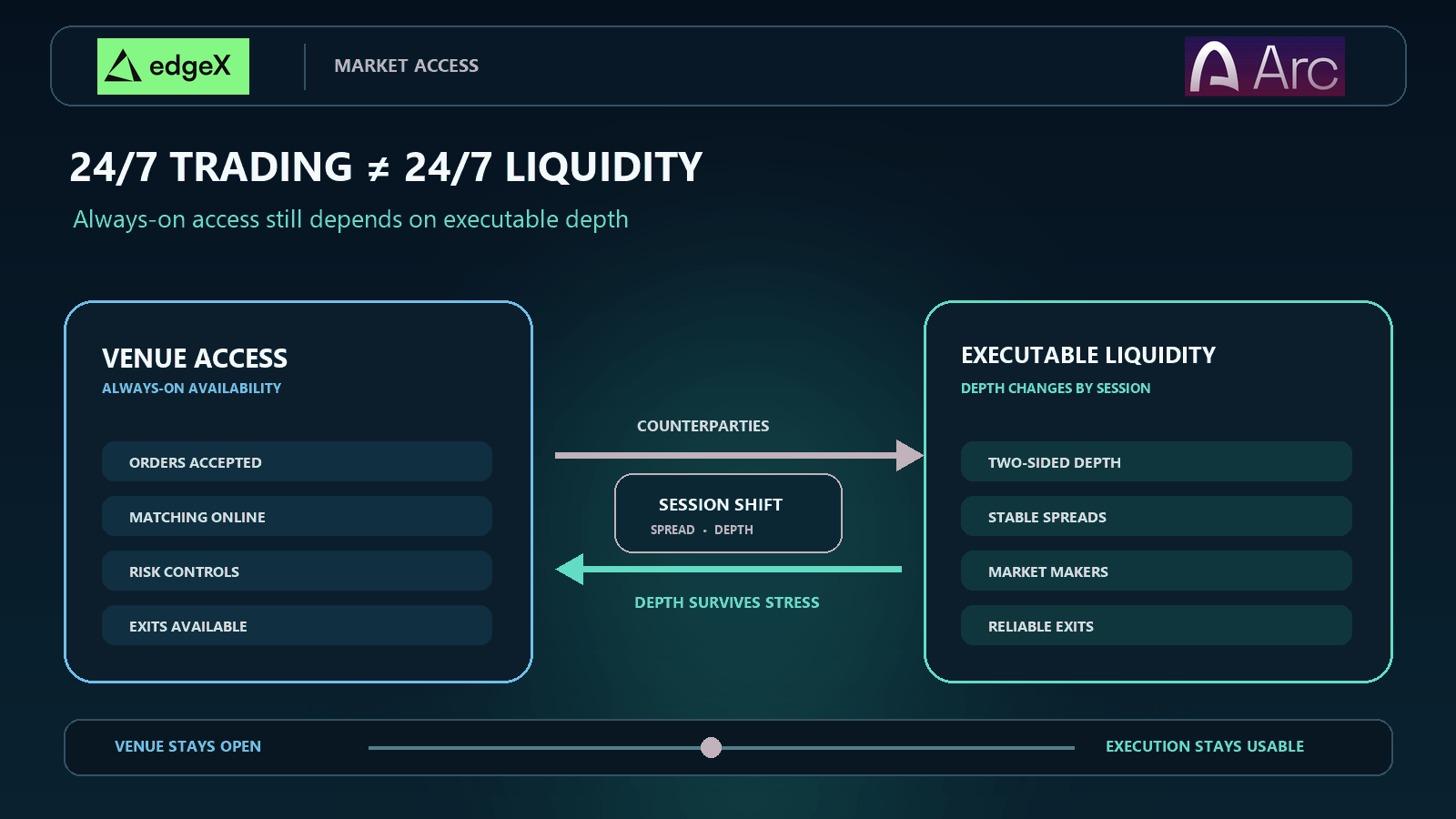
24/7 trading means that a venue can continue accepting and matching orders outside traditional market hours. 24/7 liquidity means that traders can still transact meaningful size at predictable prices with sufficient two-sided depth. The first does not guarantee the second. Liquidity depends on active counterparties, market-maker inventory, reference prices, risk limits, incentives, and reliable operations.
Always-on markets can improve access and allow new information to be reflected sooner. They can also move price discovery into thinner periods, increase slippage, and expose leveraged traders to wider marks and faster liquidations. The useful question is not whether the market is open. It is whether the market remains executable when conditions change.
Uptime and Liquidity Are Different Products
A venue’s uptime describes whether its systems are available to receive instructions. Liquidity describes what happens when a trader tries to execute those instructions. A functioning order form can coexist with a thin order book, a wide spread, stale index data, or a withdrawal queue.
This distinction matters because “24/7” is an availability claim, not a depth guarantee. An always-open perpetual may show a last price even when only a small amount can trade near that price. A market order that looks reasonable at the top of the book can move through several price levels once its actual size is included.
The spread is only the first signal
The best bid and offer show the cost of a small immediate trade. They do not show how much size is available behind those quotes or whether the quotes will remain when an order arrives. Traders should compare quoted spread with realized execution, estimate slippage at the intended size, and check whether depth replenishes after a fill.
Displayed liquidity can also be conditional. Market makers may quote tightly during normal conditions and withdraw inventory when volatility rises, the index becomes uncertain, or funding turns one-sided. A market can therefore look liquid in a snapshot and become difficult to exit during the moment liquidity matters most.
| Measure | What it tells a trader | What it does not prove |
|---|---|---|
| Uptime | The venue can receive and process requests | That meaningful size can execute |
| Volume | How much activity was recorded | That activity was diverse or low-cost |
| Spread | The immediate cost near the top quote | That deeper levels are available |
| Order-book depth | Potential size near the reference price | That quotes will remain during stress |
| Open interest | The amount of outstanding exposure | That positions can exit without impact |
| Funding | The transfer needed to align longs and shorts | That the market has balanced liquidity |
Always-On Markets Move Price Discovery
Traditional markets concentrate participation in regional sessions. Asian, European, and U.S. hours bring different banks, funds, corporations, market makers, and news flows. An onchain venue can remain open between those sessions, but the participant mix still changes.
When a major announcement arrives during a thin period, an always-on perpetual may become the first place where traders express the new information. That can be valuable: prices do not need to wait for a conventional venue to reopen. It can also be fragile because the first price may be formed by fewer accounts with less inventory and less reliable reference liquidity.
Off-hours price discovery needs resilient references
An index or mark price can help prevent a thin order book from becoming the sole source of liquidation values. But the index has its own operating assumptions. Traders should know which sources contribute, how often they update, how outliers are filtered, and what happens when one source is stale or unavailable.
The last traded price and the mark price may diverge. That divergence is not automatically an error, but it changes the price at which unrealized profit, maintenance margin, and liquidation are calculated. A trader who watches only the chart may miss the risk engine moving against the position.
Weekend and holiday conditions deserve separate analysis. Reference markets may be closed, bank liquidity may be reduced, and market makers may hold smaller inventories. The perpetual remains tradable, but its relationship to the reference can become more dependent on funding, index methodology, and a small number of active participants.
Session Transitions Create Liquidity Gaps
Liquidity does not switch on or off at one universal time. It builds as participants enter a region, overlaps as sessions meet, and thins as risk desks close. An always-on venue inherits these patterns even when its matching engine never stops.
The transition between sessions can be more important than the quiet period itself. A new group of market makers may reprice inventory, react to a different reference market, or correct a price that formed during a thin period. Traders can see abrupt spread changes, price gaps, and funding shifts without a technical outage occurring.
A global market needs local risk awareness
The same contract can carry different information across time zones. JPY exposure may respond to Asian data, U.S. rates, or policy headlines. Commodity exposure can react to inventory or geopolitical news while one region is active and another is asleep. A trader should know which reference markets are open and which are merely represented by a derivative.
An always-open product therefore changes the timing of risk management. Stops, reduce-only orders, and collateral transfers may be needed during periods when the trader’s preferred counterparties are absent. Position size should reflect the depth available in the relevant session, not the deepest book observed earlier in the day.
Market Makers Determine Whether Access Is Executable
Market makers convert venue access into tradable two-sided prices. They commit capital, manage inventory, hedge elsewhere, and price the risk that a quote will be hit before the market moves. A new venue can attract attention without yet having enough market-making capacity to support consistent depth.
Incentives can increase displayed activity, but they do not automatically create durable liquidity. Traders should test whether quotes remain after incentives change, whether several independent participants quote both sides, and whether depth survives volatility. Concentrated activity may produce high volume while leaving the market vulnerable to one participant reducing risk.
Volume needs context
A single volume number cannot distinguish organic trading, incentive-driven turnover, short-lived arbitrage, or repeated activity by a small group. Pair volume with effective spread, price impact, depth at realistic size, quote duration, and the ability to exit during fast markets.
Open interest provides another warning. Growing open interest can show adoption, but it can also show leverage accumulating faster than exit liquidity. Funding that remains strongly one-sided may signal crowded positioning. These are not automatic failure signals, but they should change position sizing and stress assumptions.
| Question | Constructive evidence | Warning sign |
|---|---|---|
| Who supplies quotes? | Multiple participants remain active across sessions | Depth vanishes when one account withdraws |
| Can size execute? | Slippage remains measurable at intended size | Small orders move the market materially |
| Does liquidity persist? | Activity remains after incentives or launch attention | Volume collapses when rewards fade |
| How does funding behave? | Funding responds without dominating expected return | Persistent extremes or unexplained jumps |
| Can traders exit? | Reduce-only and withdrawal paths remain usable | Leveraged positions remain open during access failures |
Leverage Makes Thin Hours More Expensive
Leverage turns a liquidity change into an account-level event. A wider spread can increase the cost of opening or closing. A price gap can move equity through a maintenance threshold. A mark-price update can trigger forced position reduction even if the last trade on the venue looks less extreme.
Before opening a leveraged position, traders should model more than a directional price target. Estimate the exit cost at different depths, include funding and fees, identify the liquidation price under the venue’s mark methodology, and test what happens if the order book becomes half as deep. The relevant question is whether the account can survive the path, not just whether the final view is correct.
Cross-margin can make capital more efficient while allowing one thin-market position to consume collateral supporting other positions. Isolated margin can contain the damage but may liquidate sooner. Neither mode solves a lack of liquidity. It only changes how losses reach the account.
24/7 Systems Need Planned Degradation
Continuous operation does not mean every service must remain fully active during every incident. A credible venue defines how it behaves when an index is stale, a chain is congested, an API is unavailable, or market makers cannot quote normally.
Useful controls include cancel-only mode, reduced position limits, wider risk buffers, market-specific pauses, delayed withdrawals, and clear treatment of funding and liquidations during an incident. The transition should be announced consistently, recorded with timestamps, and reversible only under defined conditions.
An outage in the trading interface is not the same as an outage in settlement. If orders can be matched but deposits or withdrawals cannot complete, obligations can grow while collateral becomes harder to move. If settlement is available but the order book is impaired, traders may need a way to cancel or reduce exposure without submitting new risk.
Operational transparency is part of liquidity. Traders should be able to identify affected services, current market mode, pending transfers, and recovery steps. A documented alternative API or emergency control path can matter more than a headline uptime percentage.
How to Evaluate an Always-On Market
Evaluate the market across normal and stressed windows. Record spread and depth at the size you would actually trade during each regional session, on weekends, around major announcements, and during funding resets. Compare quoted prices with realized fills and mark prices.
Check the contract itself: index sources, mark methodology, tick size, funding interval, leverage limits, liquidation fees, insurance arrangements, and reduce-only behavior. Then check the operating layer: deposits, withdrawals, API limits, status communication, and incident controls.
The most useful evidence is repeatable. One impressive launch-day snapshot cannot establish durable liquidity. A smaller market that maintains two-sided depth, predictable funding, and reliable exits may be more useful than a larger market whose volume disappears under stress.
Investor Summary
Always-on markets expand the hours in which traders can act, but they also expand the hours in which thin liquidity can shape price, funding, and liquidation. The central distinction is between access to a venue and access to dependable counterparties.
Investors should judge the complete stack: reference-price quality, market-maker coverage, session depth, slippage, funding, open interest, margin rules, settlement, and outage recovery. Volume and uptime are inputs to that analysis, not substitutes for it.
Final Takeaway
24/7 trading changes when a market can express information and when a trader can respond. It does not guarantee that a fair price, a deep order book, or a reliable exit is available at every hour.
The strongest always-on markets make their thin periods visible, publish clear risk controls, and keep settlement and position management reliable when conditions deteriorate. Traders should size positions for the liquidity that exists when they need to exit, not the liquidity that was visible when they entered.
Trade Perpetual Markets on edgeX With Arc Settlement
Put your USDC to work across a market layer built for active traders. edgeX brings an order-book trading experience to perpetual markets across crypto, U.S. stocks, commodities, and FX, with its white paper describing the execution stack behind the platform. Arc is designed to provide the stablecoin-native settlement environment underneath. The announced integration is designed to keep margin and settlement in native USDC, so the trading workflow and the settlement asset work together instead of being split across disconnected systems.
Ready to trade beyond a single market? Explore edgeX to find the platform and available perpetual markets. For the Arc-specific path, see edgeX on Arc and follow the announced rollout. edgeX has announced plans for new FX perpetuals alongside its existing markets, with the Arc mainnet launch scheduled for September 16, 2026. Availability, markets, and launch details may change.
Perpetuals are built for traders who want flexible, always-on market access, but they are not passive products. Leverage, funding rates, oracle design, liquidity, and liquidation can all affect results. Review the product terms and risk controls before trading.
Frequently Asked Questions
Does 24/7 trading mean liquidity is always available?
No. A venue can remain open while spreads widen, depth falls, market makers reduce size, and execution costs rise. Check executable depth and realized slippage during the hours you expect to trade.
Why can a perpetual trade when the underlying market is closed?
A perpetual is a derivative that can continue trading against an index or mark methodology without requiring physical delivery at a fixed expiry. Its price may still move when the reference market is closed, but the quality of that price depends on participants, funding, and the index design.
What is the difference between last price and mark price?
Last price is the most recent venue trade. Mark price is a risk-management reference used for unrealized profit, margin, and liquidation. A venue should explain how it calculates the mark and how it handles stale or conflicting data.
Is high volume proof of strong liquidity?
No. Volume can come from incentives, a small number of accounts, or rapid turnover. Compare it with spread, depth, price impact, quote persistence, funding, and the ability to exit under stress.
What should traders check before using an always-on market?
Review the index and mark methodology, contract specifications, funding, margin and liquidation rules, depth at your intended size, withdrawal routes, API access, and the venue’s cancel-only and incident procedures.

