From BTC to Stocks, Commodities, and FX: Why More Markets Are Moving On-Chain
Key Takeaways
- •On-chain instruments can record ownership, represent an intermediary’s claim or provide derivative price exposure, so investors must examine rights, custody and redemption terms.
- •A tokenized-form share may retain conventional market structure, while third-party stock tokens can provide economic exposure without direct shareholder ownership.
- •Perpetual contracts allow commodity and FX price exposure without physical delivery or transfer of commercial-bank deposits, but introduce funding, oracle, basis and liquidation risks.
- •Shared blockchain rails may improve collateral mobility and reduce reconciliation, although instant gross settlement can increase prefunded liquidity needs.
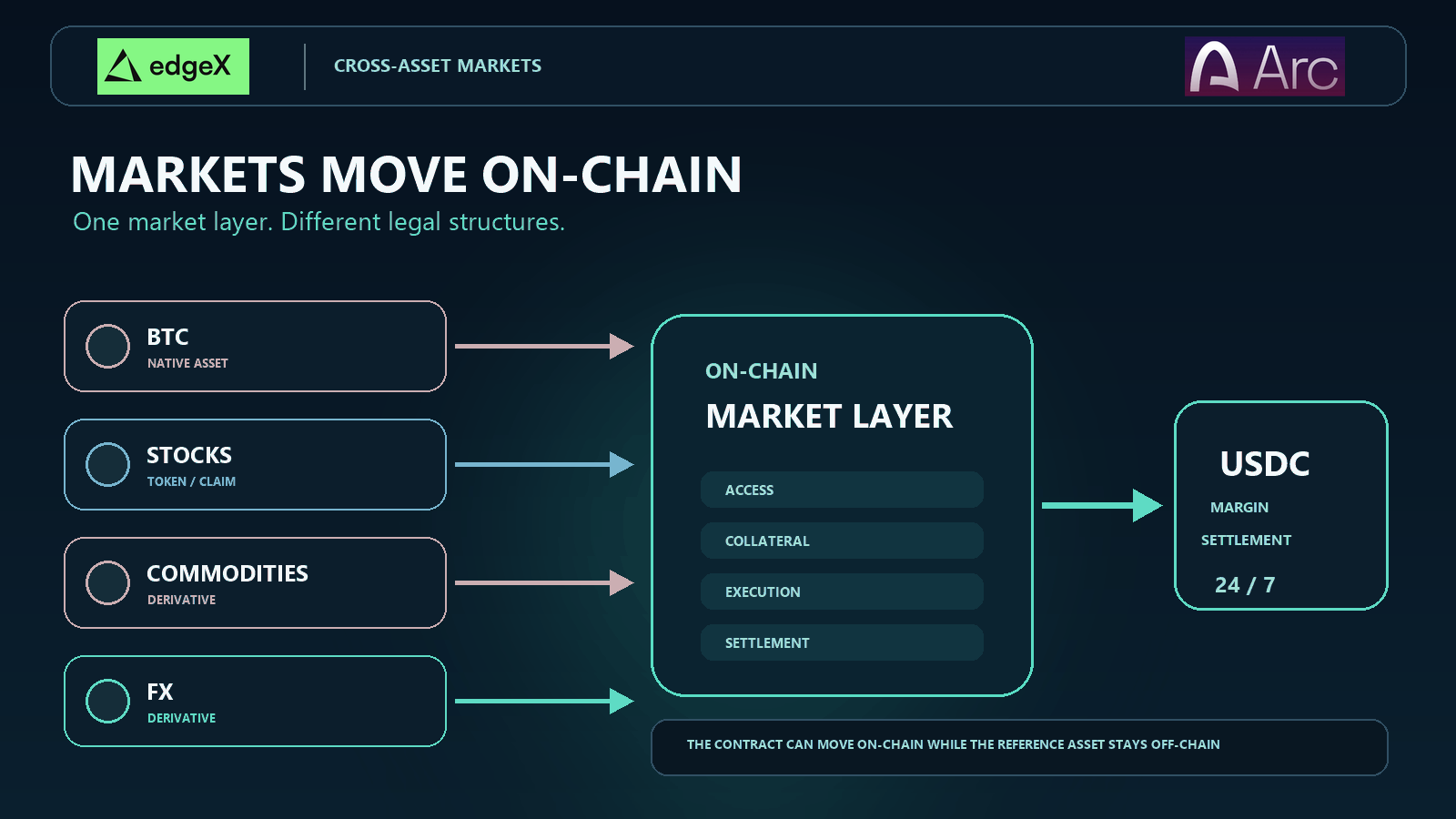
- •edgeX’s planned Arc markets will move perpetual contracts and collateral on-chain, while the referenced stocks, commodities and currencies will remain off-chain assets.
Quick Answer
More markets are moving on-chain because traders and market operators want one programmable environment for access, collateral, execution, and settlement. Bitcoin showed that an asset could trade and settle continuously on its own ledger. Stocks, commodities, and currencies are more complicated: the underlying asset may remain with an issuer, custodian, bank, or warehouse while a token or derivative trades on blockchain rails. The opportunity is a more connected market stack. The risk is assuming that every on-chain instrument provides the same ownership, liquidity, or investor protections.
“Moving On-Chain” Describes Several Different Market Structures
The phrase sounds simple, but it can hide the most important fact about a product: what the buyer actually owns. A blockchain may serve as the authoritative ownership record, track a claim issued by an intermediary, or settle gains and losses on a derivative. Those arrangements can produce similar price charts while creating very different rights.
The SEC staff’s statement on tokenized securities separates issuer-sponsored tokenization from third-party models. That distinction matters beyond U.S. securities law. It shows why investors must inspect the relationship among the token, issuer, underlying asset, custodian, and redemption process rather than treating “tokenized” as a complete product description.
Native assets combine the instrument and its ledger
Bitcoin is native to Bitcoin’s ledger. A valid transfer changes the network’s record of control; there is no separate paper Bitcoin held at a transfer agent. The Bitcoin white paper described peer-to-peer electronic cash in which a network timestamps transactions and establishes their order.
That model reduces the gap between trading the asset and moving the asset. It does not eliminate exchanges, custodians, or off-chain order books, but the asset itself can be withdrawn and verified on its native settlement system.
Tokens can represent ownership, a claim, or price exposure
A tokenized share may be the same security recorded in a new form. Another token may be issued by a vehicle that holds shares and promises equivalent economic value. A third may be a derivative whose payoff tracks the share price without giving the holder any claim on the company.
| On-chain structure | What exists on the ledger | What remains off-chain | Core question for the buyer |
|---|---|---|---|
| Native crypto asset | The asset and transfer record | Some trading, custody, and fiat access | Can I control and settle the asset itself? |
| Tokenized security | A security or authoritative ownership record | Issuer duties and parts of regulated market infrastructure | Do I receive the same legal rights as a conventional holder? |
| Backed token or claim | A redeemable token issued against held assets | Custody, corporate actions, and enforcement | Who holds the backing, and what can I redeem? |
| Derivative or perpetual | A contract and its collateral accounting | The reference asset and its primary market | How is the reference price maintained and risk managed? |
Why Bitcoin Provided a Market Template
Bitcoin did more than create a new asset. It demonstrated continuous transfer, transparent transaction history, self-custody, and settlement that did not wait for a securities depository or banking window.
Traditional markets notice this operating model because their infrastructure is divided by asset class and institution. A stock trade may involve a broker, exchange, clearing agency, custodian, and transfer agent. A commodity can require warehouse receipts and inspection. FX settles across bank accounts and time zones. Each layer has a purpose, but every handoff introduces reconciliation, operating hours, and trapped collateral.
The attraction of blockchain rails is not that every market should imitate Bitcoin’s legal design. Participants can instead reuse its technical pattern: shared state, programmable transfers, visible collateral, and settlement that triggers the next action. The challenge is preserving the protections the old handoffs provided.
How Stocks Reach Blockchain Markets
Stocks offer the clearest example of why product structure matters. A ticker on a wallet screen can correspond to a conventional share in tokenized form, a contractual claim backed by shares, or a derivative. These products should not be grouped together merely because they use tokens.
A tokenized form can preserve conventional market rights
In March 2026, the SEC approved a Nasdaq rule change for a DTC pilot covering eligible securities in tokenized form. Under SEC Release No. 34-105047, a tokenized-form share can trade on the same order book, with the same execution priority, as its conventional counterpart.
This is a narrow but important model. The tokenized form is not intended to create a shadow ticker with a separate economic identity. Existing exchange rules and depository infrastructure remain central. It shows that tokenization can change the settlement representation while retaining established market structure.
Third-party tokens can create different rights
Other stock tokens provide exposure through an intermediary. Robinhood says its Classic Stock Tokens are derivatives tracked on a blockchain that follow publicly traded stocks and ETFs. That is price exposure, not direct ownership of the referenced company’s shares.
Ondo Stocks documentation describes another model: tokens designed for economic exposure and redemption based on underlying assets. Its legal documentation says the products are backed one-for-one plus a buffer, while holders do not receive shareholder voting or statutory information rights. The product may be backed without making the token holder the registered shareholder.
Neither structure is automatically good or bad. Each should be judged by its disclosures, custody, backing verification, redemption rules, fees, jurisdiction, and treatment of dividends and corporate actions. “Tracks Apple” and “is an Apple share” are not interchangeable statements.
Why Commodities and FX Often Arrive as Derivatives
Tokenizing a barrel of oil or a bank deposit is harder than tokenizing price exposure. Physical commodities require specifications, storage, inspection, insurance, and delivery. Foreign exchange involves claims on currencies held within banking systems. A blockchain can improve the record and transfer layer, but it cannot make those external obligations disappear.
This is why perpetual contracts are a common bridge. A perpetual is a derivative with no fixed expiry. A funding mechanism encourages its market price to remain near the referenced spot price. The CFTC’s 2026 perpetual-contract policy and its approval of a Bitcoin perpetual illustrate how this market design is moving into additional regulated settings.
Price exposure can move without physical delivery
A gold perpetual can reflect changes in gold prices without giving the trader title to allocated bars. An oil contract can settle profit and loss without scheduling a tanker. An FX perpetual can express a view on a currency pair without transferring commercial-bank deposits in both currencies after every trade.
That efficiency comes with basis risk. The contract depends on reference prices, oracle design, funding, and liquid arbitrage. When the underlying cash market is closed but the perpetual remains open, fresh information may appear first in the derivative. Spreads can widen and the contract can diverge until reference-market liquidity returns.
| Market | What an on-chain instrument can improve | Dependency that remains | Typical failure mode |
|---|---|---|---|
| Stocks | Transferability, collateral use, and programmable settlement | Shareholder records, custody, corporate actions, and market hours | Token rights differ from the referenced share |
| Commodities | Fractional exposure and cash-settled trading | Storage, inspection, delivery, and benchmark integrity | Weak backing or price-reference disruption |
| FX | Shared margin and continuous cross-currency risk trading | Banking liquidity, benchmark markets, and local regulation | Thin off-hours liquidity or unstable funding |
| Crypto | Native settlement and continuous collateral mobility | Venue controls, custody choices, and oracle sources | Liquidation cascades or fragmented liquidity |
Why Market Operators Want Common Rails
The broader prize is a common environment in which cash, collateral, and market contracts can interact. A trader may otherwise keep separate capital at a stock broker, futures clearer, crypto exchange, and bank. On-chain systems make balances visible to applications and let settlement rules execute in software.
The BIS and CPMI report on tokenisation highlights the potential for new arrangements in money and other assets while stressing governance and risk management. The BIS Annual Economic Report 2025 also examines how tokenized platforms can combine money and assets on programmable ledgers. In practice, the benefits come from reducing reconciliation and coordinating delivery against payment, not from attaching a token to an unchanged workflow.
Common rails can also improve collateral mobility. Proceeds from one market can become usable margin in another more quickly when both share compatible settlement assets and risk rules. Developers can build automated rebalancing, conditional payments, and portfolio controls around that state. For users, the visible effect may be one account covering several market types instead of a chain of transfers between closed systems.
Faster settlement still has a cost. If every obligation settles instantly and gross, participants may need more prefunded liquidity than in a system that nets obligations before settlement. Good design must balance speed, netting, credit, and liquidity rather than treating the shortest settlement interval as universally best.
What the On-Chain Label Does Not Solve
Blockchain execution cannot manufacture liquidity or make a weak reference price reliable. A market can operate around the clock and still be difficult to trade at a fair price. Depth, market-maker concentration, liquidation capacity, and the behavior of prices during stress matter more than a 24/7 badge.
Nor does tokenization settle the legal question by itself. Investors need to know whether insolvency of an issuer or custodian affects their claim, who controls upgrades and freezes, which court or regulator has authority, and whether redemption is available in their jurisdiction. Smart contracts may automate rules, but people and institutions still define those rules.
Interoperability creates another trade-off. Incompatible chains, bridges, and wrappers can fragment liquidity. The same stock may be referenced by several tokens and derivatives with different backing and prices, making best execution and consolidated risk harder to assess.
Finally, leverage remains leverage. Continuous markets can liquidate positions while a trader is asleep or while the reference market is closed. Funding can compound the cost of holding a position. A useful on-chain market therefore needs transparent specifications, resilient oracles, conservative collateral controls, credible custody or backing, and a clear explanation of what the buyer owns.
Investor Summary
The migration from BTC to stocks, commodities, and FX is a move toward shared market infrastructure, not one uniform act of tokenization. Native assets settle themselves. Tokenized securities and backed claims connect blockchain records to legal and custodial systems. Perpetuals move price exposure and collateral while leaving the referenced asset off-chain.
Investors should compare instruments by rights, redemption, custody, price formation, liquidity, and leverage. The strongest products will make those differences easier to inspect, not hide them behind a familiar ticker.
Final Takeaway
Bitcoin proved that markets could pair continuous trading with a programmable settlement asset. The next phase applies that operating model to assets that come with issuers, warehouses, banks, clearing systems, and regulation.
More markets will move on-chain where common collateral and faster coordination create real advantages. But the winning structure will differ by asset. The durable question is not whether a stock, commodity, or currency has a token. It is whether the complete instrument gives users enforceable rights, reliable prices, usable liquidity, and settlement they can trust.
Trade Cross-Asset Markets With edgeX on Arc
edgeX has announced plans to bring its market layer to Arc, with perpetual markets across crypto, U.S. stocks, commodities, and FX margined and settled in native USDC. In this structure, the perpetual contract and collateral workflow move on-chain; the referenced stock, commodity, or currency does not become a native blockchain asset.
Explore edgeX to review the broader trading platform, or visit the edgeX Arc page for the Arc-specific product path. Availability and launch details may change. Perpetuals involve leverage, funding, oracle, liquidity, and liquidation risk and are not suitable for every trader.
Frequently Asked Questions
What is an on-chain market?
An on-chain market uses a blockchain for one or more core functions, such as recording ownership, holding collateral, executing contracts, or settling trades. The underlying asset does not always exist on that blockchain.
Are tokenized stocks the same as ordinary shares?
Sometimes a tokenized form can preserve the same security and rights, but other products are backed claims or derivatives. Read the legal terms to identify voting rights, dividend treatment, custody, redemption, and the claim you would have if an intermediary failed.
How can commodities trade on-chain?
A token can represent title to stored commodities, a redeemable claim, or a cash-settled derivative. Perpetuals provide price exposure without requiring physical delivery, but they introduce funding, oracle, leverage, and basis risk.
What is on-chain FX?
On-chain FX may mean spot exchange between tokenized currencies or stablecoins, or derivatives that track currency pairs. A perpetual settles gains and losses against a reference price; it does not necessarily deliver bank deposits in both currencies.
Does 24/7 trading guarantee liquidity?
No. A venue can remain open while order books are thin or the primary reference market is closed. Investors should examine spreads, depth, oracle design, funding behavior, and liquidation capacity across different trading hours.

