Trader Turns $220K Into $4.7M With Back-to-Back Wins on CASHCAT and PONS
Key Takeaways
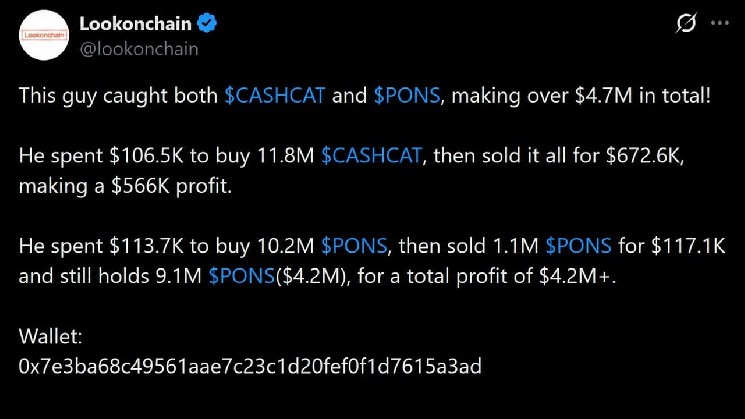
- •A wallet identified as '0x7e3ba' earned over $4.7 million in combined profit from two trades totaling about $220,000 in initial capital on Robinhood Chain tokens.
- •The wallet's closed $CASHCAT trade generated a $566K profit, while its ongoing $PONS position still holds roughly 9.1 million tokens valued around $4.2 million, meaning most gains are unrealized.
- •Both tokens launched on Robinhood Chain, an Ethereum layer-2 network built on Arbitrum's technology that has hosted highly volatile memecoin moves since its July launch.
- •$PONS underpins the Pons token-creation service, which generated over $930,000 in application revenue on August 30 — about 35% of the entire Robinhood Chain ecosystem's earnings that day.
- •Thin liquidity poses a risk: $CASHCAT once carried a $150 million valuation against only $6.6 million in liquidity, so large-holder selling could sharply collapse prices.
Trader Turns $220K Into $4.7M With Back-to-Back Wins on CASHCAT and PONS
Two Trades, One Very Good Week
Onchain trackers have identified the address ‘0x7e3ba’ as the wallet behind two consecutive winning trades on Robinhood Chain tokens. Stories like this one are a recurring feature of memecoin markets, where publicly readable blockchain data lets anyone trace a wallet's entries, exits, and unrealized gains in real time — but they are also survivorship tales, since the same transparency rarely surfaces the many wallets that bought similar tokens and lost.
The first trade was a clean exit: the wallet put $106.5K into 11.8 million $CASHCAT and sold the entire position for $672.6K, netting a $566K profit.
The second trade is still unfolding. The wallet spent $113.7K on 10.2 million $PONS tokens, has already sold 1.1 million of them for $117.1K, and continues to hold 9.1 million tokens worth roughly $4.2 million at current prices.
Taken together, the two positions have pushed the wallet's total profit past $4.7 million, with the majority of those gains still unrealized. It is the kind of onchain story that spreads quickly precisely because the numbers are so lopsided.
The Robinhood Chain Gold Rush
Both tokens originated on the same launchpad: Robinhood Chain, an Ethereum layer-2 network built on Arbitrum's technology. Since launching in July, the network has become the venue for some of the year's most volatile memecoin moves. Its arrival extends a broader trend of trading platforms and app operators deploying their own chains or layer-2 networks to capture onchain activity directly within consumer products rather than routing it through third-party networks.
$CASHCAT was the first breakout. As Bitcoin.com News reported, the token jumped more than 1,400% in a single 24-hour stretch during the same month, and gained over 5,500% across one week.
$PONS has followed a similar trajectory more recently. It is the platform token behind Pons, a token-creation and issuance service built on Robinhood Chain — a niche comparable to token launchpools on other networks, which became major fee engines during earlier memecoin cycles. $PONS collects fees in WETH, which are then used to repurchase and burn its own supply. On August 30 alone, Pons generated more than $930,000 in application revenue — roughly 35% of everything Robinhood Chain's entire ecosystem earned that day.
The Catch Is Thin Liquidity
When Bitcoin.com News profiled $CASHCAT's rise in July, the token carried a $150 million market valuation supported by just $6.6 million in actual liquidity. That gap means a wave of coordinated selling could collapse price levels far below what any single holder's paper gains suggest. It is a structural feature of low-liquidity memecoin markets generally: valuations quoted at thin order books can evaporate as soon as large holders — like this wallet, whose remaining $PONS position dwarfs the kind of liquidity pools that supported $CASHCAT — begin to sell.
In any case, Robinhood Chain's meme economy shows no sign of slowing down, and wallets like this one are exactly what keeps new money chasing the next token. Whether this particular holder cashes out the remainder of the $PONS position at current levels or holds on longer will likely depend on how long the token keeps generating the fee revenue that supports its demand.
Source: Bitcoin.com News
