Week 35 Crypto Market Watch: Breakout Digestion, Persistent ETF Demand, and the Warsh Test
Key Takeaways
- •Bitcoin finished the week near the high $77,000s and did not fall back through its former breakout range.
- •Bitcoin spot ETFs posted net inflows for the week, but a Friday outflow ended a nine-session streak.
- •Ethereum spot ETFs stayed positive across all five sessions, even though ETH underperformed Bitcoin on price.
- •Solana outperformed most large-cap altcoins, helped by fresh ETF demand and a first Solana ETF surpassing $1 billion in assets.
- •XRP, DOGE, ADA, SUI, and several other high-beta names reversed sharply after hawkish Jackson Hole remarks raised rate expectations.
Quick Answer
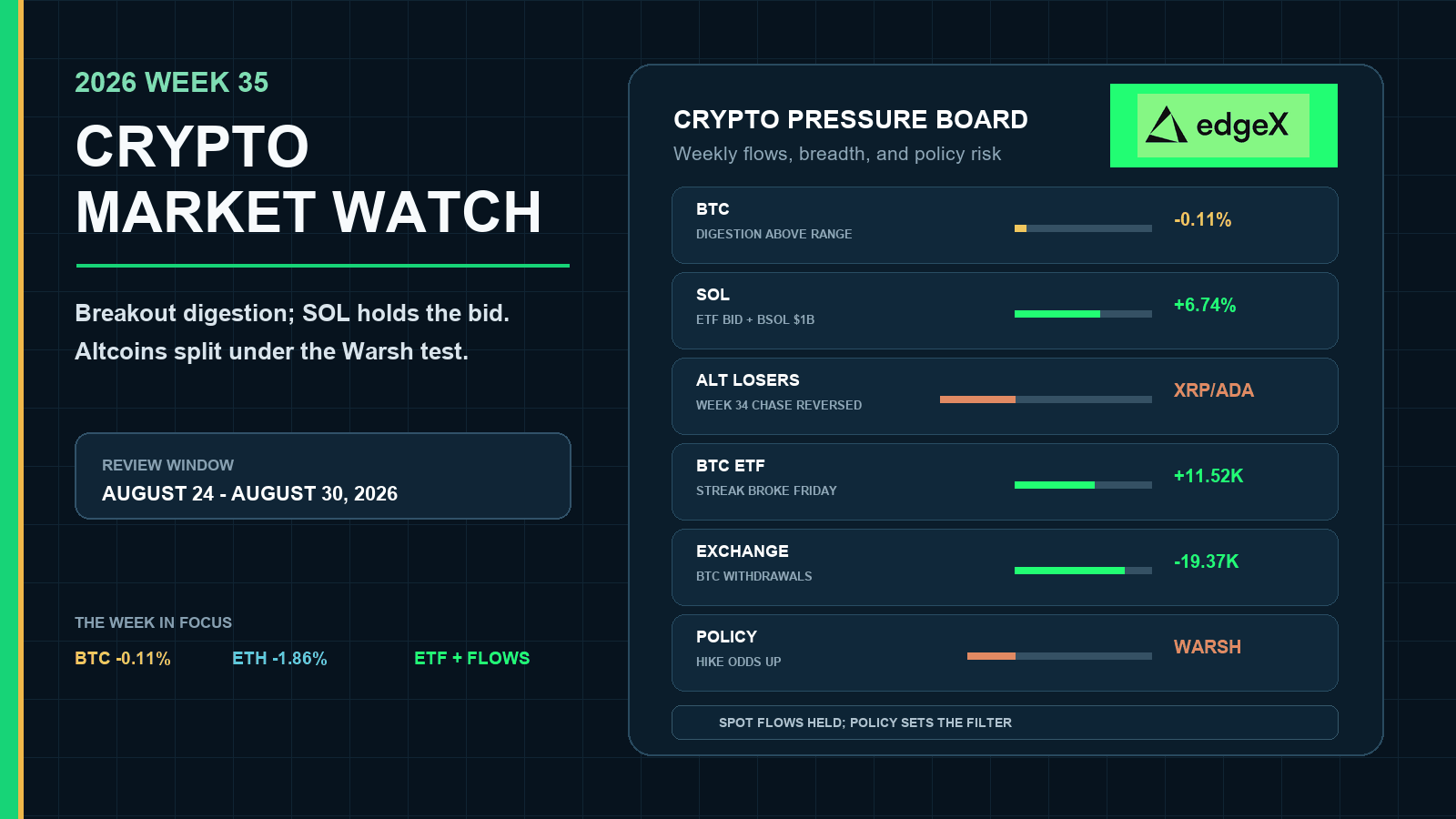
Week 35 answered the question Week 34 left open: could spot demand survive after the squeeze? The price answer was muted. Bitcoin and Ether stopped running and spent the week digesting the prior breakout. The flow answer was stronger. Bitcoin and Ether ETFs still attracted large weekly inflows, BTC continued to leave exchanges in size, and stablecoin exchange balances turned positive again. Altcoins told a third story. Solana held up with fresh ETF demand, while XRP, DOGE, ADA, SUI, and other Week 34 favorites gave back the chase. Warsh’s Jackson Hole remarks reopened the rate channel, and Friday’s Bitcoin ETF outflow broke a nine-day streak. Week 36 therefore starts with a split tape: spot flows still support consolidation above the old range, but policy risk and crowded altcoin reversals can punish any chase that treats every large-cap as interchangeable beta.
Week 35 Turned a Breakout Into a Confirmation Pause
The completed Week 35 record mattered more than the forecasts that framed it. After Week 34’s ETF-and-squeeze surge, the market had to decide whether the move would extend, broaden, or mean-revert. The answer was selective digestion.
Bitcoin held near the mid-$77,000s in the August 30 snapshot after finishing the prior week near $77,755. Ether cooled from about $2,464 to about $2,418. Neither print describes a collapse. Both describe a market that stopped compounding upside and started testing whether cash demand could replace forced covering.
Price cooled while the prior range stayed broken
The important technical point is what did not happen. Bitcoin did not fall back through the former $62,000–$66,000 trap that framed the pre-breakout market. It paused near the highs while ETF creations and exchange withdrawals continued. CoinDesk market coverage around the week’s end still described bitcoin as holding above roughly $78,000 after August’s roughly 24% monthly gain, even as majors slipped on hawkish Fed bets. The August 30 CoinMarketCap snapshot’s 7-day Bitcoin reading of -0.11% is consistent with that consolidation story.
Ether’s -1.86% seven-day move and the ETH/BTC slip to about 0.03113 show that relative strength faded with the pause. The large-cap leadership of Week 34 did not disappear overnight, but it stopped accelerating. For a post-breakout week, that is closer to digestion than to rotation failure.
Altcoins Split After the Breakout: Solana Held, High-Beta Names Gave Back
The Week 35 altcoin tape was not a simple “alts down” story. It was a selection event. CoinMarketCap’s August 30 snapshot shows Solana, Monero, and Uniswap still making progress, while the exact cohort that led Week 34’s chase, XRP, DOGE, ADA, SUI, AAVE, and related high-beta names, gave the gains back under a hawkish rates shock. Bitcoin dominance near about 59.6% to 60.2% rose as capital rotated toward the largest asset. That is digestion with leadership concentration, not a clean altcoin-season continuation.
Solana’s ETF bid separated it from the Week 34 chase cohort
SOL finished near $101.88, up 6.74% over seven days, after starting the prior week near $95.44. That made Solana the clearest large-cap exception in a week when most high-beta names failed. Bitcoin.com’s week wrap put Solana ETF inflows near $153.87M, more than five times the prior week’s roughly $28.34M and the category’s second-biggest weekly haul since inception, with positive creations in all five sessions. The Defiant and Glassnode coverage also marked Bitwise’s BSOL as the first Solana ETF above $1B in assets, holding about 9.33M SOL and capturing roughly 79% of cumulative Solana ETF flows in Farside’s six-fund table. Solana did not merely ride residual Week 34 momentum. It attracted a fresh institutional wrapper bid while Bitcoin paused and most altcoins reversed, though ETF creations can still include hedging and product-flow effects.
XRP, meme beta, and DeFi names showed the rates cut first
The losers mapped cleanly onto last week’s extensions. XRP fell to about $1.3595, down 10.69%. DOGE dropped 12.12% to about $0.0821. ADA led large-cap damage at -15.06% near $0.1927. SUI fell 16.52%, AAVE 13.50%, XLM 12.39%, BCH 11.32%, and SHIB about 10.7%. AVAX, LINK, BNB, and TRX were softer rather than collapsed, but they did not offset the breadth damage. The divergence inside XRP is the week’s sharpest warning: spot sold off even as XRP ETFs posted their strongest week of 2026, about +$110.49M, with five positive sessions and cumulative inflows near an all-time high of roughly $1.66B. For risk control, traders should trust the spot tape first and treat the ETF print as evidence that institutions have not abandoned the asset class.
Selective winners and digested leaders completed the split
Not every non-SOL winner was an ETF story. XMR rose 15.23% to about $486.08, and UNI gained 13.77% to about $5.15, with Uniswap’s 24-hour jump near 10% in the August 30 snapshot underscoring late-week DeFi interest. Mantle also posted a +6.77% seven-day reading. HYPE and ZEC tell the digestion side of the same coin: after Week 34 gains of about 43.83% and 75.34%, they cooled to -2.43% and -1.93%, even as HYPE ETFs still attracted about +$56.86M across five positive sessions. Until XRP-style reversals stop spreading, altcoin breadth remains a constraint on any second-leg breakout thesis.
Flows Stayed Constructive Even as Price Digested
The flow evidence is the main reason Week 35 should not be read as a simple top. Institutional wrappers kept buying, BTC left exchanges, and stablecoin liquidity on exchanges improved even while altcoin breadth narrowed.
Bitcoin ETF demand slowed but did not reverse the week
The CoinGlass Bitcoin ETF table shows a still-positive five-session sequence of about +4.36K, +3.90K, +2.85K, +2.89K, and -2.48K BTC, totaling approximately +11.52K BTC. That is smaller than Week 34’s roughly +28.63K BTC impulse, which is what a digestion week should look like after a vertical move. Public dollar reporting put the same week near $924.48M, with a Friday withdrawal near $201.81M ending a nine-session streak after Warsh and after rejection near the low-$80,000s.
Ether ETF demand remained the steadier institutional bid
Ethereum ETF native-unit flows were about +37.86K, +56.64K, +58.97K, +69.97K, and +29.64K ETH, totaling approximately +253.08K ETH. Unlike Bitcoin funds, the Ether sequence stayed positive through all five sessions, and dollar reporting put the weekly haul near $824.42M. That persistence matters because Ether underperformed Bitcoin on price. When ETF demand stays firm while the token pauses, the market is still absorbing supply rather than abandoning the asset.
Exchange withdrawals and stablecoin inflows improved the spot backdrop
CryptoQuant’s all-exchange BTC netflow readings were -4,166.01, -1,079.15, -6,943.57, -5,441.24, -473.03, -1,863.52, and +592.10 BTC from August 24 through August 30. The weekly total was about -19,374.40 BTC, larger than Week 34’s roughly -11,308 BTC result. Coins leaving exchanges during a flat-to-soft price week are more constructive than withdrawals during a vertical squeeze, though the late +592 BTC print shows deposit supply can still return.
Stablecoin exchange netflow flipped from Week 34’s deficit to a surplus. Daily readings were about +$432.84M, +$200.87M, -$191.51M, -$327.88M, +$193.46M, +$50.70M, and +$92.77M, totaling approximately +$451.25M. Midweek withdrawals kept the week from being one-directional, yet the net result restored exchange-based dollar capacity after the prior week’s roughly -$100.53M drain.
| Week 35 signal | Reading | What the result means |
| BTC price, August 30 snapshot | $77,667.57; -0.11% 7d | Breakout paused, not reversed |
| ETH price, August 30 snapshot | $2,417.94; -1.86% 7d | Large-cap digestion after Week 34 leadership |
| SOL / XMR / UNI | +6.74% / +15.23% / +13.77% | Selective alt leadership, not broad beta |
| XRP / ADA / SUI | -10.69% / -15.06% / -16.52% | Week 34 chase cohort mean-reverted |
| SOL / XRP / HYPE ETF flows | About +$153.87M / +$110.49M / +$56.86M | Wrapper breadth held even as spot narrowed |
| BTC ETF net flow | About +11.52K BTC | Demand slowed but stayed positive on the week |
| ETH ETF net flow | About +253.08K ETH | Institutional bid remained steadier than price |
| BTC exchange netflow | About -19,374.40 BTC | Visible exchange supply tightened further |
| Stablecoin exchange netflow | About +$451.25M | Exchange dollar buffer improved |
| BTC dominance | About 59.6%–60.2% | Capital rotated back toward Bitcoin |
Warsh Reopened the Rate Channel Without Breaking Spot Support
The week’s main macro catalyst was not a fresh crypto-native headline. It was policy communication. Fed Chair Kevin Warsh’s Jackson Hole remarks lifted rate-hike expectations and challenged the weaker-yield support that had helped Week 34’s risk-on move. Gold suffered a late-week policy shock, and crypto’s high-beta sleeve weakened with it.
Higher hike odds tested the post-breakout premium
A hawkish Jackson Hole message works through the same channel that powered the prior rally: real yields, the dollar, and the discount rate applied to speculative duration. When hike odds rise, leveraged crypto and long-duration proxies usually feel it first. That is consistent with the Week 35 pattern of soft altcoin breadth, a paused ETH/BTC ratio, and a Bitcoin ETF streak that finally broke on Friday.
The constructive part of the tape is that Bitcoin did not behave like a pure risk proxy being liquidated through the old range. Spot ETF demand and exchange withdrawals continued even while the rate shock arrived. That is closer to digestion under a policy headwind than to a failed breakout.
ETF breadth outside BTC and ETH stayed alive
Combined crypto ETF inflows reached about $2.07B, including roughly $321.22M across Solana, XRP, and HYPE funds. That wrapper breadth is constructive, but it does not cancel the spot-market reversals in XRP, ADA, SUI, and meme beta. When wrappers broaden and spot leadership narrows, traders should trust price for near-term risk control and treat ETF demand as evidence that institutions have not abandoned the complex.
Derivatives Risk Shifted From Squeeze Fuel to Policy Sensitivity
Week 34’s upside was amplified by short covering. Week 35’s risk was different. With the obvious short squeeze already spent, the market became more sensitive to whether fresh longs would overcrowd into a rates shock. Public desk commentary around the week’s end described perpetual open interest as comparatively restrained and pointed to the Friday ETF outflow plus repeated rejection near $82,000 as signs that conviction was lower than in the breakout phase.
A clean digestion needs leverage to stay secondary
If price holds the post-breakout zone while open interest rebuilds slowly and funding stays near neutral, the market can consolidate without recreating a one-way crowded trade. If open interest jumps faster than spot volume while hike odds are still rising, the next downswing can become mechanical again. The same warning applies to altcoins: chasing SOL, XRP, or UNI with leverage after a rates shock raises the odds that the next flush hits the exact names that still look relatively strong.
Week 36 Outlook: Range Digestion Meets a Rates Filter
Week 36 covers August 31–September 6, 2026. The base case is continued digestion rather than an immediate second-leg breakout. Bitcoin enters the week still above the old pre-breakout range, with ETF demand slower but not absent, exchange inventories tighter, and stablecoin balances improved. The binding constraint is macro: Warsh has already shown that policy communication can reprice the rate channel faster than crypto-specific flows.
The constructive path needs the streak break to stay temporary
First, Bitcoin ETF flows need to stabilize after Friday’s outflow. Second, Ether and Solana ETF demand should remain positive. Third, BTC exchange netflow should stay near neutral to negative. Fourth, stablecoin exchange netflow should not give back the entire +$451M buffer in one week. On price and breadth, the constructive case is BTC holding the mid-to-high $70,000s, ETH/BTC stabilizing near 0.031, SOL holding above $100 with continued ETF creations, and fewer large-cap alts making fresh weekly lows. One product-supported winner is not enough if XRP, ADA, and SUI-style reversals keep spreading.
The downside path begins with yields or wrapper fatigue
A hotter labor print, another hawkish policy impulse, or a second week of Bitcoin ETF outflows would raise the odds that digestion turns into a deeper retracement. The first mechanical warning would be BTC losing the post-breakout shelf while exchange deposits rise, stablecoin balances shrink, and SOL loses its relative-strength lead. If U.S. yields keep rising, crypto may depend too heavily on U.S. ETF creations, raising the cost of any wrapper disappointment.
The decision criterion for Week 36 is therefore not a new all-time-high target. It is whether spot flows, exchange balances, and altcoin breadth can defend the breakout after the first serious policy test. If they can, the pause is healthy. If they cannot, the same market that climbed on ETF demand and forced covering will have to prove demand again the hard way.
Trade Crypto With Leverage - Without Giving Up Custody
Decentralized perpetual exchanges have moved well past niche status. According to CoinGecko's 2025 Annual Crypto Report, DEX perpetual trading volume surged 346% last year, reaching $6.7 trillion, while centralized exchange open interest fell 20.8% over the same period. Traders are committing serious capital to on-chain derivatives, and the reasons are straightforward: counterparty risk is real, custodial failures happen, and censorship resistance matters.
edgeX is a decentralized perpetual futures exchange built for traders who want market access without sacrificing control. Here's what sets it apart:
- No KYC, no barriers. Connect a wallet and start trading. No identity verification or account approvals are required.
- True self-custody. edgeX combines off-chain order matching with verifiable on-chain settlement secured by Ethereum. Forced-withdrawal mechanisms keep funds recoverable directly from the blockchain even if the operator goes offline.
- Deep liquidity, tight spreads. edgeX maintains $10 million of market depth within a one-basis-point spread, with sub-0.1-basis-point slippage on trades exceeding $100,000.
- Up to 100x leverage. Traders can scale positions to match their risk framework, whether hedging exposure or trading momentum.
- 140% trading fee rewards. Active traders can earn rewards on their trading activity, reducing the net cost of frequent strategies.
- Institutional-grade infrastructure. edgeX processes up to 200,000 orders per second with matching latency below 10 milliseconds.
Start trading crypto perpetual futures on edgeX and put your market view to work.
Frequently Asked Questions
What dates does the Week 35 Crypto Market Watch cover?
The review covers August 24–30, 2026, using UTC dates. Week 36 refers to August 31–September 6, 2026.
Did the Week 34 breakout fail in Week 35?
No. Prices cooled and breadth narrowed, but Bitcoin held the post-breakout area in the August 30 snapshot, and spot flows remained constructive.
What did the ETF data show?
Bitcoin spot ETFs added about 11.52K BTC across the five sessions, with a Friday outflow ending a nine-day streak. Ethereum spot ETFs added about 253.08K ETH and stayed positive every session.
Did exchange flows confirm demand?
BTC exchange netflow was negative by about 19,374.40 BTC for the week, reducing exchange-held supply. Stablecoin exchange netflow turned positive by about $451.25M. Netflow alone does not prove that every withdrawal was long-term accumulation.
Why did altcoins struggle?
After Week 34’s high-beta chase, profit-taking and Warsh’s hawkish Jackson Hole message hit the most extended names hardest. XRP, DOGE, ADA, SUI, and AAVE reversed, while SOL, XMR, and UNI remained relative winners. Solana ETF demand and Bitwise’s BSOL crossing $1B AUM helped separate SOL from the broader chase cohort.
What should traders watch in Week 36?
Watch whether Bitcoin ETF flows stabilize after the streak break, Ether and Solana ETF demand stays positive, BTC exchange netflow remains near withdrawals, stablecoin balances hold, ETH/BTC stabilizes near 0.031, SOL defends the $100 area, and XRP-style altcoin reversals stop spreading under higher yields.
