Policy Uncertainty Spikes Around New Section 301 Tariffs
Key Takeaways
- •The Economic Policy Uncertainty index rose noticeably around the announcement of new Section 301 tariffs.
- •Section 301 allows the USTR to respond to foreign trade practices considered unfair or discriminatory.
- •The new Section 301 tariffs may maintain effective tariff rates previously established under Section 122.
- •Threatened Section 338 tariffs against Canada were announced only a few days before the new Section 301 tariffs.
- •The EPU-Trade sub-category showed a sharp increase, indicating heightened uncertainty around U.S. trade policy.
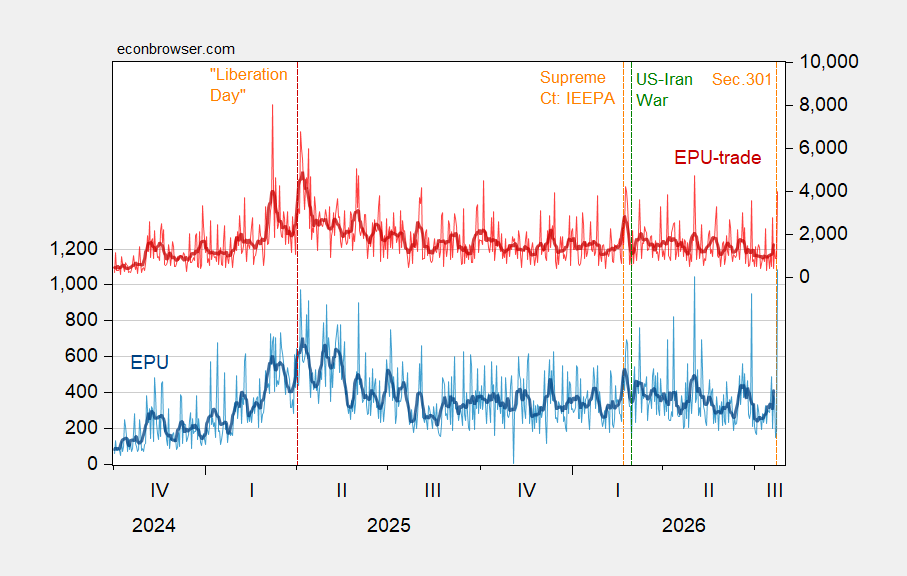
Economic Policy Uncertainty and Trade Policy Uncertainty:
Figure 1: Economic Policy Uncertainty (blue, left scale), 7-day centered moving average (bold dark blue, left scale), EPU-Trade Category (pink, right scale), 7-day centered moving average (bold red, right scale). Source: Policyuncertainty.com accessed 7/25/2026.
The Economic Policy Uncertainty (EPU) index, developed by economists Scott R. Baker, Nicholas Bloom, and Steven J. Davis, tracks newspaper coverage of policy-related economic uncertainty to gauge how much ambiguity surrounds government policy decisions. The index rose noticeably in the period surrounding the announcement of new Section 301 tariffs.
Section 301 of the Trade Act of 1974 authorizes the United States Trade Representative (USTR) to investigate and respond to foreign trade practices deemed unfair or discriminatory. It has been a primary legal instrument for imposing unilateral tariffs on imported goods, particularly in trade disputes involving technology, intellectual property, and market access. Section 301 was used extensively in the 1980s, saw diminished use after the World Trade Organization's dispute settlement mechanism became available in 1995, and returned to prominence during the U.S.–China trade tensions that began in 2018.
Hence, even if the new Section 301 tariffs merely maintain the effective tariff rates previously established under Section 122, trade policy uncertainty appears heightened. Section 122 of the Trade Act of 1974 permits the president to impose temporary import surcharges or quotas to address balance-of-payments difficulties, generally for a limited duration.
Notably, the Section 338 tariffs threatened against Canada were announced only a few days before the new Section 301 tariffs. Section 338 of the Tariff Act of 1930 empowers the president to impose discriminatory duties on imports from countries that maintain unjustifiable or unreasonable restrictions on U.S. commerce. The close timing of these distinct tariff actions across multiple legal authorities has contributed to the observed spike in trade-related policy uncertainty, as businesses and supply-chain planners face overlapping tariff regimes applied through different statutory pathways with differing durations, procedural requirements, and scope.
The EPU-Trade sub-category, which isolates uncertainty specifically related to trade policy, shows a particularly sharp increase, suggesting that market participants and analysts perceive an elevated risk environment surrounding current U.S. trade policy directions.

