Toyota Gazoo Racing Philippine Cup tests biofuels at Clark race weekend
Key Takeaways
- •Vios one-make race cars ran on E20 bioethanol, while Tamaraw race vehicles used a B5 coco-biodiesel blend at Clark International Speedway.
- •Toyota Motor Philippines said the race setting provides a demanding environment to evaluate biofuel performance, efficiency, durability, and reliability.
- •The initiative aims to reduce reliance on imported fuels and carbon emissions while supporting local coconut and sugarcane feedstock producers.
- •Representatives from the Department of Energy and Department of Agriculture were invited to observe Toyota’s approach and fuel consumption testing.
- •Toyota Motor Philippines said biofuels will remain part of the TGR Philippine Cup, which has upcoming race weekends in Batangas and Clark.
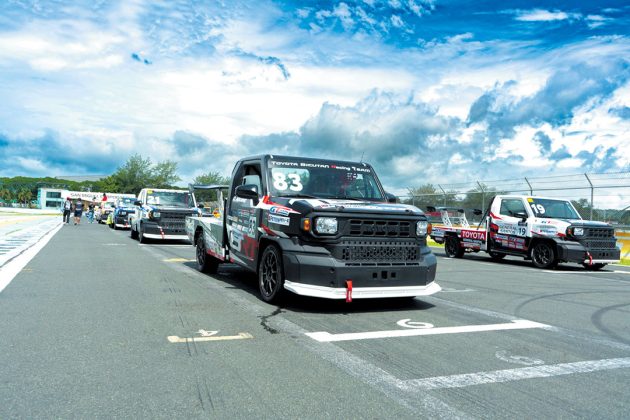
Toyota Motor Philippines (TMP) tested biofuels in competition during Race Weekend 2 of the Toyota Gazoo Racing (TGR) Cup, positioning the event as a proving ground for alternative fuels in the country’s mobility sector.
At Clark International Speedway, spectators saw cars in the Vios one-make race (OMR) run on E20 bioethanol fuel, while vehicles in the Tamaraw OMR used a B5 coco-biodiesel blend. TMP described the use of biofuels in the series as a pioneering move for Philippine motorsports, with the race setting giving the company a controlled but demanding environment to observe how the fuels perform beyond ordinary road use.
TMP President Masando Hashimoto said the event had become, in part, a “rolling laboratory” for the company. “It is allowing us to evaluate the performance, durability, and reliability of biofuels under racing conditions, generating learnings that can contribute to a more sustainable future for mobility,” he told members of the media and content creators at a press conference during the race weekend, which ran from July 9 to 11. The race weekend marked the return of the series after it was scuttled at the onset of the US-Iran war.
“At Toyota, we want to be part of the solution,” Mr. Hashimoto said. “This is why, over the past weeks, we have been conducting tests of biofuels on the racetrack.” Earlier in the day, during the event’s opening ceremonies, he said integrating biofuels into the series was intended to demonstrate Toyota’s commitment to a more sustainable future for both motorsports and mobility.
TMP Corporate Affairs Group First Vice-President Josephine Villanueva said the initiative is aimed at both energy and agricultural objectives. “The main objective is to reduce dependence on imported fuels and carbon emissions,” she said. “More importantly, we want to boost the local agriculture sector by sourcing biofuel products from feedstock grown by local coconut and sugarcane farmers. Biofuel is not new; it has been available since 2006. We are reviving interest in it, and we will continue to collaborate with the government and share our results with them.”
Representatives from the Department of Energy and the Department of Agriculture were invited to the circuit for a walkthrough of Toyota’s approach and a demonstration of fuel consumption testing. TMP said its next steps include gathering data and verifying results in coordination with its regional and parent companies. The company identified performance, efficiency, and reliability as key performance indicators, underscoring that the program is being treated as a data-gathering effort rather than a simple demonstration run.
In an earlier exclusive interview with “Velocity” during Toyota’s Road Trek 19 in Cebu, TMP Senior Vice-President Sherwin Chua Lim said the decision to feature biofuels in the TGR Cup was a proactive move by the brand. “Although it’s not requested or required from us by the government, we’d like to do our share by testing these fuels,” he said. “(By doing so), maybe we can start preparing ourselves in case there’s a similar spike (in prices due to the Middle East crisis) of traditional fossil fuels in the future.”
Mr. Hashimoto also cited Toyota’s continuing efforts to showcase biofuels on the track. Toyota Chairman Akio Toyoda competes in Japan’s Super Taikyu Series in a GR86 that runs on E20 biofuel, as well as a GR Corolla fitted with an internal combustion engine powered by liquid hydrogen. “Toyota Gazoo Racing continues to compete at the highest levels of global motorsports,” Mr. Hashimoto said. “These programs continue to prove that motorsports can accelerate innovation by testing technologies in the toughest conditions. We race to create ever-better cars.”
Responding to a question from “Velocity,” Mr. Hashimoto said the multi-fuel strategy promoted through the Toyota Gazoo Racing Cup is consistent with the company’s multi-pathway approach, which seeks to diversify both powertrain technologies and energy sources in the pursuit of carbon neutrality. According to TMP, about three-quarters of Toyota and Lexus gasoline models are already compatible with E20, while all Toyota diesel models are currently compatible with B5.
“We need to give options to our customers,” Mr. Hashimoto said. “I hope more people will realize that we have more choices beyond gasoline or diesel. Indonesia has already implemented E40 and is moving toward an even higher blend, E50. This shows that increasing the use of biofuel is possible. For the Philippines, this is an opportunity to become stronger and more self-reliant by reducing petroleum imports.”
Mr. Hashimoto said biofuels will remain an integral part of the TGR Philippine Cup. The series has two more race weekends scheduled this year: Race Weekend 3 at Batangas Racing Circuit from Aug. 13 to 15, and Race Weekend 4 at Clark International Speedway from Sept. 10 to 12.

