Third Way Launches $15 Million Campaign Against Democratic Party's Progressive Wing
Key Takeaways
- •Third Way has launched a $15 million initiative through 2028 aimed at discrediting democratic socialism within the Democratic Party and pushing back against progressive candidates.
- •The organization, founded in 2005, promotes what it calls democratic capitalism and advises Democratic politicians to maintain relationships with corporate donors and pursue market-oriented policies.
- •Progressive Democrats advocate for policies including universal healthcare, affordable college, climate action, and higher taxes on billionaires, citing strong public support in opinion polling.
- •The article traces the party's internal divide to decades of historical developments, including the decline of labor unions after Reagan's actions against PATCO and the founding of the DLC in 1985.
- •Some party members warn that internal conflict between centrist and progressive factions could further damage Democratic electoral prospects amid already significant challenges from well-funded Republican opponents.
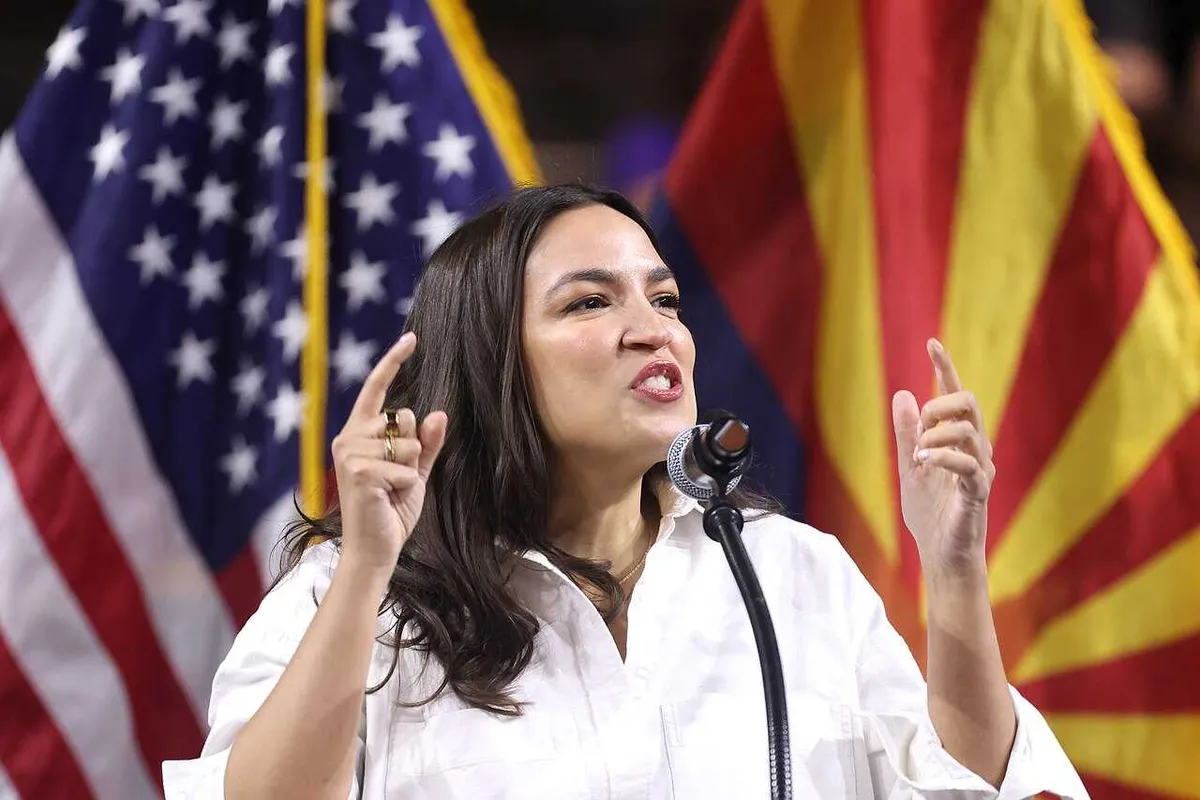
The centrist Democratic group Third Way has effectively declared its intention to push progressive candidates out of the Democratic Party, escalating an internal conflict that some observers warn could damage the party's electoral prospects.
Third Way, which describes itself as committed to "democratic capitalism," has launched a new $15 million effort through 2028 aimed at discrediting democratic socialism within the party. The move targets Democratic candidates who refuse corporate PAC money and align themselves with the New Deal and Great Society traditions associated with Franklin D. Roosevelt and Lyndon B. Johnson.
Progressives argue that the policy priorities most Americans and a large majority of Democrats support include a national healthcare program covering everyone, free or affordable college, a clean environment with action on climate change, higher taxes on billionaires and corporations, affordable housing and groceries, widespread unionization with an increased minimum wage, and an end to aggressive immigration enforcement practices.
Historical Context: From Medicare to the DLC
To understand how this rift emerged, it is useful to revisit several decades of party history.
In 1961, President John F. Kennedy and Vice President Lyndon B. Johnson pushed aggressively to expand the New Deal. Their centerpiece was a new healthcare program for seniors that was designed to eventually cover all Americans. The program's author, Robert Ball, emphasized that "Medicare" was structured so it could become a national healthcare system simply by reducing the eligibility age progressively until universal coverage was achieved.
This prospect alarmed Republicans and the insurance industry. Actor Ronald Reagan, then employed by General Electric as host of the weekly GE Theater program, recorded a 33 RPM LP album titled "A Time for Choosing," arguing that Medicare would cement a communist or socialist takeover of the United States. On the record, Reagan stated:
"One of the traditional methods of imposing statism or socialism on a people has been by way of medicine. … Behind it will come other federal programs that will invade every area of freedom as we have known it in this country until one day, as Norman Thomas said, we will awake to find that we have socialism."
Reagan traveled more than 250,000 miles that year, addressing business groups nationwide. He closed with a warning:
"If you don't do this and if I don't do it, one of these days you and I are going to spend our sunset years telling our children, and our children's children, what it once was like in America when men were free."
Kennedy was assassinated before the legislation passed. In the aftermath, Johnson successfully pushed both Medicare and Medicaid through Congress and into law.
The Republican War on Labor
Convinced that the country was on a path toward what they characterized as tyranny, Republicans sought to weaken the Democratic Party by targeting its largest funding source: labor unions, which had been legally protected under the National Labor Relations Act of 1935, signed by President Roosevelt.
That effort intensified in 1981, when newly elected President Reagan moved against PATCO, the air traffic controllers' union, effectively destroying it within a week. By 1985, private-sector union membership had fallen from a peak of 34.8% to just 14.6% of American workers, according to Bureau of Labor Statistics data.
Faced with diminished financial resources, a group of Democratic politicians concluded that the party needed to adapt. In 1985, they established the Democratic Leadership Council (DLC). Its leadership included Al From as principal founder, along with Bill Clinton, Sam Nunn, Chuck Robb, and Joe Lieberman.
The DLC promoted a "third way" approach to politics, which included welfare reform to push recipients into the workforce, free trade (NAFTA), deficit reduction through cuts to social programs, financial deregulation for banks and real estate, support for globalization and the relocation of manufacturing overseas, and partnership with corporate America.
That corporate partnership became central to Bill Clinton's 1992 presidential campaign. With unions significantly weakened, corporate money — bolstered by the Supreme Court's 5-4 decision in First National Bank of Boston v. Bellotti — became the financial engine of his successful bid. In the United Kingdom, Tony Blair pursued a similar trajectory with the "New Labour" project.
Democratic politicians increasingly aligned themselves with white-collar industries, particularly banking, insurance, and pharmaceuticals. As the middle class continued to erode, no viable grassroots fundraising alternative existed until the internet matured in the early 2000s during George W. Bush's presidency. Platforms such as ActBlue, founded in 2004, eventually enabled small-dollar donors to collectively channel hundreds of millions of dollars to Democratic candidates, giving progressives a financial base that did not depend on corporate contributors.
The Founding of Third Way
As online fundraising began offering Democrats a potential path to independence from corporate donors, a group including Jonathan Cowan, Matt Bennett, Jim Kessler, and Nancy Hale founded Third Way in 2005. The organization describes itself as committed to "democratic capitalism" and explicitly advises Democratic politicians to maintain relationships with wealthy donors, use capitalism as the governing framework, form partnerships with business interests, and advance "market-oriented solutions." Third Way has historically held significant influence within Democratic policy circles, with several of its alumni and advisors going on to serve in the Obama and Biden administrations.
Third Way is now openly confronting Democrats who seek to return the party to its New Deal and Great Society foundations.
In an article titled "Moderate Democrats Prepare for 'War' Against an Ascendant Left," The New York Times reported:
"'We are preparing for the next war that is coming,' said Jonathan Cowan, the president of Third Way, a leading centrist Democratic group, revealing to The New York Times a new $15 million effort between now and 2028 to discredit democratic socialism."
Cowan added, in reference to Abdul El-Sayed's victory in Michigan: "It is deeply troubling to see radical, far-left candidates winning in places that are potentially presidential swing states."
The Medicare for All Debate
Third Way's strategy operates within a campaign finance landscape shaped by Supreme Court rulings. In a series of 5-4 decisions issued by Republican-appointed majorities, the Court has enabled a system in which large corporations, foreign governments, and wealthy individuals can exert substantial financial influence over elections.
Public opinion polling, however, suggests broad support for progressive healthcare policy. According to Kaiser Family Foundation data, 56% of Americans and 77% of Democrats support making Medicare available to all Americans.
A recent Third Way memo titled "Read This Before Supporting Medicare for All" argues that the policy has repeatedly failed politically, citing unsuccessful state-level initiatives in Vermont, Colorado, California, and Oregon. The memo concludes:
"The Affordable Care Act is popular and provides a strong foundation on which to build."
A Divided Party Heading Into a Critical Election
Democratic candidates already face significant challenges from well-funded Republican opponents backed by billionaire donors. The internal conflict with the Third Way wing adds another layer of difficulty for candidates who reject corporate PAC money.
Previous analyses have noted how third-party and independent groups, including the Green Party and the Working Families Party, have at times contributed to Republican victories by splitting the progressive vote. With the future of American democracy widely described as fragile, some party members argue that Democrats should not also have to contend with opposition from within their own ranks. The tensions mirror broader debates across Western democracies, where establishment and insurgent factions within center-left parties — from Britain's Labour Party to Germany's SPD — have clashed over whether to embrace or resist the progressive movements energized by post-2008 economic discontent.
