Review: 'The End of Oak Street' Is a Tossed Salad of Spielberg Parts
Key Takeaways
- •The reviewer identifies classic science-fiction author Clifford D. Simak's pastoral small-town sensibility, rather than Spielberg's work alone, as the film's key creative template.
- •Anne Hathaway leads the cast as Denise Platt, an aspiring novelist, alongside Ewan McGregor as her husband Greg, with Maisy Stella and Christian Convery playing their children.
- •The film escalates its Spielberg-inspired premise with unusually bloodthirsty prehistoric creatures, including Coelophysis, a giant Titanoboa, and an apex-predator Allosaurus, while taking paleontological liberties the review highlights.
- •The critic judges Greg's easily guessed workplace secret, which fuels the couple's marital conflict, to be the movie's most significant flaw.
- •Despite a logically inconsistent ending that echoes "Back to the Future," the review concludes the film ranks among the more enjoyable movies of the year.
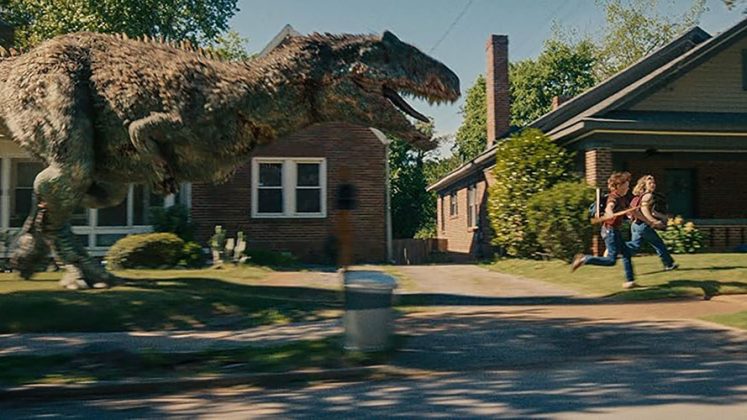
Movie Review — The End of Oak Street, directed by David Robert Mitchell
David Robert Mitchell's The End of Oak Street is a bowl of Spielberg movie parts — ET, Close Encounters, Jurassic Park, to name an obvious few — torn into bite-sized pieces and tossed together, with a dash of Robert Zemeckis for plot dressing. Less obvious are bits of tone and detail drawn from classic science fiction author Clifford D. Simak, who liked to set one fantastic premise after another in a small-town setting (“The Big Front Yard,” Way Station).
Spielberg and Zemeckis are quick, handy labels to slap on this concoction, but the reviewer submits that Simak is the key — not just to this picture, but to much of what Spielberg (and Mitchell, in this picture) is doing. First comes a patiently built portrait of suburban (in Simak's case, rural) life; we are introduced to the characters and their dynamic within the family, and the family in turn forms relationships with the community at large. Then something happens, the characters' reactions grow increasingly panicked, and the story's eventual resolution ideally emerges as a natural outgrowth of what the characters have learned along the way.
Hence Denise Platt (Anne Hathaway), an aspiring novelist living with her husband Greg (an unrecognizably middle-aged Ewan McGregor). Greg works as a pizza delivery driver on the side, and the tension between the two — over what Greg isn't telling Denise — is pulling them apart. Sensing the strain are the children, Audrey (Maisy Stella) and Brian (Christian Convery), who huddle in their rooms listening and whispering speculation about the family's future in the dark. The movie's early stretch is careful about that domestic unease, so when the impossible starts intruding, it lands not just as spectacle but as a test of whether the family can keep itself together.
Then the odd details pop up. A three-foot stem ringed with spiky leaves and bearing a heavy red club for a head sprouts in the backyard of Mrs. Huddleston (Anne Gee Byrd); librarian Ms. Valcourt (Emily Kuroda) identifies it as a pleuromeia, a vegetation with a sporing bulb common to the Triassic era along the Eurasian part of the world — that a living sample would turn up in a Michigan backyard, alongside flowers and animals from the Jurassic, is a point the review pointedly sets aside for later. Grumpy next-door neighbor Mel (PJ Byrne) complains to Greg that someone — likely the Platt's dog Starbuck — defecated in his yard, though the pile of feces he shows them stands maybe four to five feet high and weighs perhaps several hundred pounds. Flashing lights and strange noises are heard throughout the night, portents of even stranger things.
The “strange thing” could have been anything — aliens attempting contact, an alien lost and trying to phone home, aliens staging a full-scale invasion (Spielberg apparently has a thing for them); strange creatures snacking after midnight, a De Lorean flung back in time — but in this particular case it is dinosaurs, pointedly Jurassic. Spielberg's OG take on the subject, the review notes, is mislabeled: the T-Rex and, for that matter, the velociraptor are from the late Cretaceous, almost 100 million years after.
But — never mind. If the phenomenon isn't paleontologically accurate, the characters' response to it is at least halfway plausible, and one appreciates how the situation helps develop, resolve and even improve the family's inner issues and its standing within the community, with maybe a bit of a surprise — pleasant, in the reviewer's book — regarding the stargazing, Carl Sagan-reading Audrey, the family's science nerd who helps explain what is going on. It is a classic '80s playbook, and maybe even a recognizable page or two from Simak, whose Hiram Taine in “The Big Front Yard” turns out to have all the skills at hand to deal with alien visitors, and who considers the strange landscape into which the front of his house has been dimensionally folded to be just a large new extension of his yard. (He also has a dog named Towser, smarter and handier than any human in the story, who has been clued in to what is happening all along.)
The key word in Simak's fiction is “pastoral” — that sense of a quiet rural life momentarily ruffled by cosmic events, then brought back to a placid equilibrium after some adjustment. The reviewer submits that Spielberg and Mitchell take their cue from the Simak-adjacent word “comfort,” showing us a familiar world and ultimately reinforcing the value of that world by temporarily threatening it. That familiar setup also gives the movie a clear stakes structure: the more the bizarre intrusions spread, the more every small relational fracture inside the Platt household becomes part of the larger drama.
To his credit, Mitchell goes a step further than Spielberg and gives the picture its freshest spins. The creatures here are considerably more bloodthirsty, their taste for human flesh amped up. Instead of velociraptors, we get their ancestor Coelophysis, another birdlike predator depicted at its maximum estimated height (around 10 feet, though it could easily be as small as three) and an implied far heavier weight — textbooks estimate them at a maximum of 45 pounds. We get the Titanoboa, a — as implied by its name — humongous snake of the Paleocene era, reportedly 50 feet long, though here it looks to be a few hundred; at one point it slides in through a window and winds placidly through the Platt's house like an uninvited guest.
And of course we get the Allosaurus, the lighter, sleeker predecessor of the Tyrannosaurus Rex but no less deadly, easily the apex predator of Oak Street and the one to make the most disturbing kill — functioning as nearly all classic predators function, taking out the weaker of the prey species, emotionally if not physically.
Talking apex predator: Anne Hathaway is easily the star of the show. The story is told mostly through her eyes, and we are most familiar with her aspirations — she is writing a novel in secret, in the hope of someday becoming a bestselling author. She is the strongest character by far, and it is a bit unsettling, if not more than a little gratifying, to see her view Greg as something of a dead weight she has considered abandoning. Oak Street's transposition (transtemporal displacement?) has helped Greg's standing some — the family needs his superior strength and speed — but otherwise…
As Greg, Ewan McGregor plays the role of second banana with becoming humor, driving his car with the ridiculous pizza sign strapped on top (couldn't they get a Domino's endorsement?). Perhaps the movie's biggest flaw is his big secret, which fools no one and serves no real purpose except to drive a wedge between him and his wife — when you are the breadwinner and suddenly take on pizza delivery for extra cash, shouldn't everyone reasonably guess that something has happened at work?
Mitchell ends the film with a bit of a happy flourish (skip this paragraph if you plan to see the picture!), neatly stitching the conclusion of Back to the Future to this otherwise unhappy narrative — and if you are going to drag in time travel, you might as well introduce causal paradoxes and ignore logical conundrums. Yes, that final bit doesn't make sense — but boy, didn't it feel good? Wasn't it emotionally satisfying after the gut punch of a family brutally divided (though Hathaway's Denise suddenly standing bolt upright as she watches the Allosaurus feed, then wordlessly walking away, is a brutal and startlingly honest detail)? And didn't you enjoy the TV footage of all those neighbors singing Denise's praise — even as “a faint voice pipes up in your head: ‘But what happened to the Tuckers?! Did Denise — or most likely Brian — deliberately abandon them? Isn't that harsh retribution for a bit of bullying that they apologized for anyway?!’”
Comfort and a dash of escapism, with the disturbing parts kicked up a notch — Simak, the reviewer suspects, would flinch at the extra helpings of gore but otherwise approve. As for Spielberg: if you like his movies, this is for you; if you like his movies too much, you can always play your prized copy of Jurassic Park or ET (in glorious VHS!) instead. For the skeptical casual follower and occasional admirer, it works just fine — one of the more enjoyable movies of the year.

