Tether's MDK v0.11 Adds Human Approval Gate for Device Actions
Key Takeaways
- •Tether's MDK version 0.11 requires its reference AI agent to pause and obtain explicit human approval before performing any device action.
- •The toolkit enforces only the approval pause itself, leaving the method, interface, and timing of approval collection to developers building on it.
- •Sites integrating MDK v0.11 must supply their own identity verification, since the toolkit includes no built-in authentication and actions cannot proceed without this layer.
- •The human-approval design responds to concerns that AI agents controlling physical devices produce real-world consequences that are difficult to reverse.
- •Tether CEO Paolo Ardoino has publicly discussed AI agents running Bitcoin mining operations, a scenario that makes the question of who approves AI actions increasingly practical.
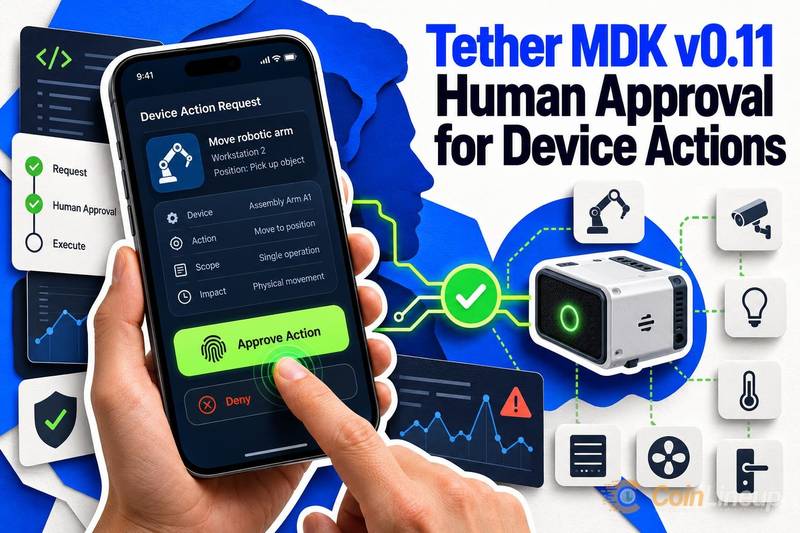
Tether has released version 0.11 of its Machine Development Kit (MDK), and the update's reference agent now halts before executing any device action, waiting for explicit human approval before anything happens. Site operators building on the toolkit must also supply their own identity verification — without it, actions will not proceed.
MDK, short for Machine Development Kit, is Tether's framework for building AI agents capable of taking real-world actions, such as controlling hardware or connected devices. Version 0.11 of the reference agent introduces a deliberate stop-point into that workflow: when an agent intends to perform a device action, it pauses and asks a person for the green light first.
This gating mechanism is commonly known as "human-in-the-loop" control. Rather than allowing an automated program to act on its own, it creates a checkpoint at which a human must confirm the action before it occurs — a long-standing safety pattern in automation and industrial systems, where consequential operations typically require a person's sign-off. The change matters because AI agents acting on physical devices produce real-world consequences that are harder to reverse than purely software-based actions.
What the Pause Means for Device Actions
In MDK v0.11, the reference agent treats every device action as something that requires permission rather than something that runs automatically. This is a deliberate design choice, not a limitation: the agent is built to ask before it acts, a meaningful constraint when the actions in question could affect physical hardware or connected systems.
Tether CEO Paolo Ardoino has publicly discussed the concept of AI agents running Bitcoin mining operations, as covered by CryptoSlate. That framing raises an immediate practical question: who has the authority to approve what an AI agent does when it controls real infrastructure? The human-approval pause in MDK v0.11 is the toolkit-level answer to that question.
Notably, the reference agent does not define how human approval is collected or displayed. It only enforces the pause. The method, interface, and timing of the approval step are left to the site or application built on top of the toolkit.
Why Sites Must Supply Identity Checks
MDK v0.11 requires sites integrating the reference agent to provide their own identity verification before any device action proceeds. The toolkit does not bundle a built-in authentication system. If a site does not implement identity checks, the approval gate has no way to confirm who is actually granting permission.
Without that identity layer, the pause is structurally present but practically incomplete. A human-approval step that cannot verify the human doing the approving amounts to a control without enforcement, and site operators building on MDK v0.11 are responsible for closing that gap themselves.
The design follows a pattern common in developer toolkits: the framework provides the structure, while the implementer supplies the security layer appropriate to its context. For operators building on Tether's infrastructure, this means identity verification is not optional — it is a prerequisite for the human-approval flow to function as intended.
Tether has been expanding its infrastructure ambitions in parallel. The company recently announced a tenge-pegged stablecoin pilot with Kazakhstan, another initiative involving financial infrastructure which identity and authorization controls are central concerns.
What It Means for Users of Tether-Powered Products
For users of products or services built on Tether's MDK, the v0.11 update means the AI layer controlling those products now has a built-in requirement to pause before taking device-level actions. That functions as a consumer protection of sorts, even if it operates behind the scenes.
The practical experience depends entirely on how a site or developer implemented the approval and identity steps. A well-built integration will present a clear confirmation prompt and verify a user's identity before acting. A poorly built one could expose the approval step to misuse if identity checks are missing or weak.
For anyone evaluating a product or platform built on MDK, asking how human approvals are handled and how identity is verified is now a reasonable and specific line of inquiry. The toolkit requires that those answers exist; it does not guarantee they are good ones.
Tether's broader push into AI-driven infrastructure — including the mining-operation concepts Ardoino has described — makes the governance question of who approves AI actions increasingly practical. MDK v0.11 establishes the reference answer: a verified human, on purpose, before it happens. How sites build that requirement into their products remains the open question, and the first wave of MDK-based integrations will show whether the pause translates into meaningful protection in practice.
Disclaimer: This article is for informational purposes only and does not constitute financial or investment advice. Cryptocurrency and digital asset markets carry significant risk. Always do your own research before making decisions.

