Tesla Stock Rises on Report of Possible SpaceX Merger, Musk Denies China Sale Claim
Key Takeaways
- •Reports suggest Elon Musk is exploring a potential merger between Tesla and SpaceX, which would combine two companies valued at over a trillion dollars each.
- •SpaceX’s status as a U.S. defense contractor requires strict compliance with export controls, complicating any deal involving Tesla's Chinese operations.
- •Elon Musk has publicly denied rumors that Tesla intends to separate or sell its China business to facilitate the transaction.
- •The proposed merger is part of Musk's wider strategy to consolidate his companies, such as X and xAI, around artificial intelligence capabilities.
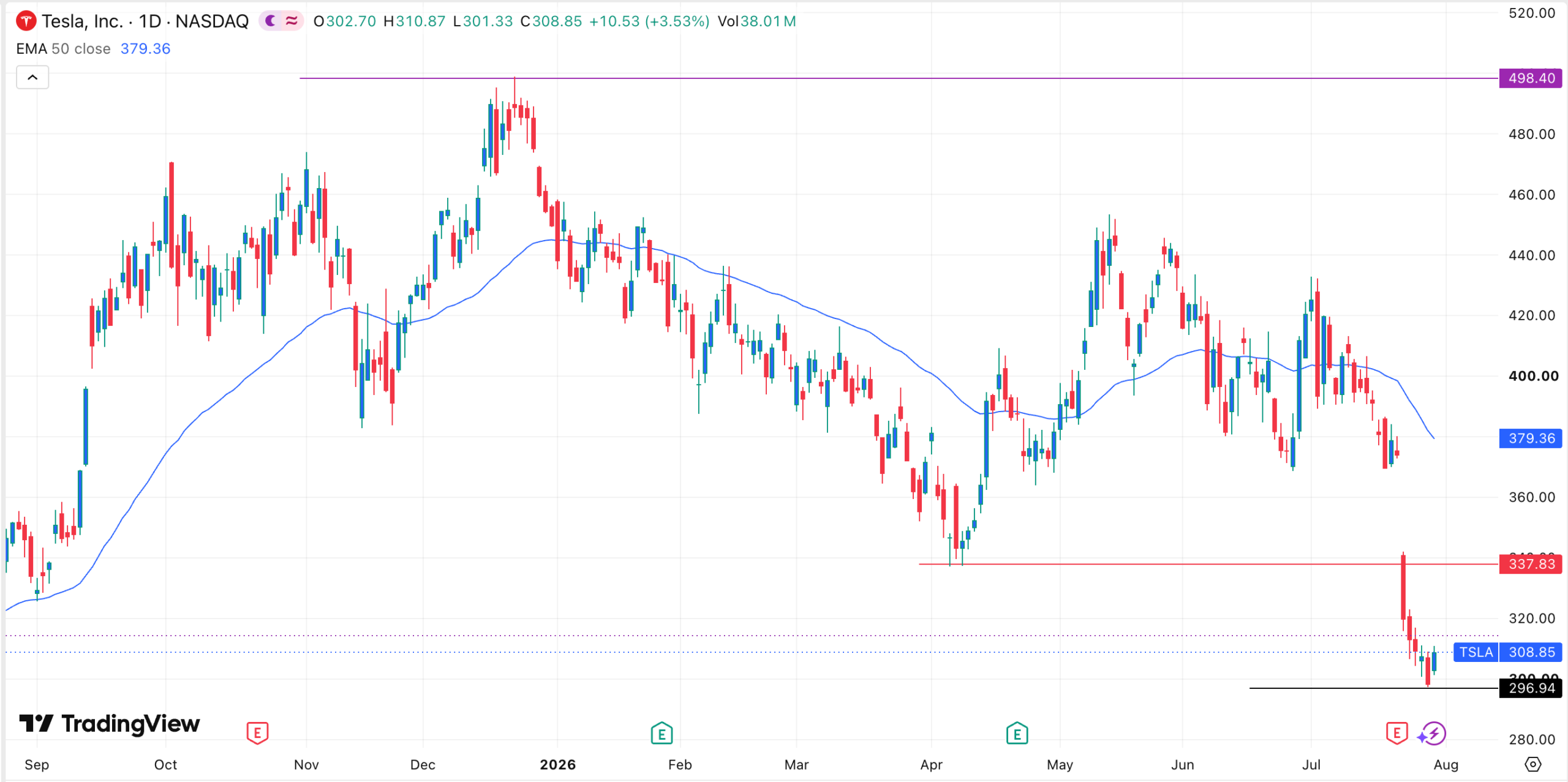
Tesla stock rose on Thursday as U.S. equity markets recovered and investors assessed reports about a possible merger with SpaceX.
TSLA climbed toward $308 during regular trading before extending its gains to about $313 in after-hours trading. The move followed a Wall Street Journal report that Tesla had considered separating its China operations to reduce obstacles to a potential SpaceX combination.
However, Elon Musk rejected the report on Friday, July 31. He described the claim that Tesla was considering selling its China operations as “absurdly fake news.”
Elon Musk is Plotting a Tesla and SpaceX Merger
Rumors that Elon Musk, the world’s richest person, could consider merging his two biggest companies have circulated for several months.
Now, there are signs that Musk may try to combine the two firms, a move that would create one of the world’s largest companies. Tesla has a market capitalization of $1.22 trillion, while SpaceX is valued at $1.47 trillion.
According to the Wall Street Journal, Musk is planning to spin off Tesla’s China operations into a separate company to make the deal possible. Musk has also told his executives to consider a sale of the business or even closure. A sale, potentially to local Chinese investors, would be possible, while shutting the business would result in a substantial loss for the company.
The challenge is that these options would have a direct impact on Tesla’s business, which counts China as its second-largest market after the U.S. It would leave the company more dependent on the U.S. and Europe.
A merger would also affect long-term Tesla investors, who have seen the stock fall from nearly $500 earlier this year to its current level. Unless Tesla were to seek a higher stock price, those investors would face a loss. Those shareholders would have limited influence because of Musk’s stakes in both companies.
For any merger deal to be completed, Tesla would need to separate its Chinese business because SpaceX is a major U.S. defense contractor. SpaceX holds substantial contracts with NASA and the Department of Defense, and companies in that position are subject to strict U.S. export controls, including the International Traffic in Arms Regulations (ITAR), which restrict technology sharing with countries such as China. The transaction would therefore aim to create a firewall between Tesla’s Chinese subsidiary and its U.S. business.
Musk Is Consolidating His Businesses Around AI
The possible Tesla and SpaceX merger comes as Musk seeks to consolidate his businesses around artificial intelligence.
For example, in 2025, he merged X (Twitter) with xAI, which owns Grok. He then merged xAI with SpaceX earlier this year. As a result, while SpaceX is a space company, it is also a significant player in the social media and AI sectors.
Musk has also launched Terafab, a large semiconductor project in Texas. Terafab, which is expected to eventually cost more than $100 billion, is being developed by SpaceX and Tesla. In its recent results, Tesla said this investment will generate negative free cash flow.
Tesla is also investing heavily in robotics and AI tools. It is developing Optimus, its robots that are expected to begin selling in the coming months. Musk is also working to improve Full Self-Driving, or FSD, features.
The main challenge for a Tesla and SpaceX merger is that it would create a conglomerate. That stands in contrast to the direction many companies are taking, with some separating their businesses to create more efficient firms. Investors have generally rewarded focused, single-business companies with higher valuations, a phenomenon sometimes called the conglomerate discount, where combined entities trade at a lower combined value than their parts might command separately.
General Electric, for example, split into three companies: GE Aerospace, GE Healthcare, and GE Vernova. Western Digital also created SanDisk. Those spin-offs have performed well since the separations.
Tesla Stock Price Technical Analysis
The daily chart showed Tesla remaining in a broader downtrend. The decline intensified after the company’s second-quarter earnings report.
Tesla found support near $296 before recovering toward $308 during Thursday’s regular session. The SpaceX merger report helped drive the rebound, although the broader market recovery also supported TSLA.
Tesla remained below its major moving averages and below former support near $337. That level had been an earlier April low before turning into resistance after the latest decline.
The stock also left a downside gap after earnings. If buying momentum continues, Tesla could attempt to fill part of that gap. The first major resistance is near $337.
A sustained move above that level could expose the moving-average region and improve the short-term technical picture.
However, failure to break above $337 could invite renewed selling.
A drop below $296 would weaken the rebound and bring the psychological support near $250 back into focus.
The merger narrative could continue to drive short-term volatility. However, Tesla and SpaceX have not confirmed any transaction, and Musk has denied the report that Tesla may sell its China operations.

