Termii: The Lagos Startup Powering OTP Delivery for 10 Million Africans Monthly
Key Takeaways
- •Termii provides OTP and messaging delivery services to more than 16,000 businesses across Africa, reaching approximately 10 million users monthly with over 400 million messages processed.
- •Industry estimates indicate that between 10 and 15 percent of users attempting OTP verification are lost due to silent SMS delivery failures across Africa's fragmented telecom landscape.
- •Nigeria's Central Bank recorded N25.85 billion in actual digital payment fraud losses in 2025, underscoring the critical importance of reliable verification messaging infrastructure.
- •Termii has raised $5.3 million in total funding and participated in Y Combinator in early 2020, becoming one of the first Nigerian communications companies to join the program.
- •The company has transitioned from basic message delivery to AI-native reliability infrastructure that monitors carrier routes in real time and predicts potential delivery failures before they occur.
Bank alerts are among the most critical elements of any digital banking transaction. Consider a common scenario: a customer transfers money to a market seller via a banking app. Even after seeing a debit confirmation, the seller may refuse to release the goods until their own account receives the corresponding credit notification. When the message arrives promptly, the system is invisible. When it fails, the consequences — from delayed transactions to agonizing refund processes — can be severe.
Most banks require customers to complete transactions using a one-time password (OTP) delivered via SMS or email, though some customers use hardware tokens or biometric authentication. In Nigeria, this requirement is not merely a best practice — the Central Bank mandates two-factor authentication for electronic payment transactions, making reliable OTP delivery a regulatory necessity for every bank and fintech operating in the country. For the past nine years, a Lagos-based company has been quietly powering this verification infrastructure.
Termii provides OTP and messaging delivery services to banks, fintechs, payment processors, and telecom companies. According to the company, more than 16,000 businesses use its platform, reaching approximately 10 million Africans each month. Its monthly message volume has grown from one million in its early days to over 400 million today — a trajectory that mirrors the broader surge in digital payments across the continent, where mobile money adoption and internet banking have grown rapidly over the past decade.
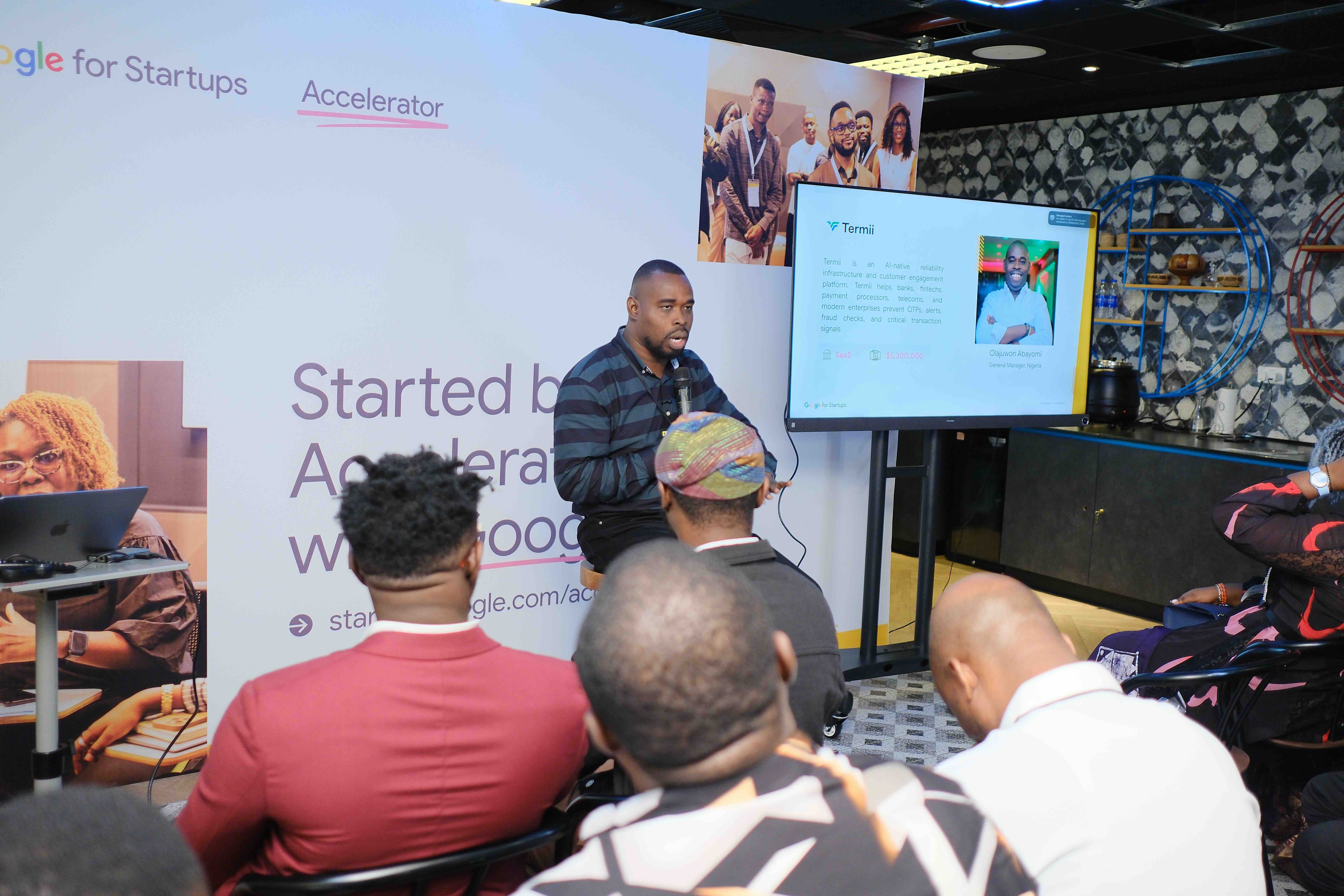
On Thursday, Olajuwon Abayomi, Termii's General Manager for Nigeria, presented the startup's story to journalists, creators, and industry stakeholders at the Google office in Lagos. He framed the problem as more significant than most observers realize.
Industry estimates indicate that between 10 and 15 percent of users attempting OTP verification are lost due to silent SMS delivery failures — messages that never arrive, generating no error message and no explanation. Global communications API providers such as Twilio and MessageBird dominate in Western markets, but Africa's fragmented telecom landscape — with varying carrier standards, inconsistent uptime, and differing character encoding requirements across countries — has created demand for infrastructure built specifically for local conditions.
"Every OTP that fails is a customer who believes their money is gone," Abayomi said.
The stakes are considerable. In Nigeria, the Central Bank recorded N25.85 billion in actual digital payment fraud losses in 2025, with attempted fraud reaching N37.57 billion. In that context, the difference between a verification message arriving in five seconds and not arriving at all is not merely a customer service concern — it can be the difference between a fraudulent transaction blocked and one completed.
"They do not call the telecom company. They call their bank, or they close the app and never come back. We exist so that call never has to happen," Abayomi added.
He identified several factors contributing to OTP delivery failures:
- Banks sometimes fail to send requests, causing delivery failures and blocking service completion.
- Telecom downtime or internal notification service outages prevent message handshakes between systems.
- Banks and apps experience downtime in their notification services, resulting in lost requests.
- SMS delivery requirements vary by language, and telecom character encoding standards differ across countries.
- Some customers lack the technical capacity to properly consume APIs, yet providers typically do not offer dedicated support engineers.
Termii's response has been to shift from simply sending messages to guaranteeing their delivery. The company now describes itself as AI-native reliability infrastructure: its systems monitor delivery routes across carriers in real time, predict where a message is likely to fail, and reroute it before the customer notices any issue.
"The best compliment our product gets is silence," Abayomi told the audience. "When we do our job, nothing happens. The alert arrives, the transaction completes, and nobody thinks about us. The whole company is built for a moment the customer should never have to notice."
The company's new platform will also enhance customer engagement by customizing interactions based on user location and behavior.
Abayomi did not portray Termii's path as easy. The company began as a young messaging startup attempting to earn the trust of banks and telecoms — institutions understandably cautious about routing critical communications through an untested provider. He described years of demonstrating reliability one client at a time, in a market where the underlying carrier infrastructure itself fails without warning.
"We were building on roads that were still being built," he said. "You cannot promise a bank 99.9 per cent delivery if the rails underneath you do not offer it. So we had to build the intelligence that makes unreliable rails behave reliably. That took years, and it nearly broke us more than once."
The company's trajectory has attracted international backers. Termii participated in Y Combinator in early 2020, becoming one of the first Nigerian communications companies to do so. It has raised $5.3 million to date, including a $1.4 million seed round led by Kepple Africa Ventures and Future Africa, followed by a later $3.65 million round (Nigerian CaaS Startup, Termii raises $3.65M to drive expansion in Africa). This places Termii within a broader wave of African infrastructure startups — alongside companies like Flutterwave and Paystack in payments — that have drawn international venture capital by solving technical challenges specific to local market conditions.
Termii is also an alumnus of the Google for Startups Accelerator Africa and builds portions of its AI infrastructure on Google Cloud.
When asked about the company's growth strategy, Abayomi emphasized depth over geographic expansion alone. He argued that most African businesses still treat customer communication as an afterthought — a cost line rather than essential infrastructure — even as their entire customer relationship migrates to mobile devices.
"Every business in Africa is becoming a digital business, whether it planned to or not," he said.
Learn more about Termii at termii.com.

