Nigeria's Petrol Three-Wheelers Are Going Electric — With Batteries Charged by Diesel
Key Takeaways
- •Swap has converted just over 300 petrol-powered tricycles to electric across its five Lagos stations, while over 100,000 vehicles remain on the company's waitlist due primarily to capital constraints.
- •The startup charges drivers nothing upfront for conversions and recovers costs through battery swap fees, making it the only operator in Nigeria's electric keke sector with no initial purchase requirement.
- •Nigeria's unreliable power grid forces some Swap stations to depend on diesel generators, reducing charging capacity to roughly one-third of grid-connected output and incurring diesel costs of up to $14,500 per month at a single location.
- •Drivers report savings of up to 50% when petrol and maintenance costs are combined, and consistently prefer electric motors despite occasional battery shortages that can leave them unable to work.
- •Swap plans to scale through a hub-and-spoke model with franchised swap stations, aiming to establish 10 depots by the end of 2026, with 1,000 additional conversion kits already ordered.
Two years ago, a mechanic's recommendation cost him a customer. Moses was a regular at the workshop, frequently bringing in his commercial three-wheeler — widely known in Nigeria as a keke — for repairs. That familiarity may be what prompted the mechanic to suggest that Moses remove the failing petrol engine from his keke and let a startup called Swap replace it with an electric motor.
Moses told TechCabal he has not visited a mechanic since.
"Since I started, I have not fixed my engine," Moses said in an interview at a battery swapping station in Magodo operated by Swap, a Nigerian startup that converts petrol-powered kekes to electric across its five stations in Lagos.
He had purchased his keke secondhand with an engine that was already failing, worn down by Lagos traffic, poor-quality fuel, bad roads, and accumulated neglect. After his mechanic directed him to Swap, Moses registered, and the company converted his vehicle at no cost. Now, twice daily, he rides to the battery station in Magodo — one of Lagos's most affluent neighbourhoods — and exchanges a depleted battery for a charged one. Within two minutes, he is back on the road.
Three-wheelers have served as the primary last-mile transport option since the government banned commercial motorcycles across most of Lagos, Nigeria's most populous city, in 2020. They navigate narrow roads that buses cannot access and that many car drivers prefer to avoid. They also connect major arterial roads and remain affordable enough to serve as a viable option for Lagosians.
According to Swap, there are now just over 300 converted kekes operating in Lagos, with more than 100,000 tricycles on the company's waitlist. The gap between those two figures reflects the central challenge this story examines: while Moses and other converted drivers, along with the extensive waitlist, demonstrate genuine demand, what constrains Swap is the cost and complexity of keeping batteries charged — and the capital required to meet demand at scale.
Different Stations, Different Realities
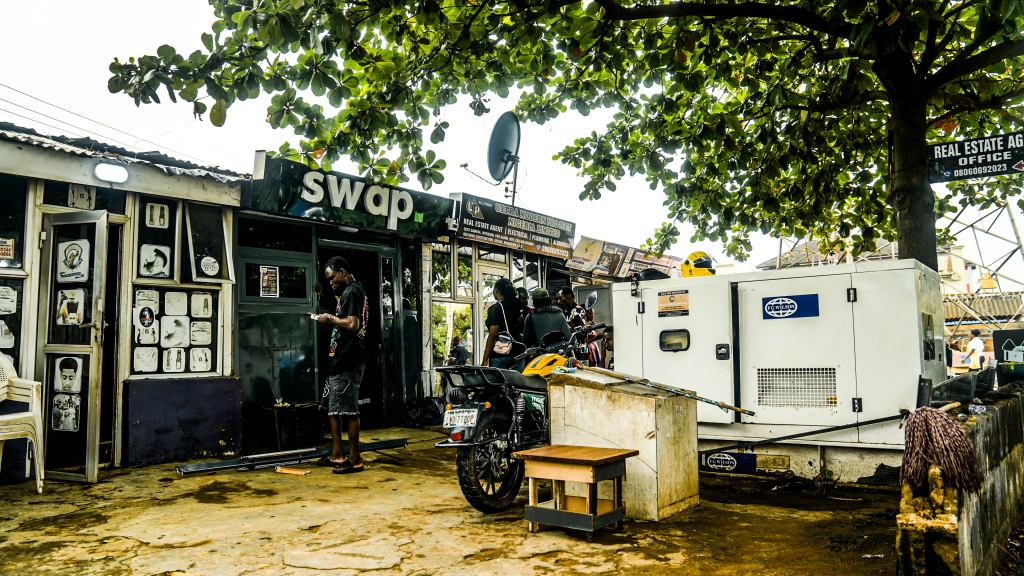
When TechCabal visited Swap's station in Ikorodu, a rapidly growing town on Lagos's northeastern outskirts, in June, the facility had been without grid electricity since January 2026. To charge batteries, the station relies on two generators that operate almost continuously. As soon as one batch of batteries finishes charging, the next set is loaded, and the generators keep burning diesel to keep drivers moving.
The station serves 150 drivers and charges between 90 and 100 batteries, according to station manager Victor Oguare. Only two diesel generators bear that load.
"If one generator runs for four hours, we shut one down and let it rest for one hour," Oguare said. "Then we turn on the other one and shut that one down to rest for another hour. There's a way we normally shuffle it so that it will not cause any overworking."
To maintain battery availability, Swap purchases diesel in bulk. "We purchase 1,000 litres for our drums, which serves us for three to four days," he said. At the current retail price of ₦1,750 ($1.28) per litre, that amounts to ₦1.95 million ($1,450) every three to four days — approximately ₦487,500 ($363) per day solely to keep batteries charged.
Over a 30-day month, purchasing at that rate costs between ₦14.6 million and ₦19.5 million ($10,900 to $14,500). Swap declined to comment on its total diesel expenditure.
The Ikorodu station's reliance on diesel generators underscores a wider irony in Nigeria's electrification push: the national grid itself is notoriously unreliable. Nigeria, Africa's most populous country with over 220 million people, has an installed generation capacity of roughly 12,500 megawatts but routinely dispatches far less, and the grid has suffered dozens of collapse incidents over the past decade. For Swap, this means that even a grid-connected station cannot guarantee uninterrupted operation — and the cost of working around that failure is borne in litres of diesel.
When relying on generators, the station's charging capacity drops significantly. The grid delivers substantially more power, enabling the station to charge 90 batteries simultaneously; on generators, it manages only 40 to 50, with each charge cycle extending from 90 minutes to nearly two and a half hours. A generator-powered station operates at roughly one-third the output of a grid-connected one.
Oguare told TechCabal that shortages caused by this reduced output are rare. Drivers, however, describe a different experience.
"We used to be there for some hours waiting for batteries," said Paul, an Ikorodu-based keke driver who operates under a hire-purchase arrangement and requested to be identified only by his first name.
Paul did not choose to switch to electric. His keke belongs to a fleet owner who handed him the key and directed him where to swap. He pays ₦7,500 ($5.61) daily to the owner, plus the cost of each battery swap: ₦2,800 ($2.09) for the first, ₦2,800 ($2.09) for the second, and ₦2,200 ($1.65) for a third if available.
On a four-battery day, he earns approximately ₦20,000 ($14.96). After subtracting the ₦7,500 ($5.61) hire-purchase fee and roughly ₦10,000 ($7.48) in swap costs, his take-home falls between ₦2,500 ($1.87) and ₦5,000 ($3.74).
On days when batteries are scarce — when the generators cannot charge fast enough to meet demand — Paul receives two or three batteries instead of four. His earning window contracts to a few hours, while the ₦7,500 ($5.61) daily delivery fee remains unchanged.
"If I pay ₦7,500 [$5.61] for delivery, with the ticket money, everything that I paid, I will not take anything home," Paul said. "It's not easy."
He has had batteries deplete mid-route. When that occurs, he must push the keke himself. There is no jerrycan equivalent for an electric vehicle, no roadside solution — the only options are to push or to find someone to help push. During a June 2026 visit to Swap's Magodo station, TechCabal observed drivers arriving on foot, carrying depleted batteries because their kekes could not move.
Despite occasional battery shortages and packs dying mid-trip, drivers consistently prefer Swap's electric motors to petrol. "It's better than fuel," Paul said. When batteries are available, the economics are favourable: he requires no mechanic, and the ride is smoother. A petrol keke driver on a comparable route spends over ₦10,000 ($7.26) daily on fuel alone, he estimated, before accounting for repairs.
Anthony Adiku has driven the same keke since 2022. He converted it in December 2025, after the petrol engine began costing more than it generated. "I swapped it to Swap because the engine then was giving me issues," he told TechCabal at Swap's Magodo station.
On a typical day, he uses two Swap batteries at ₦6,000 ($4.36) per pair and earns approximately ₦15,000 ($10.89) over a 12-hour shift. Three batteries cost him ₦10,000 to ₦11,000 ($7.26 to $7.99) and sustain longer working hours when needed.
For Anthony, the most significant change Swap brought is not primarily financial but operational. Previously, a breakdown could consume two hours of his morning, leaving him exhausted and behind target before he even started.
"Once I got into Swap, I woke up at my own convenient time because I know that I don't have any problem," he said. "The only problem I have is to face my customers. So once I wake up around nine, I close around seven; I'm okay."
Inside Swap
Launched in May 2024, Swap is an early-stage Nigerian startup that removes petrol engines from Lagos's commercial tricycles and replaces them with electric motors powered by swappable lithium batteries, with no upfront cost to the driver.
Founded by family friends Timilehin Odusina, Seyi Oguntunde, and Emmanuel Marchie, Swap describes itself as a battery-as-a-service provider. Drivers receive the battery at no cost and pay per swap, typically three times daily. A charged battery lasts between two and a half and four and a half hours, depending on the battery generation and charging conditions.
Swap's batteries power portions of the last-mile transport network connecting Lagos's 17 million residents from bus stops and junctions to their destinations. This segment, only recently digitised by ride-hailing company Bolt, has been largely controlled by kekes for the past five years.
The tricycle first gained national prominence in 2002, when President Olusegun Obasanjo's administration distributed 2,000 units through the National Poverty Eradication Programme (NAPEP), a scheme designed to provide unemployed youth with a source of income. The name endured, giving rise to the term "Keke NAPEP."
Swap is betting that this extensive, fragmented fleet can be systematically converted from petrol to electric. It currently operates swap stations in areas of Lagos including Magodo, Ikorodu, Ketu, and Ogba. The company states that drivers can save up to ₦100,000 ($72.6) monthly — a figure derived from the fuel and engine repair costs drivers no longer incur.
Price Is What Moves People
The Swap founding team did not initially focus on electrifying three-wheelers. Oguntunde's first startup, Intellectric, sold inverters when fuel prices hovered around ₦65 ($0.047) per litre. At the time, few Nigerians saw merit in alternative power while fuel remained inexpensive.
"People in Africa do not care as much about the climate," Oguntunde, Swap's chief executive, told TechCabal. "What they care about is how much it costs them to use power, whether it is for their fridge or car."
That earlier venture imparted a foundational lesson that now drives Swap's strategy: in Nigeria, price is the decisive factor for consumer behaviour.
"We knew that power was going to get more expensive," Oguntunde said. "We had various ideas, but it became clear to us that selling (inverter) batteries was not the way to solve this infrastructure problem."
The past three years have validated Swap's pivot. Nigeria's petrol price has risen sixfold, from ₦185 ($0.13) on May 29, 2023, to the current ₦1,310 ($0.95). That date — May 29, 2023 — was when newly inaugurated President Bola Tinubu announced the removal of Nigeria's decades-old fuel subsidy, a policy that had kept petrol artificially affordable but consumed a significant portion of government revenue. The announcement triggered an immediate and sustained price surge that reshaped the economics of every petrol-dependent livelihood in the country, keke drivers included. For keke drivers, the daily cost of using Swap's batteries — which are installed at no charge — is lower than petrol expenses.
The keke, however, was not the founders' initial target. Their first attempt involved motorbikes, but developing a battery capable of powering the engine while maintaining balance on a two-wheeled vehicle presented a challenge they could not address on a limited research budget.
"Three-wheelers solved the balancing problem," Oguntunde said. "I did not need to innovate around balance, which gave me enough room to innovate on the things that mattered." The Lagos ban on commercial two-wheelers further diminished that market's appeal.
The prototype was developed during the COVID-19 pandemic, between 2020 and 2021. The founders deliberately selected the worst keke they could find: a rusted, dilapidated unit that had spent its working life hauling cement. If the conversion succeeded on that vehicle, it would succeed on any.
"A few batteries exploded in the house or the garage while we were working," Oguntunde said. By 2022, the tricycle achieved the desired speed and mileage, confirming the conversion kit's viability.
The Swap Battery
The battery represents what Swap considers its core competitive advantage. The company collaborated with its battery manufacturing partner on materials suited to Nigerian conditions while developing the battery management system — the software governing charging, discharging, and self-protection — entirely in-house.
Oguntunde declined to discuss the battery or its manufacturing partner in detail, as Swap treats the battery's power rating as a trade secret to prevent competitors from reverse-engineering it.
He did disclose that Swap's financial model assumes a battery lifespan of approximately five years. The company's oldest field-deployed battery is roughly three years old and, according to Oguntunde, has shown no significant degradation.
Batteries charge in approximately 90 minutes to two hours on grid electricity. A station with grid power can charge up to 90 batteries simultaneously, as the facilities are engineered for volume and speed. When a driver arrives, an attendant removes the depleted battery, inserts a charged one, and the driver departs within two minutes.
What a Swap Driver Pays
The prices drivers pay proved to be one of the more opaque aspects of reporting this story. Anthony pays ₦3,000 ($2.20) to charge a battery at Magodo. A driver at Swap's Ikorodu station pays ₦2,800 ($2); a technician cited ₦2,000 ($1.45). When asked about the discrepancy, Oguntunde attributed it to battery capacity.
Swap's standard swap price is ₦3,000 ($2.18). At stations still using an older generation of battery with reduced capacity, drivers receive a discount reflecting the difference. At the highest-mileage location, where drivers swap most frequently, pricing is tiered: full price for the first swap, discounted rates after a driver exceeds two swaps in a day, and a volume discount for the heaviest battery users.
The company also extends loans to drivers, with repayment integrated into swap fees. Each time a driver swaps a battery, an additional ₦1,000 ($0.73) is deducted until the loan is repaid. No extra paperwork is required beyond the initial application. Oguntunde declined to detail the credit arrangement, describing the system as still maturing.
From Petrol to Batteries
During a March visit to Swap's Magodo station, Emmanuel — a technician who asked to be identified only by his first name — was preparing to convert two kekes in a single session. He told TechCabal he has converted over 50 kekes since starting in September 2025.
Two years ago, almost no one in Lagos possessed the skills to wire an electric keke. Now, several technicians like Emmanuel are building careers around electric keke maintenance and conversion.
The conversion process requires three specialists working in sequence. First, the petrol engine is removed and the keke's body is stripped to its frame. An electrician then wires in the new electric motor and installs a digital monitor displaying battery percentage and diagnostics. Finally, a welder secures the motor housing, and a mechanic positions the engine. When all three are present and ready, two kekes can be converted in approximately 90 minutes.
"The hardest part is the welder," Emmanuel said. "Because even if the mechanic is here, if the welder is not there, there's no need." Emmanuel earns between ₦80,000 ($58) and ₦100,000 ($72.6) per month as a technician still in training.
Building the Infrastructure
At its core, Swap's business model is asset financing. The company absorbs the full cost of converting each keke and recovers it over time as drivers swap batteries. "Every time a rider comes to swap their battery, they are paying for the kit," Oguntunde said. A driver averages approximately 2.5 swaps per day, with some reaching four.
The savings proposition, according to Oguntunde, was never solely about petrol. In discussions with drivers, fuel was a concern, but maintenance costs were the primary issue. Drivers reported spending between ₦50,000 ($36) and ₦90,000 ($65) monthly to keep their engines operational before any major breakdown, he said.
Swap states that its conversion delivers roughly 50% savings per rider when petrol and maintenance costs are combined, and with petrol at current prices, that gap has widened further. The startup also confirmed it has converted just over 300 tricycles across its locations, with an additional 1,000 conversion kits ordered and expected around mid-year.
Oguntunde recounted that one individual travelled from Borno State to inform the company that he controlled a fleet of over 20,000 tricycles he wanted converted.
Against a waitlist of 100,000, 300 conversions represent a fraction of a percent. The reason for this gap, Oguntunde said, is capital — specifically debt capital, since each conversion constitutes an asset that must be financed before it generates revenue.
The company's scaling strategy centres on a hub-and-spoke model. Certain locations, such as the Ikorodu station, will function as depots where batteries are recharged at scale. Charged batteries will then be distributed to smaller spoke stations dedicated solely to swapping. Swap aims to establish 10 depots by the end of 2026, each surrounded by a network of spokes.
Critically, the spokes need not be Swap-owned. Under the startup's franchising model, anyone can operate one. Oguntunde draws a parallel to the early expansion of petrol stations: the infrastructure had to exist before the business could function, and only after operators observed it working did franchising and capital follow.
"We think the real game-changer will be the infrastructure that allows everything to connect," he said.
Why Swap Matters
Swap is not the only enterprise pursuing the electrification of Lagos's last-mile transport. In April 2025, Bolt launched 25 electric kekes under a lease-to-own model with battery swap stations, with plans to scale to 1,000. Electric vehicle startups including MAX, Spiro, Qoray, and Siltech are all constructing battery swap infrastructure in Nigeria. In 2020, the Nigerian government's National Agency for Science and Engineering Infrastructure (NASENI) developed its own electric keke prototype. The momentum extends beyond Nigeria: across the continent, electric two- and three-wheeler ventures are emerging in Kenya, Rwanda, and Uganda, targeting the same informal transport segment that constitutes a primary livelihood for millions.
Most participants in Nigeria's electric keke sector sell or lease new vehicles: Bolt at ₦3.2 million ($2,324) on an 18-to-24-month lease, and Ecowaka, an indigenous Nigerian electric vehicle company, starting from ₦2.6 million ($1,945).
A few operators will convert a driver's existing petrol keke — among them Ecowaka, Qore, and Mataji Express, which holds a National Automotive Design and Development Council (NADDC) licence to import and assemble electric vehicles. However, those conversions still require an upfront purchase. Of the operators TechCabal reviewed, only Swap charges nothing upfront and recovers its costs through the swap itself.
During prototype development, the founders priced brand-new electric tricycles and found them roughly double the cost of comparable petrol vehicles. Most keke drivers in Lagos cannot afford a new vehicle at that level. They typically purchase imported secondhand kekes from other drivers or from whoever is selling. These machines are already aged by the time they acquire them, carrying years of wear before the first day of ownership. Swap's approach meets drivers where they are: bring your ageing keke, and the company will convert it.
Drivers have even coined their own term for Swap's converted vehicles. They call them "robot" kekes — as in something from the future.
The significance of this small company extends beyond its 300 conversions. When Swap removes the petrol engine from a keke, the driver crosses a threshold that is difficult to reverse. The vehicle no longer operates on fuel; it runs on Swap's batteries, charged at Swap's stations and paid for through Swap's wallet. If a station has no batteries, the driver cannot work that day. If the company falters, the keke — often the driver's sole asset, frequently purchased secondhand with borrowed funds — becomes an inert shell on wheels.
Each of those 300 kekes represents a household. A keke driver in Lagos rarely supports only himself. He pays school fees, covers rent, and provides for siblings and parents. Moses has operated his converted keke for two years. Paul hands over ₦7,500 ($5.45) daily to a fleet owner before earning a single naira for his own household.
The waitlist represents, by any conservative estimate, hundreds of thousands of people whose livelihoods would come to depend on a single startup's battery logistics.
This is the weight Swap carries — a fundamentally different kind of burden from what most startups bear. A failed fintech application inconveniences users who can simply download a competitor's product. A failed battery network strands drivers with vehicles that can no longer move. The drivers grasped this reality before the reporter did.
That is why Paul, despite all his frustration on days of scarcity, would still not return to petrol — and why that frustration carries such weight. He is describing what it feels like when the system you depend on for survival runs on two generators that must never stop.

