The Week Ahead: Jobs Report, Inflation Data and Micron Earnings in Focus for Markets
Key Takeaways
- •The August PCE price index, the Federal Reserve's preferred inflation measure, will be released September 30 as the first inflation reading since the Fed's September 16 rate hike, with a hotter-than-expected figure potentially raising the odds of an October increase.
- •Economists surveyed by Reuters expect the September jobs report, due October 2, to show 100,000 jobs added with unemployment holding steady at 4.2%.
- •Micron reports fiscal fourth-quarter results Wednesday, with analysts forecasting $31.52 per share on roughly $51.07 billion in revenue, and the memory-chip maker is closely watched as a signal of AI data center demand.
- •The 30-year Treasury yield closed at 5.49%, its highest level in more than 22 years, while the 10-year yield ended the week at 5.17%, raising borrowing costs across mortgages and corporate debt.
- •Market breadth has narrowed, with eight of the S&P 500's 11 sectors negative for September and an equal-weighted version of the index down about 4% for the month, indicating gains have relied on a small group of large technology stocks.
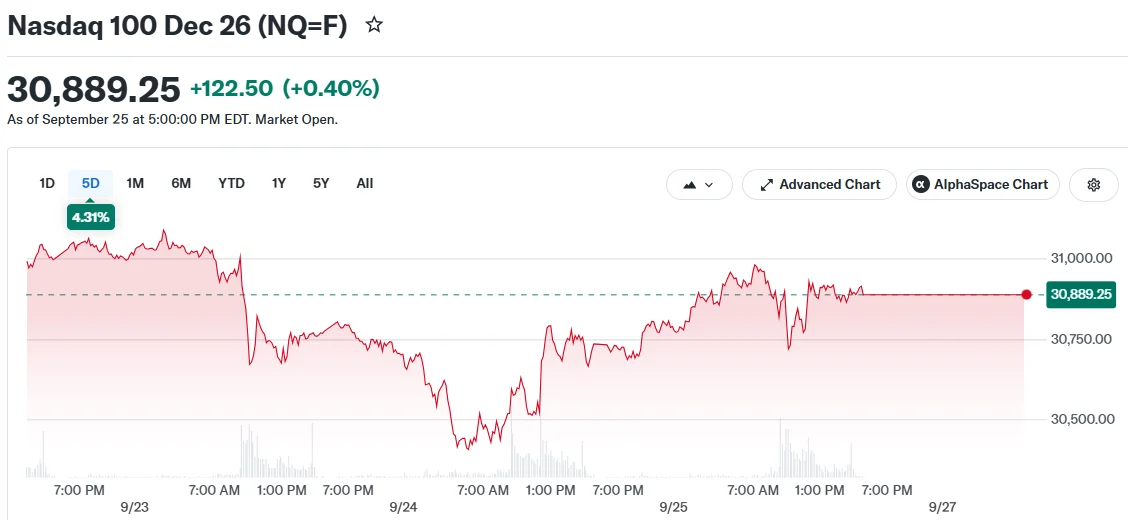
Wall Street enters the week of September 28 with inflation, jobs and a packed corporate earnings calendar in focus, as investors look for fresh signals on the direction of Federal Reserve policy and the health of consumer and business spending.
PCE Inflation Report Is First Since Fed's September Rate Hike
The Bureau of Economic Analysis will release the August Personal Consumption Expenditures price index on Wednesday, September 30. The PCE report is the Federal Reserve's preferred inflation gauge and marks the first inflation reading since the central bank raised interest rates on September 16. Unlike the better-known Consumer Price Index, the PCE index captures a broader slice of household spending — including costs paid on consumers' behalf, such as employer-provided health coverage — and adjusts for substitution as prices shift, a scope that is central to why the Fed treats it as its primary yardstick for inflation.
Core PCE rose 3.3% year over year in the last report, a pace that remains well above the Fed's 2% target. A hotter-than-expected reading could raise the odds of another rate increase in October.
The arrives after a firm stretch for equities. All three major U.S. stock indexes gained last week, the Nasdaq closed near a record high, and the Dow snapped a three-week losing streak.
Jobs Data and Consumer Confidence in Focus
Attention turns to the labor market later in the week. The Conference Board updates its Consumer Confidence Index on Tuesday, September 29. The index slipped in August even though Americans felt slightly better about the job market.
The September jobs report is due Friday, October 2. Economists surveyed by Reuters expect the economy added 100,000 jobs, with the unemployment rate holding at 4.2%. August hiring beat forecasts, though not by enough to change the low-hiring, low-firing pattern seen throughout the year. A stronger-than-expected report could support the case for another Fed rate hike. Labor figures carry that weight because maximum employment sits alongside price stability in the Fed's dual mandate, placing payroll and unemployment data directly in the path of policy decisions.
Consumer sentiment has been under pressure. The University of Michigan survey showed sentiment at its second-lowest level in the survey's 74-year history. Mortgage rates add to the strain, with the 30-year fixed rate climbing to 7.45%, its highest level since January 2025. Household spending accounts for roughly two-thirds of U.S. economic output, which is why swings in consumer mood are watched closely for early signs of strain on growth.
Micron, Carnival, CarMax and Nike Lead Earnings Slate
Results from companies spanning travel, retail, chips, food and consulting will offer a window into consumer and business spending. Earnings Whispers shared the week's reporting calendar on X:
#earnings for the week of September 28, 2026 $MU $NKE $CCL $ACN $CAG $JBL $KMX $AYI $MTN $UEC $IVA $MKC $JEF $CNXC $FDS $PRGS $AIR $SANG $GNS $BSET $ATCH pic.twitter.com/qDjcnxmtyc
— Earnings Whispers (@eWhispers) September 25, 2026
Carnival Corporation kicks off the week's earnings on Monday, September 28. Analysts expect $1.35 per share on revenue of $8.39 billion. Cruise spending held up this summer even as some consumers cut other travel costs.
CarMax reports fiscal second-quarter results on Tuesday. An activist investor pushed the used-vehicle retailer earlier this year to consider price cuts, and the report may show whether that pricing pressure has eased.
Micron Technology reports fiscal fourth-quarter results on Wednesday. Analysts forecast $31.52 per share on revenue of about $51.07 billion. The memory-chip maker is watched closely as a signal of demand tied to AI data centers, where large-scale buildouts depend on substantial amounts of memory hardware.
Nike reports fiscal first-quarter results Wednesday after the close, with analysts expecting $0.44 per share on revenue of $11.33 billion. The company's previous report showed a 12% drop in China sales, a region that has historically ranked among Nike's largest international markets.
McCormick & Company also reports Wednesday. Analysts expect $0.76 per share on revenue near $1.98 billion. The spice maker plans to merge with Unilever.
Accenture reports Thursday, October 1. Analysts expect $3.18 per share on revenue of $18.03 billion. The consulting firm recently signed a five-year AI safety partnership with Anthropic.
Bond Yields and Broader Market Conditions
The 10-year Treasury yield ended last week at 5.17%, while the 30-year yield reached its highest level in more than 20 years.
U.S. 30-Year Treasury Yield closes at 5.49%, the highest level in more than 22 years 🚨 🚨 pic.twitter.com/MyAfEkUceX
— Barchart (@Barchart) September 25, 2026
Longer-dated yields have been climbing, and higher yields make future company earnings less valuable in today's dollars. Treasury yields also serve as the reference rate for borrowing costs across the economy, filtering into mortgages, corporate debt and other forms of credit, which is why their climb resonates well beyond bond markets.
Market breadth has narrowed. Eight of the S&P 500's 11 sectors were negative for September, and an equal-weighted version of the index was down about 4% for the month, a sign that the market's gains have relied heavily on a small group of large technology stocks.
Gold closed near $4,322.40, oil traded near $92.79, and Bitcoin ended the week close to $83,809. The VIX, a measure of expected market volatility, fell to 14.87.
Several companies trade ex-dividend this week, including Cisco Systems, Deere, and Bristol-Myers Squibb — a designation that marks the deadline for new buyers to qualify for those companies' next scheduled dividend payments.
Investors will weigh this week's jobs and inflation data against elevated bond yields to gauge the market's next direction in the sessions ahead.
Source: CoinCentral

