Jobs Report, PCE Inflation and Micron (MU) Earnings Headline Heavy Week for Markets
Key Takeaways
- •The August PCE inflation report, the Federal Reserve's preferred price gauge, arrives Wednesday as the first inflation data since the central bank's September 16 rate hike, and a reading above expectations could boost the case for another increase in October.
- •Economists polled by Reuters anticipate the September employment report will show 100,000 new jobs created, with the unemployment rate projected to hold at 4.2%.
- •The 30-year Treasury yield closed at 5.49%, its highest level in more than two decades, while the 30-year fixed mortgage rate climbed to 7.45%, the highest since January 2025.
- •Micron's fiscal fourth-quarter report, with analysts projecting $31.52 per share in earnings on roughly $51.07 billion of revenue, is positioned as a key indicator of demand tied to AI data center infrastructure.
- •Eight of the eleven S&P 500 sectors posted negative returns in September and the equal-weighted index fell about 4%, showing that market gains have depended heavily on a small group of large-cap technology stocks.
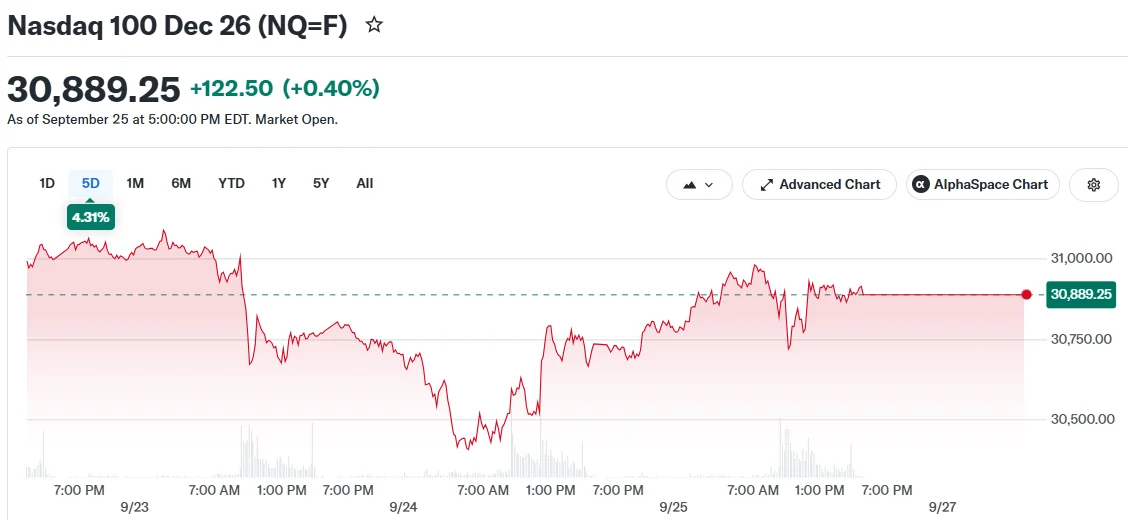
Wall Street begins the new week with attention fixed squarely on inflation metrics, employment figures and a heavy slate of earnings announcements. All three major stock indexes posted gains during the previous week: the Nasdaq finished trading near an all-time high, while the Dow ended a three-week decline. Bond markets remain a defining backdrop, with the 10-year Treasury yield finishing last week at 5.17% and mortgage borrowing costs climbing to their peak levels since January 2025. Among the headline events are the August Personal Consumption Expenditures inflation report, the September employment report and Micron Technology's fiscal fourth-quarter results.
PCE Report Is First Inflation Reading Since September Rate Hike
The Bureau of Economic Analysis will publish the August Personal Consumption Expenditures (PCE) price index on Wednesday. The metric serves as the Federal Reserve's favored measurement of inflation, and this release marks the initial inflation data since the central bank implemented its interest rate increase on September 16. The Fed anchors its 2% objective to this gauge in part because PCE captures a broader range of household spending than the better-known Consumer Price Index and adjusts for the way shoppers substitute between items as prices shift.
The previous report showed core PCE climbing 3.3% on an annual basis, a figure that remains considerably above the Fed's 2% objective. An inflation reading that exceeds expectations could increase the likelihood of an additional rate hike in October, making Wednesday's release a key data point for investors and policymakers alike.
Employment Numbers and Consumer Sentiment Under Scrutiny
Tuesday brings an update to the Conference Board's Consumer Confidence Index. The index experienced a decline in August, despite Americans reporting marginally improved perceptions of employment conditions.
The stakes for these readings are heightened because consumer spending drives roughly two-thirds of U.S. economic activity, so shifts in confidence and hiring feed directly into how investors weigh the durability of household demand.
Friday's September employment report is anticipated to show 100,000 new positions created, according to economists polled by Reuters, with the jobless rate projected to hold steady at 4.2%. While August's hiring numbers exceeded projections, the gain was not substantial enough to alter the pattern of modest hiring and limited layoffs observed throughout this year. A jobs report that surpasses expectations could strengthen arguments for another Federal Reserve rate increase.
Consumer sentiment faces ongoing challenges. The University of Michigan's survey revealed sentiment reaching its second-lowest point in the survey's 74-year existence. Mortgage borrowing costs compound these pressures, with the 30-year fixed rate ascending to 7.45%, its highest level since January 2025.
Quarterly Results From Micron, CarMax, Carnival, Nike and Accenture
Micron Technology unveils its fiscal fourth-quarter performance on Wednesday. Wall Street analysts project earnings of $31.52 per share with revenue totaling approximately $51.07 billion. As a memory chip manufacturer, Micron serves as an important indicator of demand connected to AI data center infrastructure.
#earnings for the week of September 28, 2026 $MU $NKE $CCL $ACN $CAG $JBL $KMX $AYI $MTN $UEC $IVA $MKC $JEF $CNXC $FDS $PRGS $AIR $SANG $GNS $BSET $ATCH pic.twitter.com/qDjcnxmtyc — Earnings Whispers (@eWhispers) September 25, 2026
CarMax announces fiscal second-quarter results on Tuesday. Earlier this year, an activist investor urged the retailer to evaluate price reductions on pre-owned vehicles, and the earnings release may indicate whether pricing pressures have diminished.
Carnival Corporation launches the week's earnings cycle on Monday. Wall Street forecasts $1.35 per share on revenue totaling $8.39 billion. Cruise industry spending remained robust during the summer months, even as some consumers reduced expenditures on alternative travel options.
Nike delivers fiscal first-quarter results Wednesday following market close. Analysts anticipate $0.44 per share with revenue of $11.33 billion. The athletic apparel giant's previous quarterly report revealed a 12% decline in China-based sales.
Accenture releases earnings on Thursday, with analysts projecting $3.18 per share and revenue of $18.03 billion. The consulting giant recently established a five-year AI safety collaboration with Anthropic.
McCormick and Company also announces results on Wednesday, with expectations of $0.76 per share on revenue approaching $1.98 billion. The spice manufacturer is planning a merger with Unilever.
Read against sentiment sitting near the lows of the University of Michigan's 74-year record, this cluster of consumer-facing reports offers a company-level gauge of where household spending is holding firm and where it is softening.
Treasury Yields and the Overall Market Environment
The 10-year Treasury yield concluded last week's trading at 5.17%, while the 30-year yield hit its highest point in over two decades, closing at 5.49% according to Barchart. Elevated yields diminish the present value of companies' future earnings streams.
U.S. 30-Year Treasury Yield closes at 5.49%, the highest level in more than 22 years pic.twitter.com/MyAfEkUceX — Barchart (@Barchart) September 25, 2026
Eight of the eleven sectors within the S&P 500 posted negative returns for September. An equally weighted calculation of the index declined approximately 4% during the month, illustrating how market advances have depended heavily on a limited number of large-cap technology companies.
Gold settled near $4,322.40, crude oil traded around $92.79, and Bitcoin concluded near $83,809. The VIX, which measures anticipated market volatility, dropped to 14.87.
Multiple corporations go ex-dividend during this week, including Cisco Systems, Deere and Bristol-Myers Squibb. Market participants will evaluate this week's employment and inflation releases alongside elevated bond yields to determine the market's trajectory ahead, while results from companies spanning memory chips, consulting, travel and consumer staples will show how corporations are managing through the same conditions.

