Stock Futures Slide as Middle East Tensions and Fed Hawkishness Weigh on Markets
Key Takeaways
- •U.S. military strikes on two Iranian rocket launchers on Larak Island in the Strait of Hormuz prompted Iranian retaliation against American positions in Jordan and a commercial tanker, sending Brent crude up 2.3% to $90.17 per barrel.
- •Fed Chair Kevin Warsh's Jackson Hole remarks suggesting markets underestimate inflation lifted the implied probability of a September rate increase from roughly 40% to between 57% and 60%, according to CME FedWatch data.
- •Dow, S&P 500, and Nasdaq-100 futures each declined about 0.2% in Monday's pre-market session, with the Dow slipping 85 points.
- •Barclays now expects 25 basis point rate hikes at both the September and December FOMC meetings, while two-year yields hit multi-year highs in Japan and Germany, signaling a global repricing toward higher rates.
- •Despite Monday's weakness, August has been positive overall, with the Dow up 2%, the S&P 500 up nearly 3%, and the Nasdaq up about 4%, ahead of key jobs data and earnings from Broadcom and Dell.
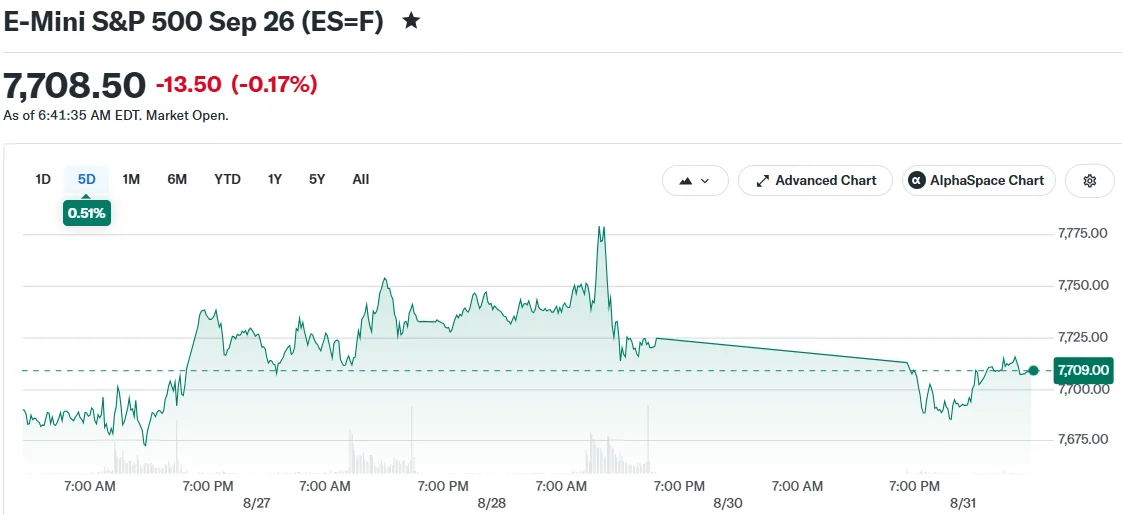
Major U.S. equity index futures fell during Monday's pre-market session as heightened geopolitical tensions in the Middle East converged with increasingly hawkish Federal Reserve policy signals, unsettling investors on the month's final trading day.
Futures tied to the Dow Jones Industrial Average slipped 85 points, a 0.2% decline, while both S&P 500 and Nasdaq-100 futures also retreated 0.2% in early morning trading. The pullback follows a strong month for equities, leaving markets balancing solid August gains against two emerging sources of risk.
Crude Prices Jump Following Military Action Against Iran
American military forces conducted strikes over the weekend targeting two Iranian rocket launching facilities on Larak Island, located within the strategically vital Strait of Hormuz. Tehran retaliated with attacks on U.S. military positions in Jordan and claimed responsibility for striking a commercial tanker in regional waters.
BREAKING: U.S. official, speaking to Axios: "Earlier today U.S. forces struck two Iranian launchers on Larak Island. Islamic Revolutionary Guard Corps forces were observed preparing to launch rockets with sea mines into Strait of Hormuz." Source: @BarakRavid, Axios,… pic.twitter.com/xyAh2PNU6Z — Mario Nawfal (@MarioNawfal) August 30, 2026
President Trump announced via social media that Iran's primary oil export facility on Kharg Island was being "blown to smithereens," although no official military sources have verified the assertion.
Brent crude advanced 2.3% to reach $90.17 per barrel, and West Texas Intermediate gained 2.3% to settle at $85.32. Because the Strait of Hormuz serves as a critical global energy transportation corridor — roughly a fifth of globally traded oil passes through it — any potential disruptions typically trigger swift market reactions. Sustained higher oil prices also feed into broader inflation concerns, compounding the pressure markets are already feeling from the Fed's policy posture.
Rate Hike Expectations Soar Following Warsh Remarks
Federal Reserve Chair Kevin Warsh, speaking at the annual Jackson Hole symposium last Friday, indicated that market participants may be underestimating persistent inflation threats. His comments dampened expectations for monetary easing while raising the likelihood of additional tightening. Jackson Hole, the Federal Reserve's annual economic policy symposium held in Wyoming, has historically served as a venue for Chairs to signal shifts in monetary policy direction.
Financial markets reacted immediately. The implied probability of a September interest rate increase jumped from roughly 40% one week earlier to between 57% and 60% by Monday's opening, according to CME FedWatch tool data.
Barclays analysts revised their forecast to anticipate 25 basis point rate increases at both the September and December Federal Open Market Committee meetings. JPMorgan's lead U.S. economist described the September gathering as "live" while still expecting the initial hike to occur in December.
Two-year Treasury note yields stabilized at 4.34% after a sharp 12 basis point surge on Friday. Japan's equivalent 2-year government bond yield touched a 31-year peak, and Germany's 2-year yield climbed to levels not seen since July 2024, indicating the repricing toward higher rates is a global phenomenon rather than a U.S.-only shift.
Elevated interest rate projections typically weigh on equity valuations, particularly for growth-oriented and technology sector stocks, which accounts for Monday's early session weakness.
Despite Monday's retreat, August has delivered positive performance overall. The Dow has climbed 2% during the month and appears positioned for a fifth consecutive monthly advance. The S&P 500 has appreciated nearly 3%, while the Nasdaq has registered gains of approximately 4%.
Critical employment data releases are scheduled for this week, including Tuesday's JOLTS Job Openings report and Friday's comprehensive U.S. Employment Report — readings that will shape expectations for the Fed's September decision. Quarterly earnings announcements from Broadcom and Dell Technologies will also draw attention as investors assess ongoing artificial intelligence infrastructure investment trends.
Gold declined 0.3% to $4,437 per ounce but holds gains of approximately 10% for August, a move that has coincided with the month's geopolitical escalation, as gold is traditionally viewed as a haven asset during periods of uncertainty.
