Polymarket Odds Put Feijóo Near 80% as Sánchez Sets Snap Spanish Election for November 29
Key Takeaways
- •Pedro Sánchez announced the November 29 election on October 5 after his minority government’s housing measures were rejected by Parliament.
- •Polymarket snapshots placed Alberto Núñez Feijóo at roughly 80%–82% and Sánchez at about 18%–19% to become prime minister.
- •Cited polling showed the People’s Party at 31.3%, PSOE at 26.9%, Vox at 19.4%, and SUMAR at 6.3%.
- •A possible PP-Vox coalition was projected to hold 203 of the 350 lower-house seats in a Sigma Dos poll reported by Reuters.
- •The prediction-market prices are trader-implied probabilities that can change and do not guarantee the election result or the formation of the next government.
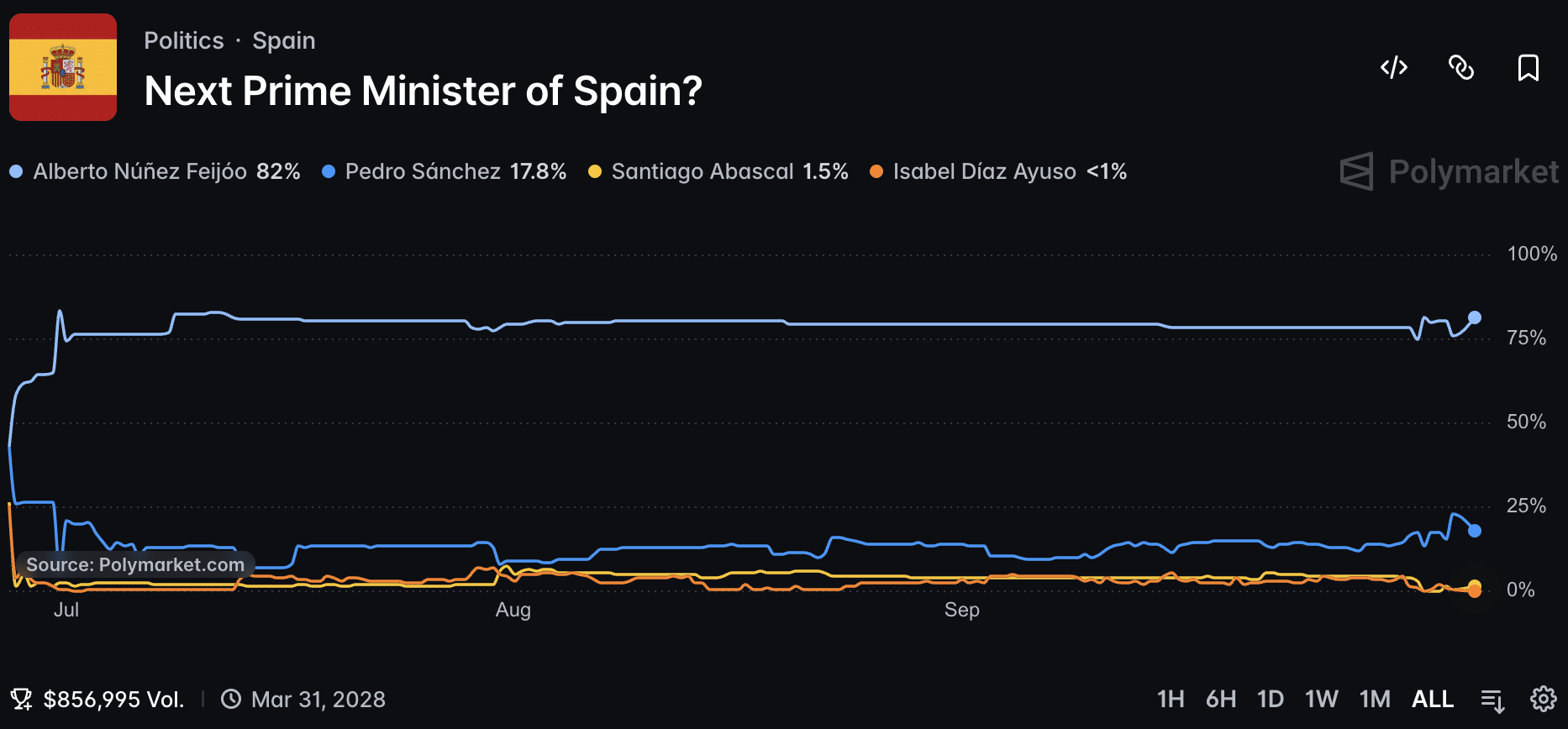
Spanish election Polymarket odds are live after Prime Minister Pedro Sánchez called Spain's next general election early, setting a snap contest for November 29, and a market snapshot on Polymarket, the crypto-based prediction market platform, placed opposition leader Alberto Núñez Feijóo at roughly 80% to become the country's next prime minister.
That price is a trader-implied probability, not a poll result and not a guarantee. The election remains weeks away, and Spain's parliamentary process means the next prime minister is not determined automatically by whoever wins the most votes. (Source: Polymarket)
Supplied market summaries placed Feijóo at roughly 80%–82% and Sánchez at roughly 18%–19%. Those readings are separate snapshots rather than a single fixed set of odds. Market prices are often read as probabilities, much as a temperature gauge provides a quick signal without explaining every cause behind it. That distinction between market prices and polling is central to interpreting Polymarket's implied probabilities.
Why Pedro Sánchez Called an Early Election
Sánchez announced the vote on October 5, shortly after Parliament rejected housing-relief measures proposed by his minority government. The Spanish government's official announcement confirmed the November 29 election date.
NEW: Pedro Sánchez has announced a snap general election for November 29
Here's what the latest opinion polls project, compared with the 2023 election:
PP – 31.3% (-1.8) | 129 (-8) PSOE – 26.9% (-4.8) | 106 (-15) VOX – 19.4% (+7.0) | 69 (+36) SUMAR – 6.3%…
— Politics Global (@PolitlcsGlobal) October 5, 2026
The polls cited in that post put the conservative People's Party (PP) first on 31.3%, with Sánchez's Spanish Socialist Workers' Party (PSOE) on 26.9%, Vox on 19.4%, and SUMAR on 6.3%, alongside projected seat counts in the 350-seat chamber.
Housing has become a major political pressure point in Spain. The government said more than 70,000 people attended a housing protest in Madrid, while Idealista figures cited in the primary coverage show that average rents have almost doubled over the past decade and asking home prices have risen about 90%.
The election call therefore gives Sánchez a chance to put housing, and his government's response to it, before voters, but it also follows a conspicuous parliamentary setback. The vote will test whether that issue can strengthen support for his progressive coalition or whether dissatisfaction over housing costs helps the opposition.
What the Odds Say About the Likely Next Government
Spanish election Polymarket odds must be read against the mechanics of a parliamentary system: the outcome depends not only on the popular vote but also on whether a candidate secures an investiture vote, the parliamentary step in which a nominee must win the chamber's approval to form a government. A party can lead the vote count without having a clear path to govern. Between election day and a new government, the markers to watch include the allocation of the chamber's 350 seats, post-election coalition negotiations, and the investiture vote itself.
Conventional polling cited in the primary coverage points to a possible coalition led by the conservative People's Party (PP), with support from Vox. Reuters reported that a Sigma Dos poll published in El Mundo projected 203 combined seats for PP and Vox in the 350-seat lower house. Such a coalition would bring Vox into central government for the first time since the death of dictator Francisco Franco.
That backdrop helps explain why traders have priced Feijóo ahead, but prediction markets are not polling averages. Their prices can move as new information arrives, and a market outcome depends on the contract's resolution terms as well as on the political process. The odds are a snapshot of traders' positions, not a settled verdict on the Spanish election, and the displayed percentage should be treated as a live market reading rather than a forecast.
Spain's government is trying to pass the SAME housing measures parliament already rejected…
Last week, lawmakers voted down decrees including rent caps, eviction protections, and limits on corporate home purchases.
The defeat helped trigger Pedro Sánchez's decision to… pic.twitter.com/eZwozNVPGW
— Mario Nawfal (@MarioNawfal) October 6, 2026
Traders Should Read the Current Polymarket Price
A price near 80 cents on a contract that pays $1 if the event occurs is commonly interpreted as an implied probability near 80%, before accounting for trading costs and other market frictions. The number does not mean that polling gives Feijóo an 80% vote share. The distance between Feijóo's roughly 80% market price and the PP's 31.3% polling figure cited above captures the distinction: the contract prices his chance of ending up as prime minister, which can hinge on coalition arithmetic, rather than his party's vote share. Readers comparing political contracts can apply the same distinction between a market snapshot and an official forecast when looking at Brazil election odds or Senate election markets.
These odds are informational, subject to volatility, and not investment advice. They do not guarantee who will win the November 29 vote or who will ultimately become prime minister. The price can change as polling, campaign developments, and coalition prospects evolve in the weeks before Spaniards head to the polls.

