SpaceX Stock Slides as Credit Risk Hits Record on $40 Billion Debt Plan
Key Takeaways
- •SpaceX stock closed down 2.51% at $167.60 on Oct. 7 after touching $176.42 in the previous session.
- •The spread on SpaceX's five-year credit default swaps rose to 194 basis points, up from 110 basis points when the contracts debuted in June.
- •SpaceX is reportedly in talks with Apollo Global Management for $40 billion in financing, including $10 billion in syndicated loans, to fund Nvidia chip purchases.
- •Second-quarter capital expenditure exceeded $18 billion, a more than sixfold increase from the same quarter last year, with most spending directed at the AI business.
- •Analysts on average expect revenue to exceed $45 billion this year and reach $114 billion next year, with Google paying $950 million monthly and Anthropic more than $1.5 billion monthly.
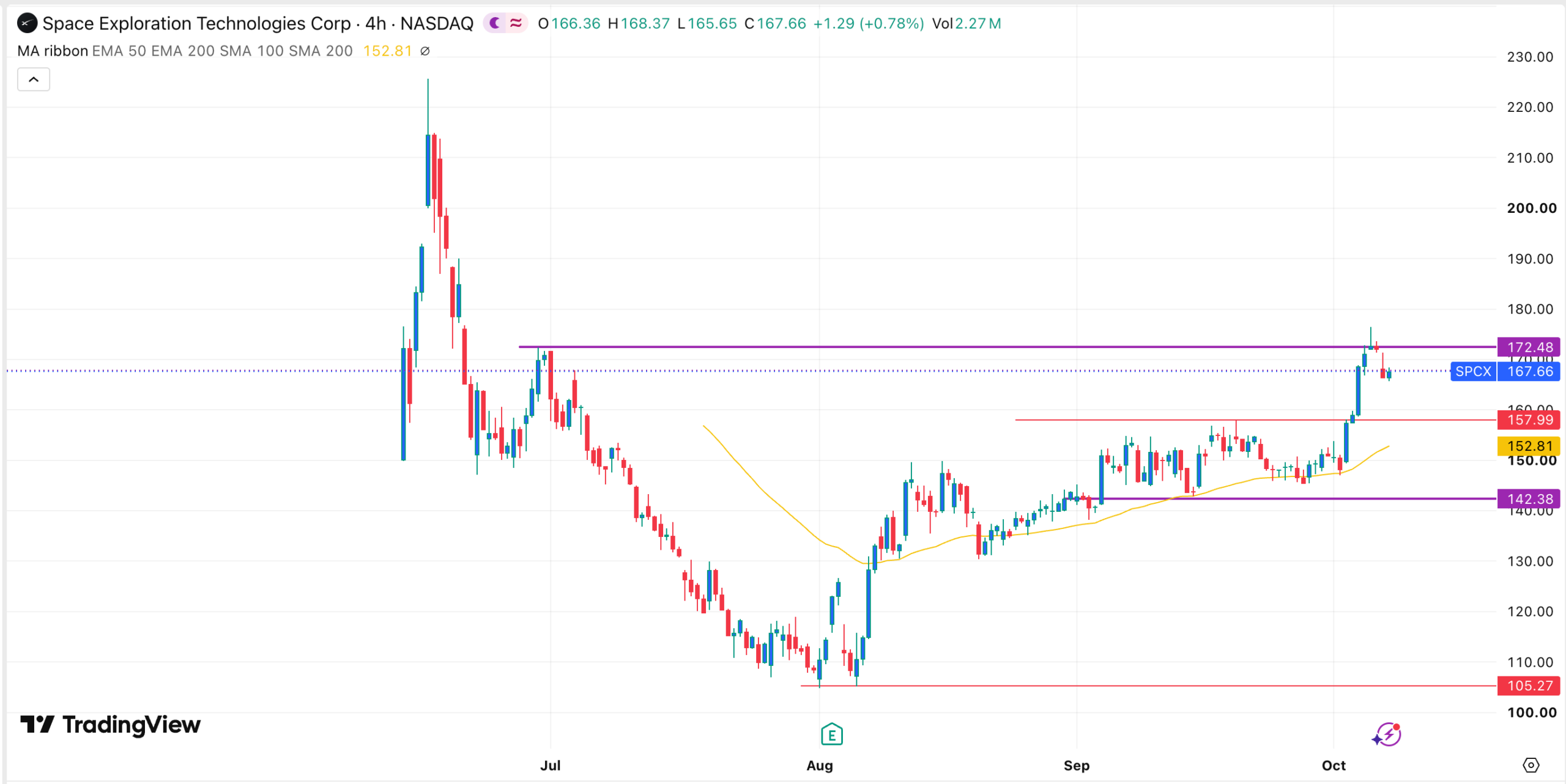
SpaceX shares pulled back on Oct. 7 as investors reacted to the company's latest artificial intelligence financing plans, with credit-default-swap spreads climbing to their highest level since the contracts began actively trading in June.
Space Exploration Technologies (SPCX) closed at $167.60, down 2.51%, after touching $176.42 in the previous session. The decline coincided with a sharp increase in SpaceX credit risk, as bond investors pushed back on the company amid reports of a $40 billion debt raise to fund purchases of Nvidia chips.
Credit Default Swap Spreads Hit Record
The spread on SpaceX's five-year credit default swaps jumped to 194 basis points on Wednesday, meaning it now costs about $19,400 annually to protect $1 million of the company's debt against default. The contracts began trading at 110 basis points and have been in a strong upward trend since. Credit default swaps function much like insurance on a borrower, so the widening spread offers a running, market-based read on how much default risk bond investors currently assign to SpaceX — a gauge that has moved steadily higher since the contracts debuted.
The surge followed a Financial Times report that SpaceX is in talks with Apollo Global Management for $40 billion in financing to buy Nvidia chips. Of the total, $10 billion would come through syndicated loans — debt supplied by a group of lenders sharing the exposure — with the remainder issued as investment-grade bonds, a rating tier generally associated with lower borrowing costs than high-yield debt.
Spending Spree Since the IPO
The prospective raise would extend a heavy run of financing and acquisitions. SpaceX went to the debt market shortly after its IPO, raising about $20 billion and lifting cash on hand to roughly $100 billion. It also acquired Cursor, an AI coding startup, for $60 billion.
Capital expenditure rose to more than $18 billion in the second quarter, up from $10 billion in the first quarter and $2.8 billion in the same quarter last year — a more than sixfold year-over-year increase that gives a sense of the scale behind the proposed $40 billion raise. Most of that spending is directed at SpaceX's artificial intelligence business, which comprises data center and Grok solutions.
In addition to widening credit spreads, SpaceX bond yields have climbed this month. Bonds expiring in 2056 now yield 7.9%, while those maturing in 2046 rose to 7.92%. The spread over U.S. government bonds — the premium investors demand to hold the company's debt rather than Treasuries — has jumped by 1.76% since June.
Revenue Growth Seen Offsetting Risks
Elon Musk and his team are betting that expected revenue growth will justify the ongoing spending. Analysts are optimistic that the company has room to grow: the average estimate calls for annual revenue to exceed $45 billion this year, rising to $114 billion next year.
SpaceX has already secured major AI business, including from Google, which is paying it $950 million a month, while Anthropic pays more than $1.5 billion a month.
Some analysts are more bullish. Goldman Sachs projects revenue will scale to $474 billion by 2030, supported by its Starlink and data center businesses, while Morgan Stanley sees revenue soaring past $330 billion in 2030. Both firms participated in the company's IPO in June.
SpaceX also has a large equity base supporting its borrowing. With a market capitalization of more than $2.27, the company could readily sell shares to raise cash if its debt came under substantial pressure.
Against that backdrop, the near-term markers to watch are concrete: whether the talks with Apollo produce a finalized package and on what terms, how the record-wide credit spreads settle once the structure is known, and whether upcoming quarterly disclosures show the AI contracts already on the books — including the monthly payments from Google and Anthropic — scaling toward the revenue levels analysts project.
Technical Analysis
The four-hour chart shows SPCX has performed well over the past few days. The stock recently made a strong bullish breakout above the key resistance level of $157.9 — its highest level on September 21 — and has remained above the 50-period moving average, which is a bullish sign.
However, it also formed a shooting star candlestick on October 6, which explains the current pullback. According to the analysis, the most likely scenario is a drop to $160, followed by a resumption of the upward trend.
This article is for informational purposes only and does not constitute financial or investment advice. Credit spreads, bond prices, analyst forecasts, and technical levels may change as market conditions evolve.
This article originally appeared on The Market Periodical.

