Anthropic Launches Cheaper Claude Haiku 5.5 to Complete Its Model Lineup Ahead of Planned IPO
Key Takeaways
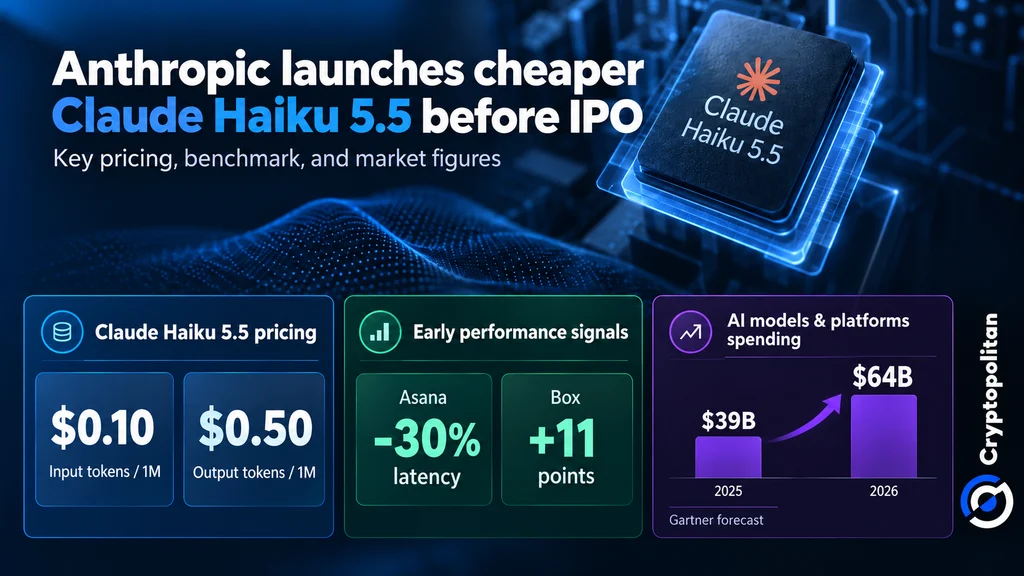
- •Claude Haiku 5.5 is on average about 75% cheaper than Haiku 4.5, with pricing of $0.10 per million input tokens and $0.50 per million output tokens for requests up to 100,000 tokens.
- •Ramp's summer report covering more than 70,000 businesses found that Anthropic has surpassed OpenAI in adoption among US business customers.
- •A World Economic Forum analysis of 44 supplier invoices showed a mid-level AI model handled every task while a more powerful model completed only 91% of them.
- •Anthropic's prospectus revealed 2025 revenue of nearly $4.6 billion, a twelvefold increase, alongside an $8.06 billion operating loss and $518 billion in future cloud and infrastructure commitments.
- •Provider switching among businesses reached a record 8% in September, and 52% of companies using Anthropic or OpenAI are customers of both.
Anthropic released Claude Haiku 5.5 on October 7, adding the final piece to its three-model lineup alongside Sonnet 5.5 and Opus 5.5. The new model is aimed at helping users with day-to-day work processes as organizations search for ways to bring down the cost of using AI, and it arrives as Anthropic prepares for its initial public offering. With the release, the company now fields offerings at three distinct points on the price capability curve — a structure that lets organizations match each model to the complexity of the work at hand rather than defaulting to the most capable option for every job.
Priced to run at scale
According to Anthropic, Haiku 5.5 is on average approximately 75% cheaper than Haiku 4.5. For requests of up to 100,000 tokens, pricing stands at $0.10 per million input tokens and $0.50 per million output tokens. The model targets everyday tasks, including summarization, classification, database queries, and actions performed by AI agents.
Anthropic has also lowered cache-read costs for Sonnet 5.5 — the reduced rate charged when an application reuses context the model has already processed. In launch testimonials, Asana said it had reduced latency by more than 30%, while Box showed improvement of 11 points over version 4.5.
A market growing 63% a year
The launch reflects a market in which businesses are rapidly increasing their spending on AI. According to Gartner, spending on AI models and platforms is estimated to rise by more than 60% this year, from $39 billion in 2025 to $64 billion.
As AI spending grows, companies are becoming more selective about where they invest. A September study by BCG found that nearly half of businesses are already seeing value returns from AI, increasing the pressure on providers to charge reasonable prices while improving results.
Why the biggest model isn't always the pick
The most powerful model is not necessarily the best choice for every task. In an analysis published by the World Economic Forum on August 27 involving 44 supplier invoices, a mid-level AI solution was able to handle all of the invoices, while a more powerful solution completed only 91% of them. The findings suggest that a model's suitability for the task matters more than its ranking. As Cryptopolitan reported, competition is increasingly shifting beyond benchmark scores toward the cost of completing a task. Haiku 5.5, with its focus on everyday work, sits squarely inside that contest.
Gaining on OpenAI, but loyalty is thin
Anthropic has been building ground among business customers. Ramp's summer report, which examined the spending of more than 70,000 businesses, indicates that Anthropic has surpassed OpenAI in adoption in the US market.
Maintaining that lead may prove difficult, however. More than half of businesses using Anthropic or OpenAI (52%) are customers of both providers. Ramp's separate research shows that provider switching reached a record 8% in September, suggesting that businesses are increasingly comfortable moving between competing AI services — an environment in which pricing decisions carry direct competitive weight.
The question before the IPO
Lower prices could help Anthropic attract new customers and encourage existing ones to use its models more often. That strategy could strengthen its position ahead of a possible IPO, but the company still needs to demonstrate that growing demand can translate into sustainable profits.
Anthropic is targeting a public listing after the November 2026 US midterm elections, although no firm date has been announced. A September 28 Reuters report said the offering could value the company at more than $2 trillion. Its prospectus also revealed the financial pressures behind that valuation: revenue surged twelvefold to nearly $4.6 billion in 2025, but Anthropic recorded an operating loss of $8.06 billion and disclosed $518 billion in future cloud, computing, and infrastructure commitments.
Those figures reflect the enormous resources required to develop and operate advanced AI systems, and they raise the stakes for Anthropic's lower-cost model strategy. Cheaper models may encourage wider adoption, but higher usage must eventually generate enough revenue to cover the company's growing expenses. As Anthropic prepares to go public, the central question is whether it can achieve sustainable profits while continuing to invest heavily in AI infrastructure.

