SpaceX Stock Slips 17.2% From October High Ahead of Oct. 20 Earnings
Key Takeaways
- •SpaceX stock closed at $146.03 on Oct. 16, down 17.2% from its October high of $175, ahead of third-quarter earnings scheduled for Tuesday, Oct. 20.
- •Second-quarter revenue surged 92% to $7.8 billion, led by Starlink's $429 billion with active users surpassing 12 million, though the company posted a net loss of $143 million.
- •Analysts expect third-quarter revenue to reach $13 billion, with the most optimistic estimate at $15.19 billion, supported by funding including more than $925 million monthly from Google, $125 million from Reflection AI, and $1.2 billion from Anthropic.
- •SpaceX reportedly spent $8 billion acquiring US spectrum to compete with AT&T, T-Mobile, and Verizon, and is raising $40 billion, including $10 billion in bank debt, to purchase Nvidia chips for its data center ambitions, even as investors demand higher interest on existing bonds.
- •Technical analysis indicates the shares may fall further toward the 61.8% Fibonacci retracement level at $132, where the RSI could reach oversold territory, before potentially rebounding to the October high of $175.
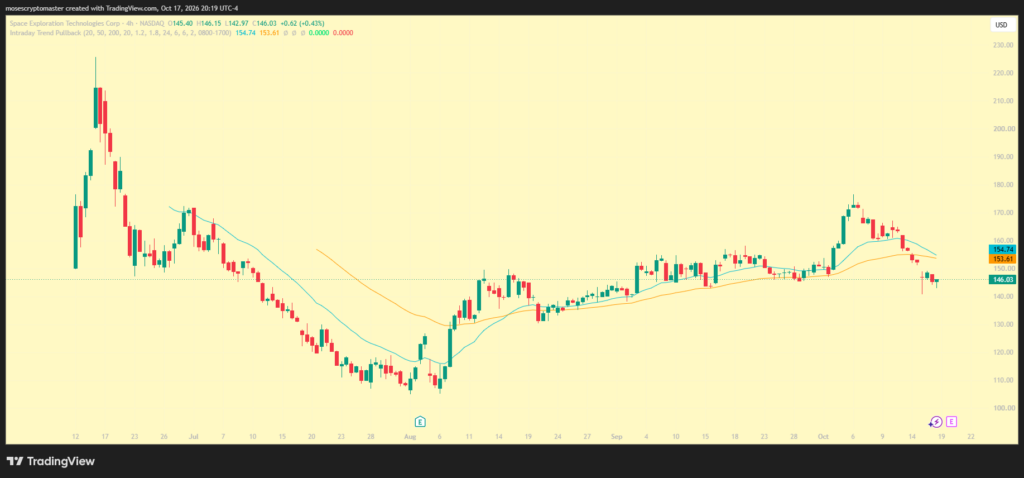
SpaceX shares have moved into a local correction, falling 17.2% from their October high ahead of the company's third-quarter earnings announcement. The stock closed at $146.03 on Oct. 16, extending a pullback that began after the Oct. 6 of $175.
The retreat comes as investors reassess SpaceX's rapidly expanding artificial intelligence infrastructure spending. The company also faces growing scrutiny over its borrowing requirements and the returns generated by new computing capacity. Even so, its latest financial statements showed substantial revenue growth across connectivity and AI operations, and Tuesday's report will test whether that expansion is translating into stronger financial performance.
Third-Quarter Results Due Tuesday
The next major catalyst for SpaceX stock is the earnings report due Tuesday, Oct. 20, which is expected to provide more insight into the company's growth trajectory.
The most recent quarterly results showed revenue surging 92% in the second quarter to $7.8 billion. Starlink drove the bulk of that figure, with segment revenue soaring to $4.29 billion as active users surpassed 12 million. The AI business followed with $2.5 billion in revenue, while the space launch service generated $962 million. Despite the top-line strength, SpaceX posted a net loss of $143 million, with the AI and space businesses losing $1.25 billion and $542 million, respectively.
Analysts are optimistic that the business will keep thriving in the third quarter, driven by the AI segment. Consensus expectations call for revenue to jump to $13 billion, with the most optimistic analyst predicting $15.19 billion. Much of that anticipated growth reflects substantial funding from top companies in the AI space: SpaceX is receiving more than $925 million a month from Google, $125 million from Reflection AI, and $1.2 billion from Anthropic. When the numbers land, key figures to watch include whether Starlink's subscriber momentum holds, whether AI revenue scales toward the consensus figure, and whether the overall net loss narrows from the second quarter's $143 million.
Results Land Amid Major Strategic Moves
The report arrives at a time when SpaceX is making significant moves. The company recently spent a reported $8 billion acquiring spectrum in the US, positioning it to become a major name in the telecommunications industry and compete with AT&T, T-Mobile, and Verizon. Analysts believe the move could add billions of dollars in revenue, though building the required infrastructure in urban areas will take many years, and the spending could exacerbate its free cash flow issues.
SpaceX is also raising $40 billion to buy Nvidia chips as it seeks to become a major player in the data center industry. The raise consists of $10 billion in bank debt, with the remainder in investment-grade bonds. In response, investors have continued to demand higher interest on the company's existing bonds, a shift that enlarges the debt-service burden accompanying the buildout.
The company has also made major progress in its Starship trial, an important step toward deploying the most advanced models of its Starlink satellites, which will offer faster download and upload speeds.
The results also come as the company faces headwinds from ongoing AI bubble fears. In a recent report, Gartner predicted that neocloud and other data center companies will need to report billions of dollars in impairments, the accounting write-downs that reduce the recorded value of assets and weigh on reported earnings. SpaceX would be affected if that happens.
Technical Analysis
The four-hour chart shows that SpaceX stock formed a small shooting star candlestick pattern on October 6 and then began moving downward. The shares have since dropped below the 38.2% Fibonacci retracement level, and the Relative Strength Index has continued falling toward the oversold level.
The stock has also fallen below the 25-period Exponential Moving Average (EMA). The most likely outlook, according to the analysis, is a further decline toward the 61.8% retracement level at $132, followed by a rebound. Such a retreat would give the RSI a chance to reach the oversold level of 30. Eventually, the stock may rebound to the October high of $175.
This article is for informational purposes only and does not constitute financial or investment advice. Stocks can experience substantial volatility and capital losses. Investors should conduct independent research and consult a qualified financial adviser before making investment decisions.
This article originally appeared on The Market Periodical.

