SpaceX Stock Near $149 as Starship V3 Test Highlights Cost Risks
Key Takeaways
- •Starlink V3 satellites weigh about 2,000 kilograms and are too large for Falcon 9, requiring Starship for deployment.
- •Starlink generated more than $4.29 billion in second-quarter revenue, equal to 53% of SpaceX’s total revenue.
- •SpaceX reported over $18 billion in second-quarter capital expenditures, with more than $15 billion allocated to its AI business.
- •The company held more than $100 billion in cash and marketable securities, including $85.7 billion raised through its IPO.
- •Technical analysis identified a rising wedge and bearish divergence in SPCX stock, with a potential downside target near $120.
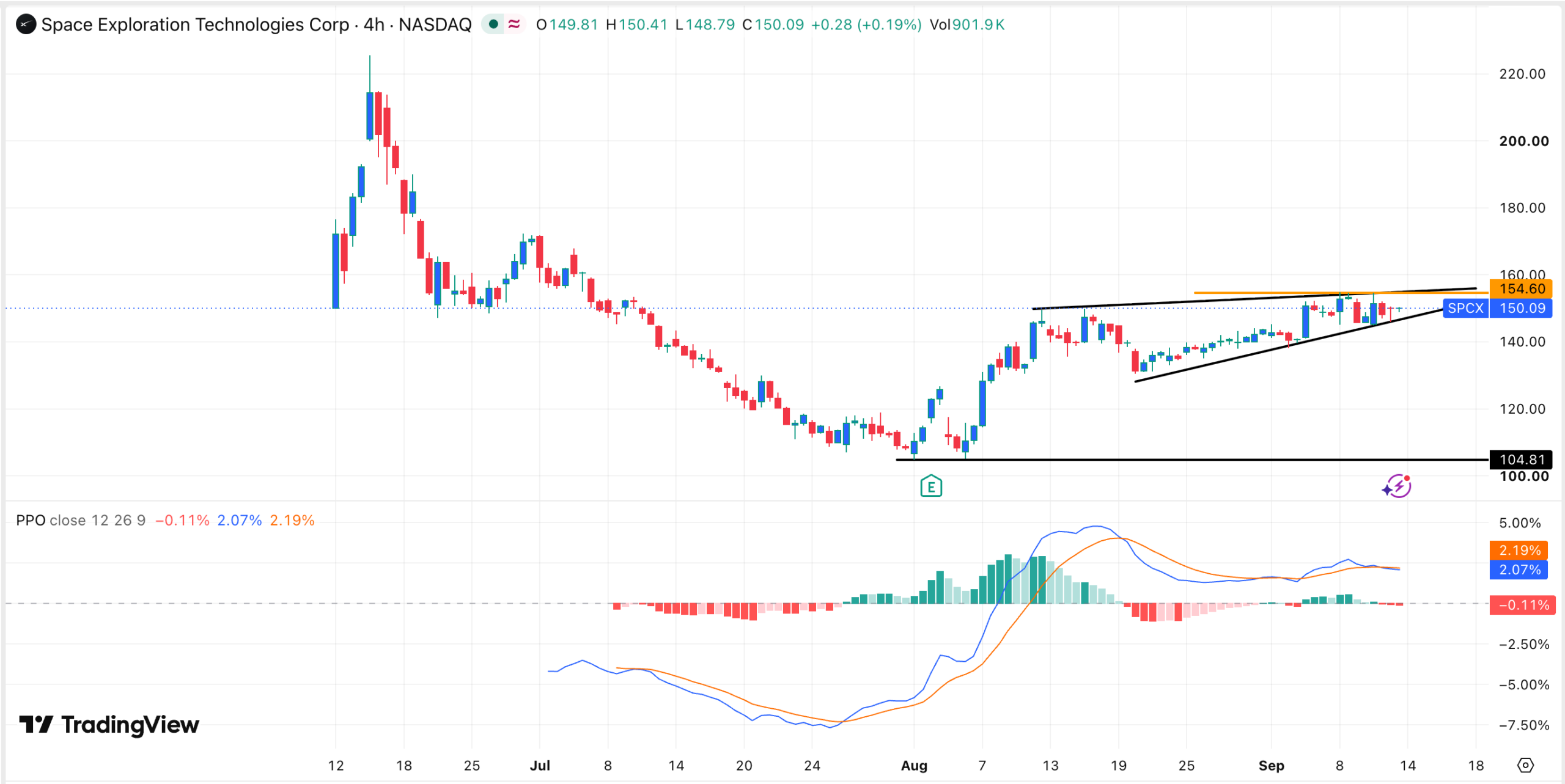
SpaceX stock traded near $149 on Sept. 11 as the company approached another major Starship milestone while facing substantial spending requirements. The SPCX stock remained below its recent September high and had settled into a relatively narrow range after significant volatility since its June IPO.
The upcoming Starship V3 test and the pace of spending on AI infrastructure are two major near-term developments for the company. SpaceX’s operating businesses continue to expand, led by Starlink connectivity and a growing AI segment. However, its latest SEC filing showed that quarterly capital expenditures exceeded $18 billion, underscoring the cost of funding rockets, satellites and data centers at the same time. Technical indicators also suggest that the stock is approaching an important decision point.
SpaceX Focuses on Starlink V3 and Starship
Next week is expected to be important for SpaceX as it conducts the Starlink V3 launch. Starlink V3 is the third-generation Starlink satellite, designed to launch aboard Starship rather than Falcon 9.
The new satellites require Starship because each weighs about 2,000 kilograms, more than three times the weight of a second-generation satellite. Starlink V3 will be capable of supporting up to 1 Tbps of downlink capacity and 160 Gbps of uplink capacity. The uplink figure is 24 times that of a V2 mini satellite.
SpaceX plans to launch the V3 satellite next week ahead of the eventual operational launch. The satellite will be carried by Starship, the same vehicle that Elon Musk hopes will eventually help the company deploy data centers on Mars. An iteration of the spacecraft is also intended to ferry humans to the Moon and Mars in the future.
These developments are significant for SpaceX’s broader business. The company’s latest results showed that Starlink, part of its connectivity segment, generated more than $4.29 billion in the second quarter, representing 53% of total revenue.
Rising Capital Expenditures Across SpaceX Businesses
The planned developments come with elevated costs. In its latest earnings report, SpaceX said its capital expenditures rose to more than $18 billion in the second quarter. Most of that spending was allocated to its AI business, which includes tools such as Grok and its data centers. The AI business accounted for more than $15 billion of capex.
Capital expenditures also increased in the company’s space and Starlink businesses, reaching $1.17 billion and $1.3 billion, respectively. The spending contributed to the company’s loss in the latest quarter.
SpaceX nevertheless has substantial liquidity on its balance sheet, with more than $100 billion in cash and marketable securities. That amount includes the $85.7 billion raised in its initial public offering (IPO), along with separate funding from a bond sale.
Analysts also expect SpaceX’s revenue growth to accelerate. Yahoo Finance data shows that analysts forecast annual revenue of $44.7 billion, driven by the artificial intelligence industry. The company generated more than $18 billion last year, while analysts expect annual revenue to exceed $106 billion next year. The projected growth is expected to come from the AI and Starlink businesses.
SPCX Technical Analysis
On the daily chart, SPCX stock has remained within a narrow range over the past several weeks. A closer review shows what the source describes as major bearish chart patterns, including a rising wedge whose two trend lines are approaching confluence.
The stock has also developed bearish divergence, a pattern that occurs when an oscillator declines while the asset price moves higher. In this case, both the Percentage Price Oscillator (PPO) and the Relative Strength Index (RSI) are falling.
The setup could therefore precede a bearish breakout, with a potential move toward $120, according to the technical analysis described in the source.
This article is for informational purposes only and should not be considered financial or investment advice. Equity markets remain volatile. Readers should conduct independent research before making investment decisions.
Source: The Market Periodical

