SpaceX Stock Eyes Starship Flight 14 as Musk Raises AI Ambitions
Key Takeaways
- •Elon Musk predicted that Grok will soon field the industry's most advanced models and surpass Anthropic and OpenAI, even though the platform currently holds below 20% AI market share and its leading model has a 500k context window smaller than' offerings.
- •SpaceX's AI revenue surged to more than $2.56 billion from $818 million in the prior-year period, supported by computing agreements including a newly signed $1.1 billion-a-month deal with an unnamed company.
- •Wells Fargo raised its SPCX price target to $212 and Pivotal Research lifted its target to $220, both well above the stock's recent trading level near $148.
- •Starlink connectivity revenue jumped to $4.29 billion from $3.2 billion as customers surpassed 12 million, and the third version of Starlink satellites is scheduled for a major test aboard Starship Flight 14 on Sept. 28.
- •Polish officials said a fire at a Starlink station was deliberate sabotage likely carried out by Russian entities attempting to disrupt service to Ukraine, and Denmark separately warned that Russia was considering hybrid attacks that could also affect SpaceX.
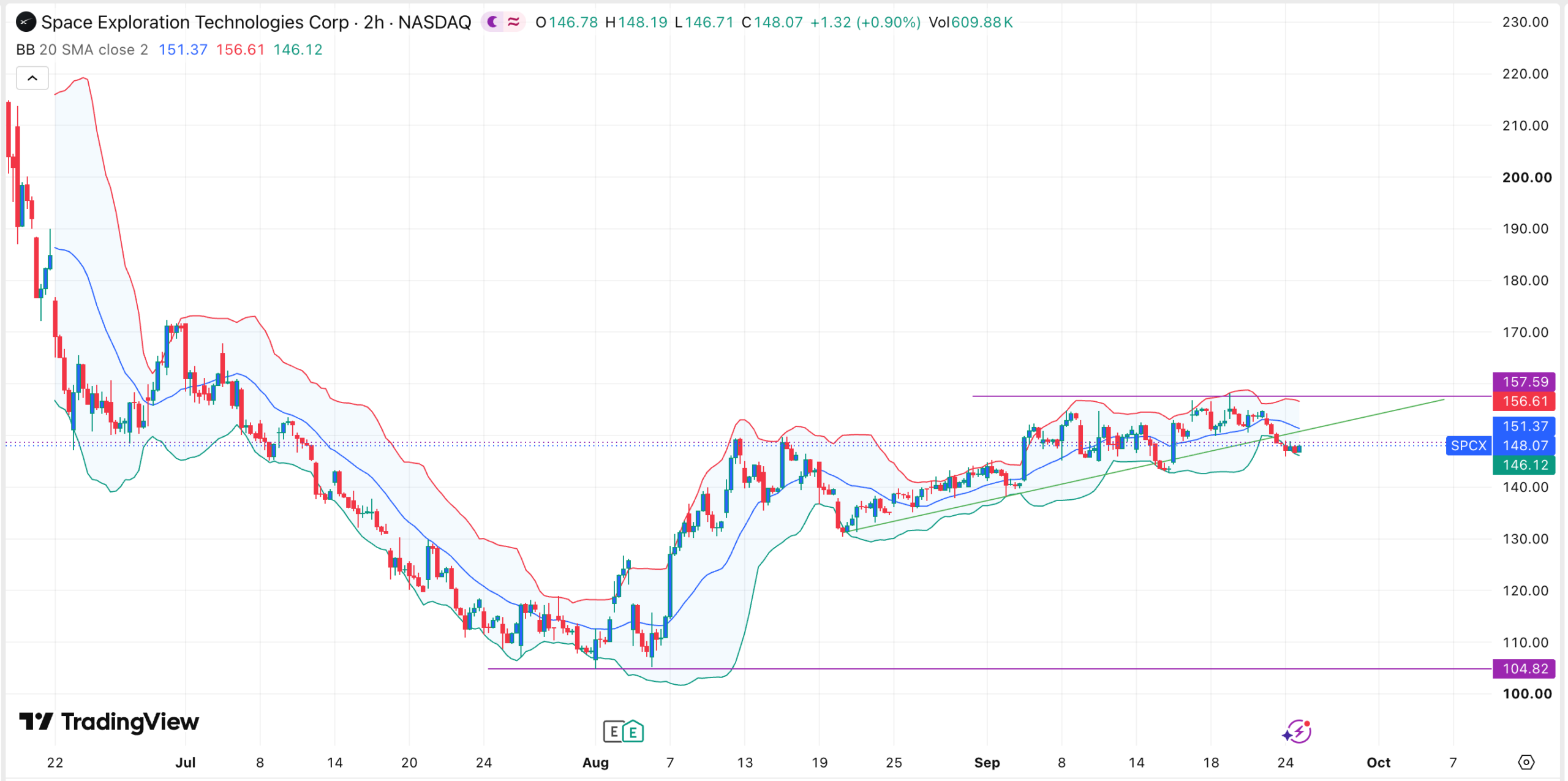
SpaceX (SPCX) shares traded near $148 on Sept. 25 as investors weighed developments across the company's artificial intelligence operations and its Starlink connectivity business. The stock remained below this week's high of roughly $157 after several sessions of sideways trading.
Two near-term catalysts framed the week. Elon Musk raised expectations for SpaceXAI, saying its models could approach leading systems within months, while the company scheduled Starship Flight 14 for Sept. 28, adding another near-term operational event to the calendar.
Musk Predicts Grok Will Surpass Rivals
In a statement this week, Musk predicted that Grok, his AI platform, will soon field the most advanced models in the industry, surpassing offerings from Anthropic and OpenAI, the companies currently leading the sector. His forecast comes at a time when Grok has trailed those peers in both market share and development.
A third-party LLM ranking currently places Anthropic's models at the top of the industry, followed by OpenAI and Meta Platforms, with Meta's Muse gaining market share this month. The most advanced Grok model has a context window of just 500k — considerably smaller than competing models from companies including Xiaomi, Alibaba, and Google — which is one reason Grok's market share remains below 20% in the AI space. A context window measures how much text a model can process at one time, a specification that has become a closely watched benchmark among competing AI models.
Musk has positioned SpaceX as a vertically integrated player in artificial intelligence. He is developing Terafab, a large semiconductor manufacturing plant in Texas, as part of that integration push. Beyond Grok, the company sells computing solutions to other AI firms: it recently signed a $1.1 billion-a-month deal with an unnamed company, on top of existing agreements with companies such as Google, Reflection AI, and Anthropic that pay it billions of dollars a month.
The most recent results showed the AI business is thriving, with total revenue surging to more than $2.56 billion, up from $818 million in the same period last year. That trajectory has underpinned bullish analyst sentiment, with Wells Fargo raising its price target to $212 and Pivotal Research lifting its target to $220 — both well above where the stock trades today.
Starlink Upgrade in Focus
The company is also betting on an upgraded Starlink product to drive sales. In its last results, connectivity revenue jumped to $4.29 billion from $3.2 billion as the number of customers rose to more than 12 million.
SpaceX is now counting on the third version of its Starlink satellites to strengthen the network and potentially attract more customers. A major test of the new hardware is scheduled aboard Starship Flight 14, set for Sept. 28, making the launch the week's key operational test for the upgraded constellation.
The test follows a security incident in Poland, where officials said a Starlink satellite station in the country suffered a fire attack in a deliberate act of sabotage. Polish warned that the sabotage likely came from Russian entities attempting to disrupt service to Ukraine. In a separate statement, Denmark said Russia was considering hybrid attacks, a development that may also impact SpaceX. Together, the statements underscore how Starlink's role serving Ukraine has given the network a geopolitical profile alongside its commercial business.
Technical Picture
On the two-hour chart, SPCX has moved sideways over the past few days after meeting substantial resistance at $157.60. The stock has slipped below the ascending trendline that connects the lowest levels since Aug. 20 this year and has moved to the lower Bollinger Band, while the Relative Strength Index (RSI) has turned downward.
Based on those signals, the stock will likely remain under pressure before rebounding, with the analysis pointing to a possible retreat toward $125 followed by a recovery to a record high. With the Sept. 28 launch on the calendar, investors now have a defined sequence of markers to track — the Flight 14 hardware test and the chart levels outlined above.
This article first appeared on The Market Periodical.

