SpaceX Starship reaches orbit, deploys 26 Starlink V3 satellites in shortened Flight 14
Key Takeaways
- •Starship deployed 26 operational Starlink V satellites in orbit for the first time on Flight 14, though engine shutdowns ended the mission after roughly three hours instead of the planned six orbits over nearly ten hours.
- •The deployed V3 satellites add 26 Tbps of potential network capacity, nearly ten times what a Falcon 9 launch of V2 Mini satellites provides.
- •Starlink accounted for 97.1% of worldwide satellite Speedtest samples as of Q3 2025, while SpaceX reported approximately 10.3 million Starlink subscribers as of March 31, 2026, per an SEC filing.
- •The global space economy generated nearly $626 billion in revenue in 2025, with around 78% of that total coming from commercial activity.
- •Oxford Economics projects LEO satellite broadband could serve 78 million to 421 million users and add between $32 billion and $863 billion to global GDP by 2035, depending on policies, affordability, and competition.
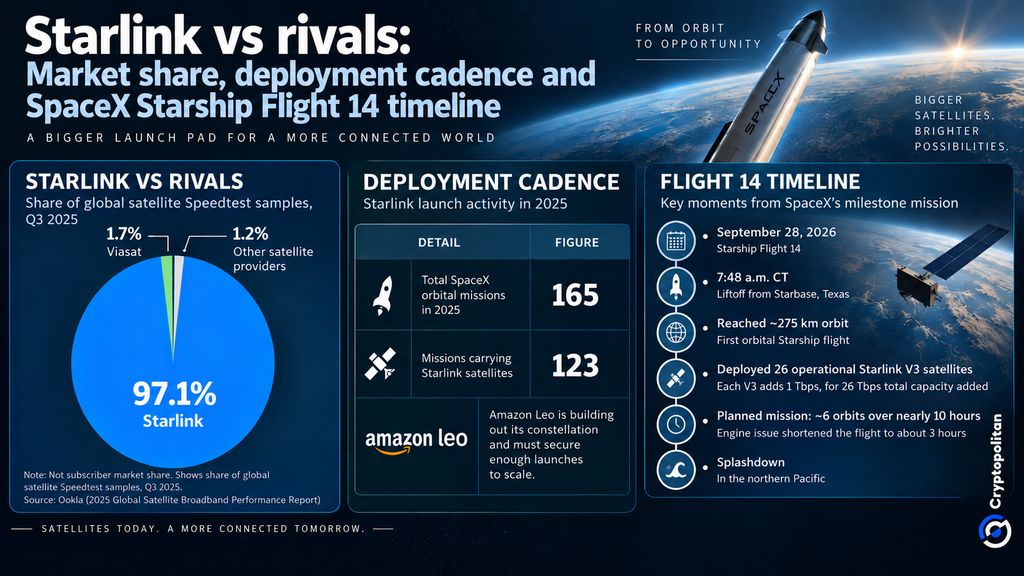
SpaceX's Starship reached orbit and deployed satellites from the vehicle for the first time on September 28, 2026, releasing 26 operational Starlink V3 spacecraft before engine trouble forced the company to cut the mission short. The flight demonstrated that Starship can lift SpaceX's largest satellites into orbit, but it did not prove that the company can maintain a sufficient launch frequency.
An engine dropped out on the way up
Starship lifted off from Starbase, Texas, at 7:48 a.m. CT on Flight 14, the mission's official designation. During the ascent, one Super Heavy engine switched off, followed soon after by the early shutdown of a vacuum Raptor engine on the upper section of the spacecraft. Starship adapted effectively, burning its remaining engines for longer than planned before concluding its orbital burn as flight managers checked the status of the craft.
The spacecraft accomplished its primary objective, reaching low-Earth orbit at an altitude of about 275 kilometers and deploying its batch of 26 Starlink V3 satellites. SpaceX had intended to complete roughly six orbits over a period of nearly ten hours, but the engine problem ended the mission after only about three hours. The result was a mission that met its headline objectives — orbit and satellite delivery — while falling short of the planned six-orbit, nearly-ten-hour profile.
According to SpaceX: "The Starlink V3 satellite is designed to support 1 Tbps of downlink and 160 Gbps of uplink capacity." The deployment adds 26 Tbps of potential network capacity — nearly 10 times the capacity provided by a Falcon 9 launch of the V2 Mini satellites.
Why orbit was the milestone SpaceX needed
As a report from Cryptopolitan noted, putting Starship into orbit is the main obstacle SpaceX had to overcome before it can begin deploying V3 satellites and proceed to conduct refueling tests in space. Flight 14 clears that first gate.
Starlink is already the leading name in consumer satellite broadband. Research conducted by Ookla indicates that Starlink's share of worldwide satellite Speedtest samples stood at 97.1% as of Q3 2025, while rival Viasat held only 1.7% — a usage-sample measure, not subscriber market share. Separately, per an SEC filing, SpaceX recorded approximately 10.3 million subscribers for its Starlink service as of March 31, 2026. Starship is positioned to widen that lead, since it is capable of carrying more V3 capacity on each mission than its predecessor, Falcon 9.
A $626 billion market leaning on satellites
In 2025, the broader space economy generated nearly $626 billion in revenue, with around 78% of that total coming from commercial activity. Nevertheless the OECD has issued a warning about strategic vulnerabilities resulting from reliance on space infrastructure that may allow for concentration in the markets — a vulnerability that consumer satellite broadband, where usage samples skew heavily toward a single operator, already illustrates.
The benefits are sizable. According to Oxford Economics, LEO broadband is set to cater to 78 million to 421 million users, and in doing so add anywhere between $32 billion and $863 billion to global GDP by 2035, depending on a range of factors including policies, affordability, and competition.
Flight 14 was more than a technological achievement: it also gave SpaceX an opportunity to see how Starship can speed up the rollout of Starlink. With orbit demonstrated and the first V3 batch delivered, the remaining checkpoints are the ones this flight could not test: in-space refueling and a launch cadence high enough to make such deployments routine. The next step is finding a way to ensure that more such successful orbital trips can be accomplished by SpaceX in the future.
Source: Cryptopolitan

