Robinhood Stock Falls to $116.46 as Analysts Maintain Targets Up to $165
Key Takeaways
- •Robinhood shares dropped 2.46% to $116.46 on Sept. 28, retreating from a double-top area around $126 but remaining well above their March low.
- •Rising Treasury yields could boost Robinhood's interest income, which surpassed $389 million and grew 9% year over year as interest-bearing assets expanded.
- •Citizens Bank, Bernstein, and Mizuho raised their price targets to $165, $160, and $140 respectively, implying roughly 20% to 42% upside from the latest close.
- •Robinhood Chain's total value locked topped $1 billion, and its 30-day decentralized exchange volume of more than $55.7 billion exceeded Ethereum's $41.2 billion.
- •Network fees on Robinhood Chain surged to $35 million, over five times the prior month's $6.6 million, while the chain's real-world asset capitalization reached $295 million.
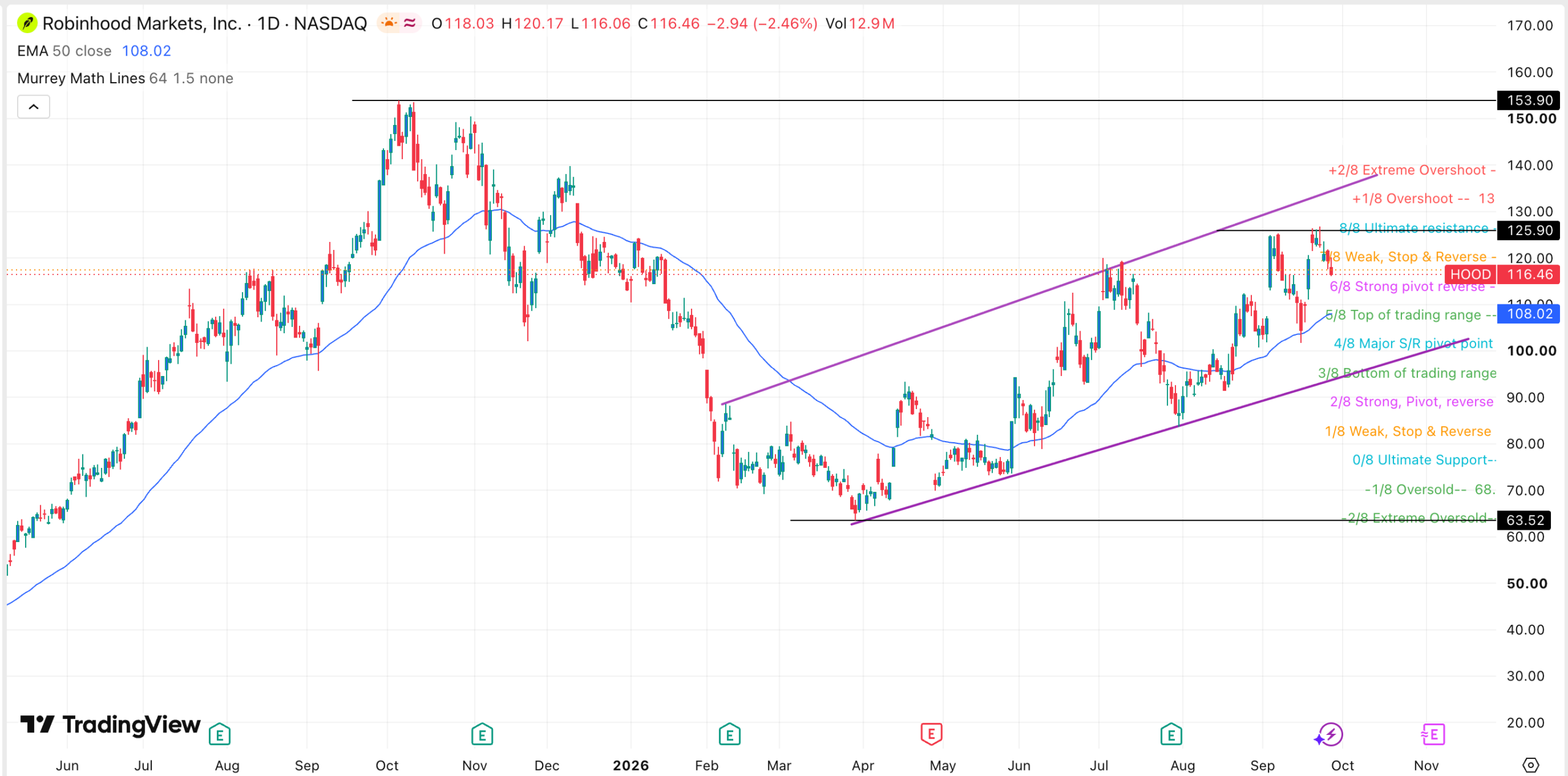
Robinhood stock extended its pullback on Sept. 28, closing at $116.46 after losing 2.46% on the session. Shares of the retail trading platform have retreated from a recent double-top area around $126 but remain well above their March low. The stock still sits roughly 24% below Robinhood's all-time closing high of $152.46, and a return toward the intraday record near $154 would represent about 32% upside from the latest close. The close also sits below every analyst price target referenced this month, leaving a visible gap between the market's current pricing and Wall Street's published expectations.
Higher Short-Term Yields Could Support Interest Revenue
HOOD shares may benefit from rising government bond yields. The ten-year Treasury yield rose to 5.22%, while the five-year and three-month yields climbed to 5.05% and 4.22%, respectively.
Rising yields can work in Robinhood's favor because the company holds large cash balances that are now earning higher returns. Interest is a key component of Robinhood's business, generating more than $389 million in revenue, up 9% from a year earlier. That increase came as interest-bearing assets continued to grow, although it was partially offset by a drop in interest rates during the quarter.
That mix — a growing pool of interest-bearing assets and higher yields on those balances — is the mechanism through which the rate environment feeds into Robinhood's reported results. Both bond yields and the pool of yield-earning assets have continued to rise in recent weeks, however. That combination places Robinhood among the companies positioned to benefit from the higher-yield environment.
Wall Street Analysts Stay Bullish on HOOD
Analyst support is another key factor behind the positive outlook on the stock. Earlier this month, Devin Ryan of Citizens Bank maintained his market-outperform rating on Robinhood and raised his price target from $155 to $165.
Mizuho's Dan Dolev kept his outperform rating while lifting his target from $130 to $140, and Bernstein's Gautam Chhugani raised his target to $160. Analysts at other banks, including Jefferies, Goldman Sachs, Morgan Stanley, and Cantor Fitzgerald, are also bullish on the company.
Measured against the $116.46 close, Mizuho's $140 target implies roughly 20% upside, Bernstein's $160 about 37%, and Citizens Bank's $165 about 42% — figures that reflect analyst models rather than guarantees.
These analysts point to Robinhood's revenue growth, which is expected to jump 17% this year and accelerate to 28% next year.
Robinhood Chain Metrics Are Soaring
Meanwhile, the recently launched Robinhood Chain has been performing strongly, with developer activity and assets on the network continuing to rise. Total value locked (TVL) on the chain has just crossed the $1 billion mark, with leading participants including Morpho Blue, Steakhouse Financial, and Uniswap.
Decentralized exchange (DEX) volume is also gaining momentum. Data show the network has handled more than $55.7 billion over the last 30 days, exceeding Ethereum's $41.2 billion and coming in at more than double the amount processed by Base Chain in the same period. The chain's largest DEX protocols are Uniswap, Fables, RamsesX, and Up.
These numbers indicate that Robinhood Chain is now generating millions of dollars, some of which it transfers to Arbitrum. Network fees climbed to $35 million, more than five times last month's $6.6 million.
The chain's real-world asset (RWA) totals are soaring as well, reaching a market capitalization of $295 million. That growth may continue now that the Securities and Exchange Commission (SEC) has granted an innovation exemption to tokenized assets.
Technical Setup Keeps $126 and $154 in Focus
Robinhood stock reached $126.41 on Sept. 21 and $126.74 on Sept. 23. Those two highs formed a possible double-top structure around the $126 level. Traders watch that pattern because two unsuccessful approaches at the same zone can mark a near-term ceiling. HOOD then fell to $116.46 by Sept. 28, and the latest session low was $116.06.
The supplied TradingView chart places the stock above both its 50-day exponential moving average and its Supertrend indicator, while also showing a broader ascending structure from the March low.
A recovery above the $126 area would weaken the double-top setup and reopen the path toward higher resistance. The historical all-time closing high stands at $152.46, while the intraday 52-week high was about $153.86. From $116.46, a move back toward $153.86 would represent roughly 32% upside — a conditional technical scenario rather than a price forecast.
On the downside, a sustained break below $100 would weaken the broader bullish structure shown on the chart. The near-term test is whether buyers can defend the $116 area and reclaim the recent $126 resistance zone.
This article is for informational purposes only and does not constitute financial or investment advice. Analyst price targets and technical scenarios remain conditional.
This article originally appeared on The Market Periodical: Robinhood Stock Falls to $116 as Analysts Keep $165 Targets

