SpaceX Launches NASA's $4.3 Billion Roman Space Telescope to Study Dark Energy
Key Takeaways
- •The Nancy Grace Roman Space Telescope, valued at $4.3 billion, launched on a SpaceX Falcon Heavy from Cape Canaveral at 7:26 a.m. Sunday for a five-to-ten-year mission.
- •The telescope will operate near the second Sun-Earth Lagrange point, about one million miles from Earth, with first observations possible as early as December.
- •Roman will investigate dark matter and dark energy and search for exoplanets, and could map the sky roughly 1,000 times faster than Hubble with a field of view 100 times wider despite a similarly sized mirror.
- •A coronagraph instrument that blocks starlight may enable the discovery of planets orbiting nearby stars.
- •The project, originally conceived as WFIRST in the early 2010s, faced a 2018 cancellation attempt and a lack of initial 2025 budget funding before Congress ultimately approved it.
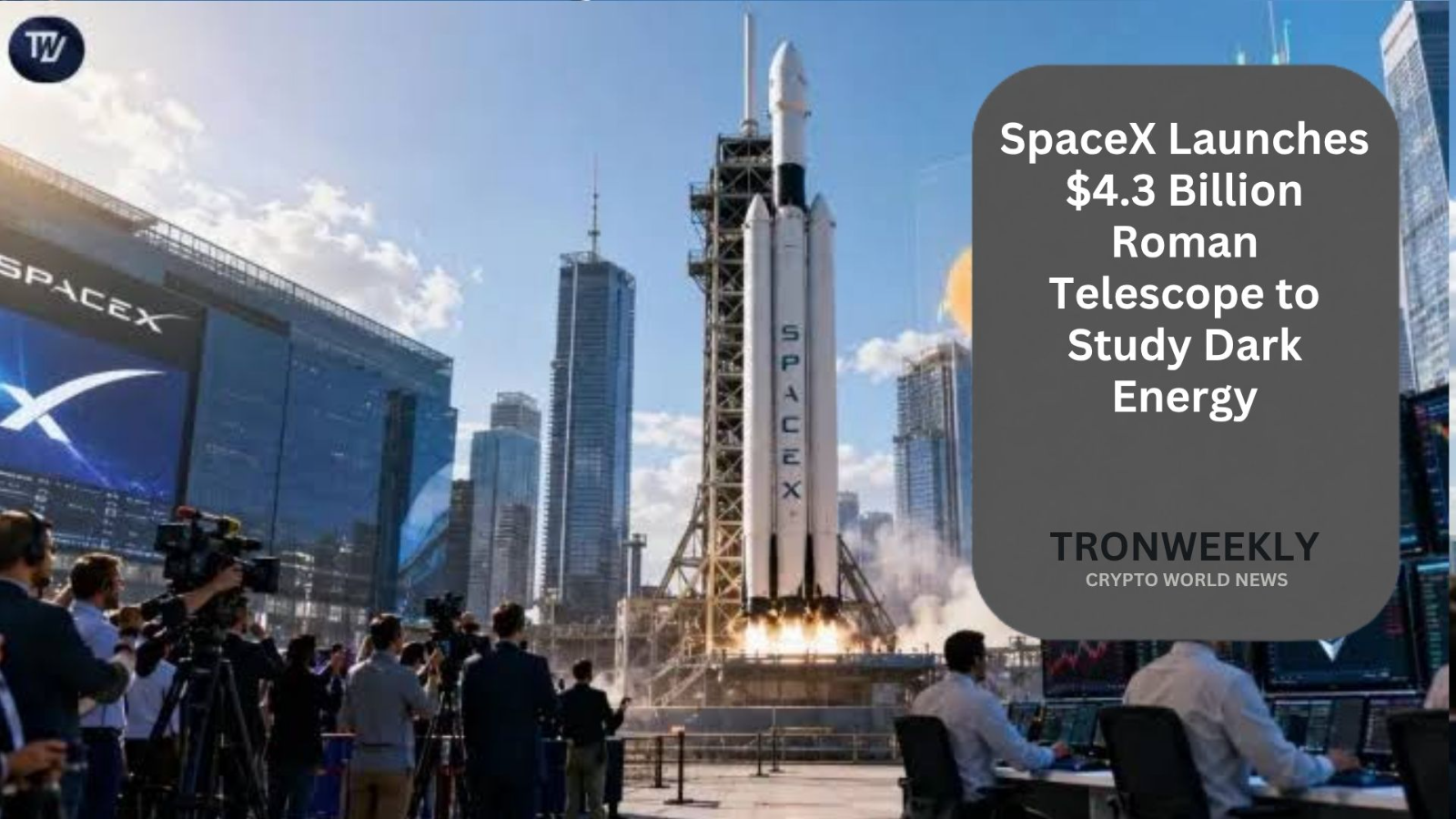
SpaceX has launched NASA's $4.3 billion Nancy Grace Roman Space Telescope, kicking off a mission expected to last five to ten years and designed to investigate some of the biggest questions about the universe. The spacecraft lifted off aboard a Falcon Heavy rocket from Cape Canaveral, Florida, at 7:26 a.m. on Sunday, adding another milestone to NASA's long-term space science effort.
According to Bloomberg, the telescope will travel roughly one million miles from Earth before beginning scientific observations as early as December. That distance places it near the second Sun-Earth Lagrange point (L2), a gravitationally stable region where the James Webb Space Telescope also operates, offering an unobstructed vantage point for infrared observations. Its primary objectives include studying dark matter and dark energy — which together are thought to make up the vast majority of the universe's contents — as well as searching for exoplanets outside the solar system, potentially including Earth-like planets. The mission could provide important evidence about how the universe formed and why it continues to expand. Roman joins Europe's Euclid space telescope, launched in 2023, in a broader international effort to map the large-scale structure of the cosmos and probe the nature of cosmic acceleration.
Kristen McQuinn, head of the Roman mission office at the Space Telescope Science Institute, said Roman could help determine whether something fundamental is missing from current physics, underscoring the telescope's potential to challenge established scientific understanding through observations across distant cosmic regions.
Roman Expands NASA's Search Across Space
The Roman telescope possesses enormous surveying capabilities compared with other observatories. While its mirror is similar in size to Hubble's, its wide-field infrared camera allows it to observe a field of view 100 times wider. According to McQuinn, Roman could map the sky 1,000 times faster than Hubble, enabling scientists to carry out far larger surveys.
The telescope is also equipped with a coronagraph, an instrument that can block starlight. This capability may allow scientists to discover planets orbiting nearby stars, making Roman not only an explorer of deep space but also a tool for studying planetary systems beyond our own.
NASA is launching a new $4.3 billion telescope into space today on top of a SpaceX $SPCX Falcon Heavy rocket "The telescope is designed to study dark matter and dark energy, and will attempt to catalogue how these forces are shaping distant stars and galaxies." – Bloomberg pic.twitter.com/bPQ65GpM9R — Evan (@StockMKTNewz) August 30, 2026
SpaceX Strengthens NASA Launch Partnership
The successful launch marks another achievement for SpaceX and its Falcon Heavy rocket, while underscoring the government's ongoing reliance on commercial launch providers. For NASA, partnering with SpaceX ensures access to heavy-lift launch capability for major science missions. Continued demand for spacecraft and payloads could benefit the broader space industry.
The development of Roman reflects the difficulties NASA missions often face. Conceived as the Wide Field Infrared Survey Telescope (WFIRST) and announced in the early 2010s, the project encountered rising costs and uncertainty. The first Trump administration attempted to cancel it in 2018, and the administration's initial 2025 budget proposal contained no funding for the telescope before Congress ultimately approved it.
The telescope is named in honor of Nancy Grace Roman, NASA's first chief astronomer and the first woman to hold an executive position at the agency.
Following its launch on SpaceX's Falcon Heavy, the observatory will now begin its journey to its operational location and prepare for science operations, with first observations anticipated as early as December. The data collected over the course of the mission is expected to shape the future of astronomy.
