Transco, Florida Natural Gas Basis Strengthens as Pipelines Near Capacity
Key Takeaways
- •September natural gas basis in the Southeast strengthened sharply relative to October as cooling demand kept pipeline systems near capacity.
- •Portions of the Transco system, including compressor station CS 60, and Florida Gas Transmission's Zone 3 are effectively saturated, tightening deliverability into Florida and surrounding markets.
- •An eastward shift in the late-summer heat dome lifted demand across Louisiana and the Southeast while cooler weather unwound the Desert Southwest's price spike.
- •Demand-side pressures include strengthening LNG feed gas volumes, a South Central storage withdrawal in the week ended Aug. 21, and Mexico averaging over 8 Bcf/d in US gas imports.
- •Forecast cooling trends could relieve constrained Southeast capacity, while continued heat would keep basis premiums elevated into the shoulder season.
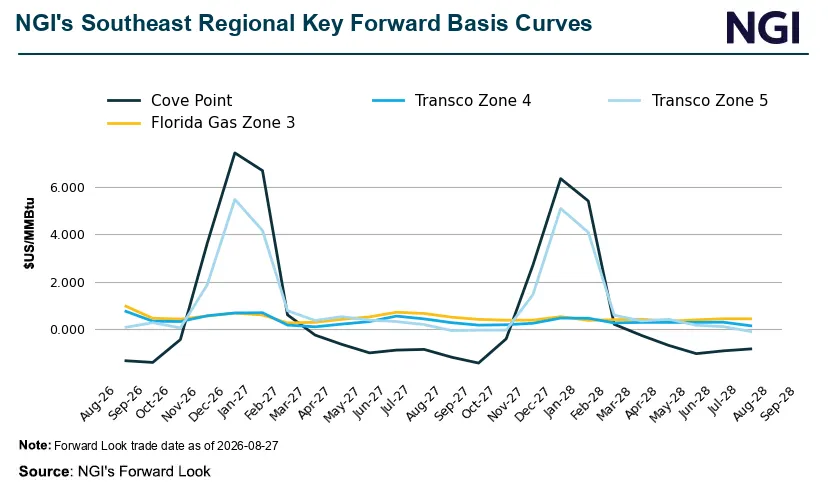
September natural gas basis across the Southeast has strengthened sharply relative to October, as lingering cooling demand keeps pressure on pipeline systems already running near capacity.
At a Glance
- Florida Gas Zone 3 spread doubles
- Cooling demand keeps capacity tight
- Transco CS 60 runs near limits
Basis — the difference between the cash price at a regional hub and the benchmark futures price at Henry Hub — widens when transport constraints make it harder to move gas into a region. With heat-driven demand still running strong late in the cooling season, portions of the Transcontinental Gas Pipe Line (Transco) system, including the compressor station at CS 60 in the Southeast, and Florida Gas Transmission's Zone 3 are effectively saturated, tightening deliverability into Florida and surrounding markets.
Transco, operated by Williams, is one of the largest interstate natural gas pipeline systems in the United States, running roughly 10,000 miles from the Gulf Coast through the Southeast and Mid-Atlantic to New York City. Florida Gas Transmission, meanwhile, is a key supplier of gas into peninsular Florida, where demand is heavily shaped by air-conditioning load.
When pipelines operate at or near their maximum throughput, locational premiums tend to strengthen as buyers compete for constrained capacity. That dynamic has been amplified in recent sessions by the eastward shift of the late-summer heat dome, which has lifted demand across Louisiana and the Southeast even as cooler weather unwound the price spike in the Desert Southwest.
The strain on Southeast takeaway and deliverability comes as the market navigates the September-to-October contract roll, with October futures recently taking over as the prompt month. Related market forces are adding to the demand side of the ledger: LNG feed gas volumes have been strengthening, and South Central storage operators drew on inventories during the week ended Aug. 21 as heat and recovering LNG activity pressured supply. Mexico's natural gas imports from the United States, meanwhile, averaged over 8 Bcf/d this week as scorching temperatures in northern Mexico drove cooling demand — another draw on the same Gulf Coast and southern corridor supply that feeds Southeast markets.
For regional buyers and pipeline shippers, the near-term question is how quickly the late-summer heat recedes: forecast cooling trends that have already weighed on futures demand expectations would relieve pressure on constrained Southeast capacity, while continued heat would keep basis premiums elevated into the shoulder season.
Related NGI coverage
- Arizona Natural Gas Cash Plunges $4 as West Cools, Heat Shifts East — Physical natural gas prices fell at most hubs Friday for delivery through Monday as cooler weather unwound the Desert Southwest's late-week price spike, while the eastward-shifting heat dome lifted Louisiana and Southeast hubs.
- Natural Gas Futures Ease as October Takes Prompt Baton — Natural gas futures pulled back Friday as cooler early September weather trends undercut demand expectations and Thursday's rally stalled short of $3, outweighing persistent late-summer heat and the leanest storage builds of the summer.
- Intense Heat Propels Mexico's Natural Gas Imports — Mexico's natural gas imports from the United States averaged over 8 Bcf/d since Monday as scorching temperatures in the northern part of the country drove cooling demand.
- South Central Natural Gas Storage Shrinks as Strong Demand Dictates Withdrawal — Operators in the South Central region drew heavily on supply in storage during the week ended Aug. 21 as sweltering heat and recovering LNG activity put upward pressure on demand.
- October Natural Gas Futures Debut Meekly as Prompt Month Amid Conflicting Fundamentals — Natural gas futures traded gingerly early Friday, with the October contract moving to the front of the curve amid abiding summer heat, strengthening LNG volumes, a dwindling but still notable storage surplus and seasonally strong production.
- Southwest Natural Gas Cash Tops $8 as Southern California Supply Runs Short — Physical natural gas prices climbed at most hubs Thursday as a Southern California supply shortage warning sent Arizona cash nearly $3 higher, while heavy rain took the edge off Gulf Coast premiums.
Source: Natural Gas Intelligence

