South Korean Container Ship to Test Arctic Route to Europe Amid Western Concern
Key Takeaways
- •The PanStar Acro is scheduled to depart Busan on a trial Arctic container voyage to Europe and back, with stops in Felixstowe, Rotterdam and Gdansk.
- •PanStar expects the round trip to take 40 to 45 days, and the company is modifying the 2,700-TEU vessel for polar navigation.
- •Western diplomats have raised concerns because the route requires Russian permission, and experts warned the voyage could create sanctions risks if Moscow’s help is needed.
- •South Korea says the Arctic route could cut sailing time by up to 35 percent versus the Suez Canal route and reduce fuel use.
- •Officials want to use the pilot voyage to build experience for a target of regular Arctic commercial service by 2030, while China is also seeking first-mover advantage on the route.
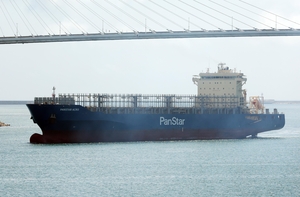
South Korea will send a container ship to Europe via the Arctic on Saturday, testing whether a route opened by melting sea ice can be commercially viable, in a trial that risks friction with Western allies because the voyage requires Russian cooperation.
If the trip succeeds, it would be South Korea's first commercial voyage to Europe via the Arctic, placing the country alongside China and Russia among the few nations whose shipping firms have tested or run cargo services along the route.
The PanStar Acro will sail north from the port of Busan, calling at Felixstowe in Britain, Rotterdam in the Netherlands and Gdansk in Poland before returning — a journey its operator, PanStar, expects to take 40 to 45 days.
"Around September, when this voyage will mainly take place, Arctic sea ice is at its lowest level of the year, making safer navigation possible," an official of the group said on condition of anonymity, as he was not authorized to speak to media.
President Lee Jae Myung has made Arctic shipping a priority, with officials saying the route could help transform the southeastern port of Busan into a global maritime hub and position the Arctic as a regular trade route by 2030.
Western diplomats unhappy with the plan
The plan has drawn unease among Western diplomats, however, as it required Seoul to consult Russia and seek permits for the ship's voyage. That dependence is structural: Russia administers the Northern Sea Route, and foreign vessels need Moscow's permission — and, when ice requires it, paid Russian icebreaker support — to transit.
"We want to isolate Russia, we don't want engagement with Russia," one European diplomat said, citing Russia's war in Ukraine and adding that the concerns had been voiced to South Korean officials.
Arctic shipping experts also said South Korea could be at risk of breaching sanctions if the ship sought Russia's help to tackle problems encountered on the route, such as getting stuck in ice.
South Korea's Oceans Ministry and Russia's Foreign Ministry did not respond to requests for comment.
Melting sea ice makes the route attractive
Faster melting of Arctic sea ice attributed to global warming has made it more feasible to attempt the Northern Sea Route (NSR), as it is known, this summer. As traffic on the route grows, the Norwegian tracking foundation Centre for High North Logistics said 88 vessels made 103 transits through the NSR last year, up from 97 in 2024 and 43 in 2022, chiefly from countries such as Russia and China.
South Korea's Oceans Ministry said the Arctic route could shorten voyages by up to 35 percent compared with the traditional Suez Canal route and require less fuel. The appetite for shortcuts has grown since Houthi attacks on commercial shipping in the Red Sea began in late 2023, prompting many of the world's biggest container lines to divert around the Cape of Good Hope — adding roughly two weeks to Asia–Europe voyages.
Commercial feasibility, however, may be harder to assess. Unit transport costs on the Arctic route are swelled by factors such as vessel size limits and insurance costs, former naval officer Hyewon Choi said in a study published last year in the journal Ocean Policy Research.
"We cannot use the NSR year round," he told Reuters, adding that the route is navigable by container vessels only during the three summer months when the ice melts.
The vessel and its cargo
PanStar, picked through a government-backed tender for the pilot voyage, bought a 2,700-TEU (twenty-foot equivalent unit) container ship from HMM and is modifying it for polar navigation, with a crew of 20 Koreans and Indonesians. That capacity is a fraction of the more-than-20,000-TEU mega-ships that dominate Asia–Europe services via Suez.
The company told Reuters it is seeking at least 1,300 TEUs of cargo such as automobile parts, food and cosmetics, along with shipments from China and Japan, with clients from the latter expressing interest.
Race for first-mover advantage
China, which declared itself a "near-Arctic" state in 2018 and promotes Arctic shipping under its Polar Silk Road initiative, is already trying to secure first-mover advantage on the route, making a South Korean voyage more urgent, the PanStar official said.
"Korea must begin accumulating operating experience and data that it has not had until now, if the national goal of commercial scheduled service by 2030 is to be achievable."
Chinese container company Sea Legend Shipping plans to launch the first regular container service to Europe via the NSR, according to the route's Russian operator. (Reuters)

