South Korea Launches First Government-Backed Arctic Container Voyage in a Decade
Key Takeaways
- •The PanStar Acro left Busan on Aug. 22 with 737 TEUs, below the roughly 1,300 TEUs of potential demand identified in an initial survey.
- •The Northern Sea Route from Busan to Rotterdam is about 13,000 kilometers, roughly 35 percent shorter than the Suez Canal route and could save about 10 days of sailing time.
- •South Korea's government will use the voyage's operational and cost data to evaluate establishing regular Arctic services by 2030.
- •The route requires Russian clearance, and operator PanStar Starline obtained approval from Rosatomflot, an entity under an EU asset freeze since March, raising unresolved payment and insurance questions.
- •The Arctic navigation window has widened from about four months a decade ago to five or six months, and the Korea Maritime Institute projects eight or nine months by 2040.
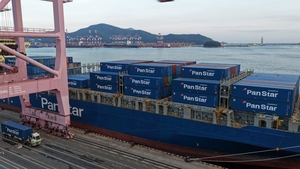
South Korea has launched its first government-backed container ship voyage through the Arctic in a decade, testing whether a route 35 percent shorter than the Suez Canal passage can become commercially viable despite high operating costs, limited cargo and geopolitical risks.
The trial comes as container shipping between Asia and Europe has been disrupted in recent years. Attacks on commercial vessels in the Red Sea since late 2023 prompted many carriers to divert ships around the southern tip of Africa, adding thousands of kilometers and days of transit time to Asia-Europe sailings and pushing up freight rates.
The PanStar Acro departed Busan New Port on Aug. 22 carrying 737 twenty-foot-equivalent units (TEUs) of cargo. It will travel through the Northern Sea Route and call at Felixstowe in Britain, Rotterdam in the Netherlands and Gdansk in Poland before returning to Busan. The round trip is expected to take about 45 days.
The government will use operational and cost data from the voyage to assess the feasibility of establishing regular Arctic services by 2030.
"This trial run will provide a crucial opportunity for Busan to cement its place as a global maritime capital," PanStar Acro Capt. Seo Myung-won told reporters before departure.
The Northern Sea Route runs along Russia's northern coast. The passage from Busan to Rotterdam spans about 13,000 kilometers, roughly 35 percent shorter than the 20,000-kilometer route through the Indian Ocean and Suez Canal. It could cut sailing time by about 10 days.
But a shorter route does not necessarily mean a cheaper one. The Ministry of Oceans and Fisheries said the voyage will help determine whether fuel savings can outweigh the additional costs of Arctic operations, including icebreaker escorts, insurance and specialized crews.
"The significance of this voyage lies in accumulating experience and identifying viable cargoes and business models, rather than proving profitability immediately," Hong Seong-won, director of the Institute of Arctic Logistics at Youngsan University, told The Korea Herald. "One voyage cannot determine the route's economic feasibility," he said.
Cargo volume presents an immediate test. An initial survey identified potential demand for about 1,300 TEUs, but the vessel departed with 737 TEUs. The ministry attributed the shortfall partly to the limited time available to secure cargo and uncertainty surrounding the first trial.
Hong said any regular service would need sufficient cargo in both directions. Asia-to-Europe routes typically carry larger volumes because of Asia's manufacturing base, leaving ships at risk of returning from Europe with unused capacity.
"Securing cargo for both eastbound and westbound voyages will be critical," he said.
The route also carries geopolitical complications. Ships using the Northern Sea Route require clearance from Russian authorities and may depend on Russian navigation and icebreaker services.
Norwegian outlet High North News reported Aug. 11 that PanStar Starline, the vessel's operator, had secured approval from Russia's state-owned Rosatomflot, which oversees transit along the route. The European Union imposed an asset freeze on Rosatomflot in March over Russia's war in Ukraine.
That raises questions over payments for navigation and icebreaker services, insurance coverage and other Russia-related transactions. Neither PanStar Starline nor the Korean government has publicly detailed how those issues will be handled, according to the report.
Korean companies conducted Arctic shipping trials in 2013, 2015 and 2016, but none led to regular services. The latest voyage is more closely tied to government policy, with the Lee Jae Myung administration identifying the Northern Sea Route as part of its push to make Korea a leading maritime power.
The Arctic navigation window is also widening. The route, accessible for roughly four months of the year a decade ago, can now be navigated for five to six months, according to industry estimates. The Korea Maritime Institute expects the season to extend to eight or nine months by 2040. South Korea is not alone in watching this shift: China has promoted itself as a "near-Arctic" state and has sent cargo vessels through the route, while Russia has sought to develop it as a commercial shipping corridor.
If regular services become viable, Busan could gain additional container, storage and inland transport demand. Korean shipbuilders could also benefit from greater demand for ice-class vessels.
For now, however, the PanStar Acro's voyage is intended to answer a more immediate question: whether the Arctic route's shorter distance can translate into a workable business proposition. Key indicators to watch will be the voyage's cost and operational data, whether follow-up sailings are scheduled, and how the operator and Seoul handle the Russia-related payments and insurance questions.
"This is the first step toward verifying the feasibility of the Northern Sea Route using an actual vessel and cargo," Lee Su-ho, director general of the ministry's Arctic Route Promotion Headquarters, told reporters.
