'Show Me What You Built': South Africa's Tech Employers Rewrite the Hiring Benchmark
Key Takeaways
- •South Africa's graduate unemployment stood at 12.4% while national unemployment reached 33.6% in the second quarter of 2026, even as employers report shortages in software development, networking and cybersecurity.
- •A World Bank report published in August 2026 found that weak links between academic curricula, labour market demands and workplace training contribute to the country's digital skills mismatch.
- •Amogelang Chaane secured a position at Amazon Web Services before completing his degree by building a full-stack application at Richfield, interning unpaid at a startup and competing in hackathons.
- •Richfield has partnered with AWS, IBM, Salesforce, Fortinet and Microsoft to offer vendor-certified short courses in areas such as cloud computing, data analytics and cloud security alongside accredited qualifications.
- •A five-student Richfield team built Richfield Connect, a platform linking students, alumni and businesses, using React, Node.js, Supabase and Vercel during a hackathon.
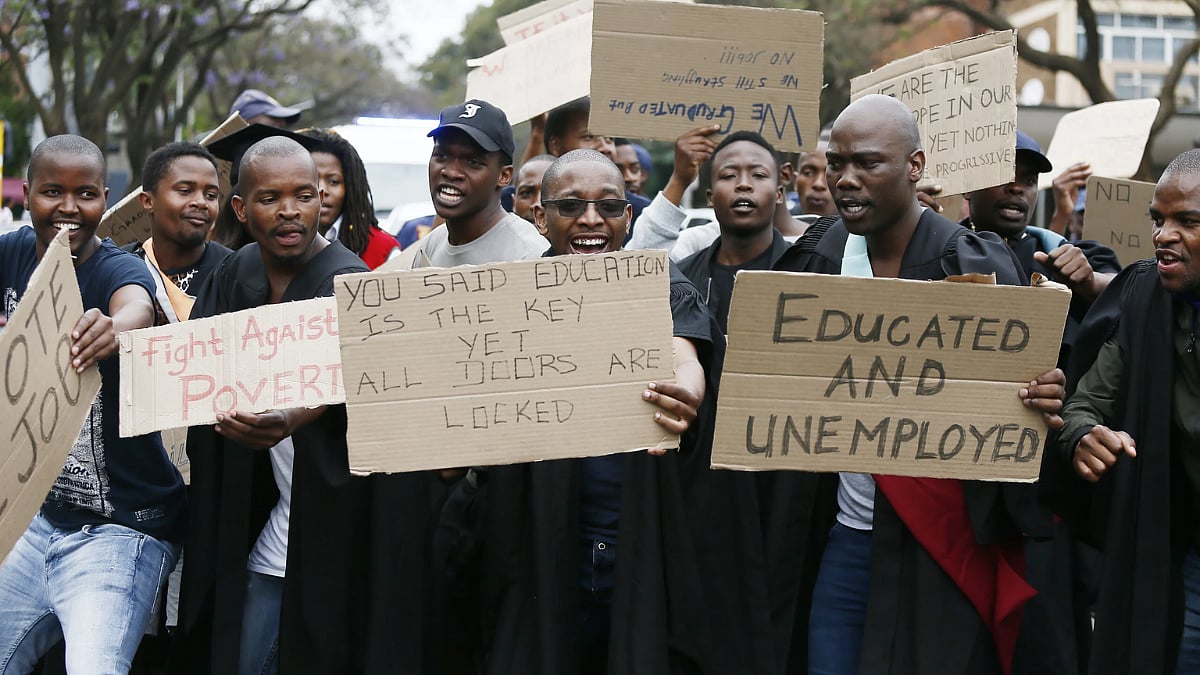
In South Africa's technology sector, a university degree may get a CV read, but a working application is increasingly what gets a candidate hired. With graduate unemployment at 12.4% and persistent shortages of skilled developers, employers are making a firm pivot in how they judge job readiness: don't tell me what you studied, show me what you built.
A TechCabal feature by Phathisani Moyo examines how students, private colleges and global technology companies are rewriting the rules of job readiness — from building full-stack platforms on campus to landing roles at Amazon Web Services (AWS) before graduation, as emerging tech talent bets on GitHub repositories over academic transcripts to stand out.
Before Amogelang Chaane landed his first job at AWS, the global digital infrastructure giant, he was already doing the work. He was coding, shipping projects and building software wherever he could. At Richfield, a higher-education institution, he developed a full-stack application. He joined a technology startup as an unpaid intern, entered hackathons, worked on personal projects and taught himself skills outside the lecture hall.
The degree was on its way, but Chaane was not waiting for graduation day. "I realised early on that having the qualification wasn't enough. I had to build things and put myself in situations where I could prove what I was capable of," he told TechCabal in an interview on Tuesday.
By the time he began applying for jobs, Chaane's CV carried more than a qualification. He had functional software to demonstrate, real-world problems he had tackled and experience collaborating in team environments.
That distinction is becoming critical across South Africa's technology ecosystem, where universities and colleges graduate thousands of students each year even as employers struggle to find candidates who can execute from day one. Chaane's journey illustrates the expanding gap between studying technology and working in it. Dineo Maakamedi, a first-year BSc Information Technology (IT) student, is still establishing her foundation, while Ntshembo Nobela, a third-year student in the same programme, is preparing to enter the workforce. Together, the three students represent different milestones along the same trajectory, and their experiences highlight why a technical qualification is only the baseline.
Why the degree is no longer enough
According to Statistics Africa, national unemployment reached 33.6% in the second quarter of 2026, while graduate unemployment stood at 12.4%. At the same time, the World Bank reports that employers face persistent talent shortages in critical areas, including software development, networking and cybersecurity.
A World Bank report published in August 2026 identified weak links between academic curricula, labour market demands and workplace training, and found that these gaps contribute to the mismatch. Richfield is among the private higher-education institutions attempting to bridge the divide.
Keeping the curriculum close to industry
Nancy Madiba, Head of Department for Information Systems and Databases, sits close to the machinery behind that effort. Her department works with the academy's programming, mathematics and networking departments to develop curriculum, assessments and teaching materials across Richfield's eight campuses and online platforms.
Richfield also has an advisory board made up of its regulatory team, department heads and industry experts. The group meets twice a year to assess whether what students are being taught remains relevant to the technology industry.
"We need to make sure that our curriculum is industry-ready and relevant," Madiba told TechCabal during a campus tour of Richfield on September 3.
Formal academic qualifications, however, cannot always adapt quickly. New module content must remain aligned with learning outcomes accredited by the Council on Higher Education (CHE), South Africa's higher education regulator. To work around these constraints, Richfield has formed partnerships with global tech companies including AWS, IBM, Salesforce, Fortinet and Microsoft.
Through these partner academies, students can complete vendor-certified short courses in high-demand domains such as cloud computing, data analytics and cloud security. Several of the programmes offer simulated enterprise environments where students interact with production-grade tech stacks. The partner companies update the external content, and Richfield then integrates it into its instructional framework. In effect, the model lets students pair an accredited qualification with vendor certifications while they are still studying.
"The idea is to expose students to tools and practices they may encounter after graduation rather than leave industry exposure until their first job," Madiba explained.
Teaching for an AI-shaped workplace
The rapid rise of generative artificial intelligence (AI) has added urgency to this approach, reshaping both the baseline skills required of graduates and how technical work is executed.
Every Richfield IT student completes an Information Systems module covering AI fundamentals, hardware, software and digital literacy, with the curriculum including prompt engineering and ethical AI usage. On the software engineering track, students work with frameworks and languages including React, Java, Python and C#. From their second year, students can specialise in networking, programming, data analysis or IT management.
Those choices lead towards different careers. A BSc IT graduate can pursue roles such as software engineer, application developer, business or data analyst, systems analyst, database administrator or information security analyst. A Diploma in IT can lead to positions such as network engineer, Python developer, application programmer, business analyst or systems administrator, while a Higher Certificate in IT can move students towards IT technical support, junior web developer or systems developer roles. Further specialisations open pathways into artificial intelligence, cloud computing, cybersecurity, data science and machine learning.
Yet mastering technical terminology in a classroom remains fundamentally different from deploying code in production.
Where students get to build
That is where Richfield's hackathon becomes useful. At the competition, students receive a client brief and must build a solution in teams. They decide who does what, write code, manage the project, test their work and eventually explain what they have built.
A five-student hackathon team called ECHO5 from Richfield's Umhlanga campus built Richfield Connect, a platform designed to connect students, alumni and businesses. The project used React, Node.js, Supabase and Vercel, covering the interface, runtime, backend and deployment, with GitHub used for development. The students also worked on analytics, testing and deployment using tools including Flutter, n8n and Recharts.
For Reilyn Noo, the value went beyond learning another set of technologies. "Working under strict time constraints in a five-person team taught me how to effectively divide complex tasks and integrate AI workflows to speed up problem-solving," he told TechCabal in an interview on Wednesday.
That is a different kind of evidence from an examination. A student can say they studied software development; a working project shows they built something with other people, handled deadlines and solved problems when there was no step-by-step answer to follow. It also exposes students to what building real projects actually involves: code that breaks, features that need testing, deadlines that loom and responsibilities that do not always fall neatly into place. At some point, they also have to explain the product to people who had nothing to do with developing it. Those experiences are difficult to recreate in an exam.
From classroom to workplace
Richfield is trying to build that exposure into a broader qualification. Students complete practical examinations in computer labs, and at exit level they must also complete a credit-bearing Work-Integrated Learning module before graduating.
Yvette Van Der Walt, Campus Manager of Richfield Bryanston, believes that exposure can have consequences beyond academic credit. "It gives them hands-on experience, and it can lead to their first employment," she said.
The college assists with placements where possible, and guest speakers and company visits give students a look at the workplace before they enter it. The hackathon follows the same philosophy and is open to first-, second- and third-year students, with campus competitions feeding into a national final. For students, the project becomes something they can carry into a portfolio, an interview or a conversation with an employer.
Chaane's journey shows what that preparation can look like when it works. While at Richfield, he wanted to build immediately: after working on his college project, he joined a tech startup without pay, built personal projects and continued teaching himself. By the time he entered the job market, he had more than a qualification to discuss, and he understood that the technology industry would require him to keep learning.
"The IT world, from my view, is rather saturated, so one needs to be consistent and refine their craft, so that when an opportunity presents itself, you're ready, and I most certainly was," he noted.
He sees AI as another tool aspiring developers will have to learn to use well. "Though it takes some of the fun out of coding, it's rather efficient, and learning how to work with it will make you a better engineer (if you use it right)."
Looking back at his own transition from student to developer, his approach was simple: "Prepare early."
That mindset is reflected in the structure Richfield is building around its students. Industry partnerships expose students to tools and credentials, practical classes and hackathons give them projects to build, and work-integrated learning takes that experience into the workplace, alongside industry sessions with people already in their chosen fields.
When the classroom meets the job market
No single institution can solve South Africa's structural tech skills deficit in isolation. For providers like Richfield, the challenge is keeping academic programmes aligned with fast-changing industry, where technology often moves faster than traditional accreditation cycles. The model's own checkpoints — the advisory board's twice-yearly relevance reviews and the partner companies' updates to external course content — are where that alignment gets tested. For students like Maakamedi, Nobela and Chaane, the imperative remains immediate: translating academic instruction into proof of engineering capability. Maakamedi is building her foundational knowledge, Nobela is preparing to transition into his first industry internship, and Chaane has completed that bridge and is working at AWS.
Their individual journeys reflect a broader evolution in technical education across the continent. An academic degree confirms what a student has studied. But when a graduate opens a public GitHub repository, demonstrates a live application and articulates how they resolved production bugs under deadline, the hiring conversation changes completely.
Reporting by Phathisani Moyo; first published by TechCabal.

