Solana (SOL) Fights to Hold Trendline Support Near $90 as Oversold Signals Appear
Key Takeaways
- •Solana traded near $89.62 on November 6 after falling roughly 28% from its September high near $124, briefly dipping below its June ascending trendline at an intraday low of $88.82 before recovering.
- •Network usage stayed heavy despite the price retreat, with approximately 108.27 million transactions, 2.83 million active addresses, about $2 billion in DEX volume, and $5.26 billion in total value locked over 24 hours.
- •US spot Solana ETFs saw about $1.18 million in net outflows on November 5, with 30-day outflows near $127.4 million, while cumulative inflows since launch stay positive at about $1.47 billion and fund assets hold roughly 2.53% of Solana's market capitalization.
- •A stablecoin account launched inside Samsung Wallet on November 5, enabling eligible US Galaxy users to buy, hold, send and receive USDC on Solana, though the token's low-fee structure means stablecoin growth may not significantly increase SOL demand.
- •Technical indicators point to oversold conditions, with the RSI at 30.06 just above the 30 threshold, the MACD line below its signal line, and analyst Jesse Olson noting the break below his third target raises the odds of a move to target four.
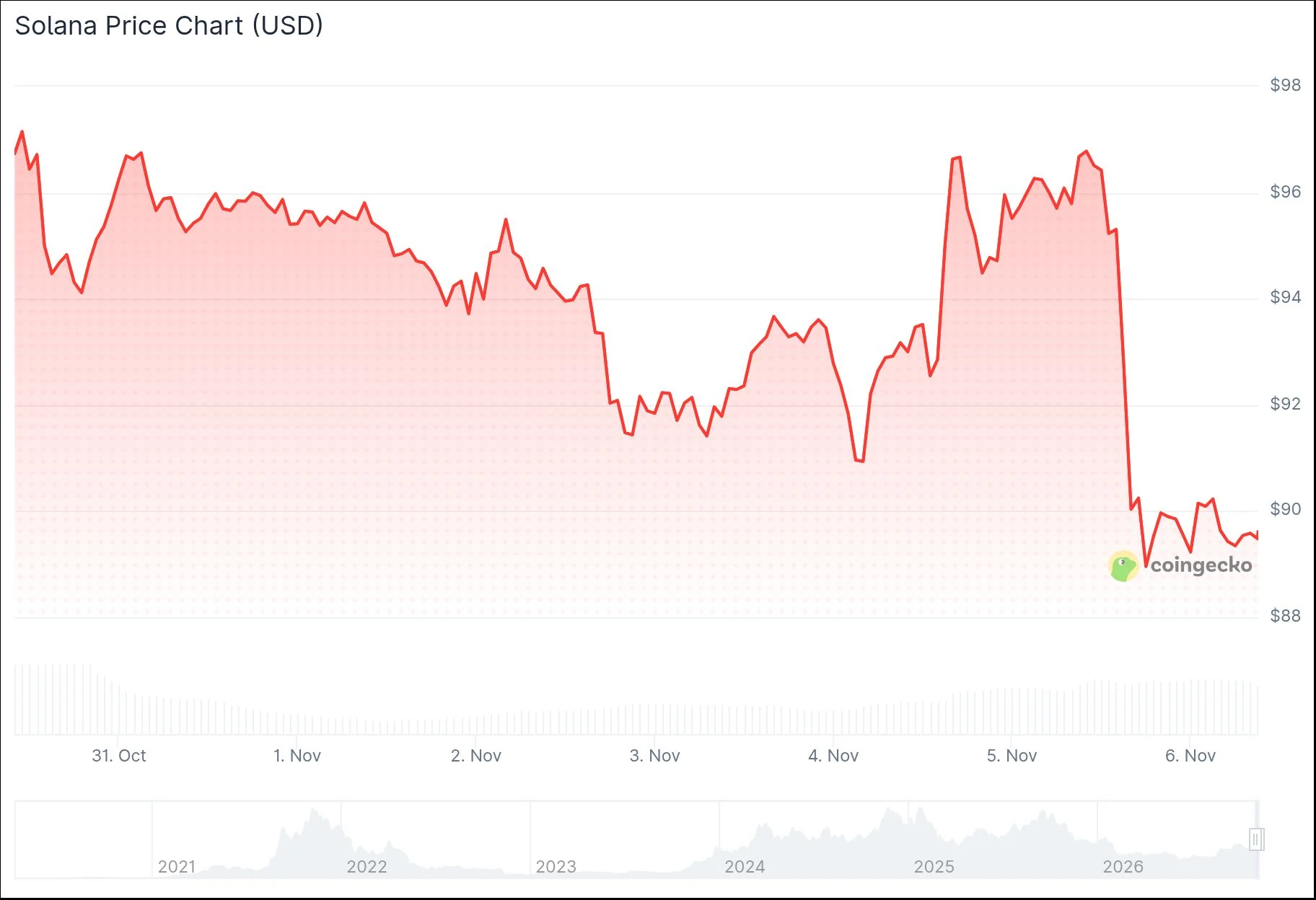
Solana (SOL) traded around $89.62 on Friday, November 6, holding near the ascending trendline that has guided the market since June while the network continued to post heavy usage numbers. The token has fallen roughly 28% from its September high near $124, leaving the gap between on-chain activity and price as the backdrop to the current test of support.
Solana is a high-throughput proof-of-stake blockchain known for low transaction fees, and its activity metrics have remained elevated even as the price has retreated. DefiLlama data from November 6 shows the network processed about 108.27 million transactions in 24 hours, with 2.83 million active addresses over the same period. Decentralized exchange trading volume reached about $2 billion, and total value locked across Solana's DeFi ecosystem stood near $5.26 billion.
Liquidity Slips While Network Use Holds
Seven-day DEX trading volume fell 10.7%, and stablecoin market capitalization on Solana dropped 2.73% to $14.76 billion. Stablecoins are dollar-pegged tokens, and their combined supply on a chain is a commonly cited gauge of dollar liquidity parked on that network. The decline in DeFi value partly reflects lower crypto prices rather than an equal amount of capital leaving, and the network's activity counts remained high during the same stretch.
On November 5, Solana announced that a stablecoin account went live inside Samsung Wallet. Eligible Galaxy users in the United States can now buy, hold, send and receive USDC, a US dollar-pegged stablecoin, on Solana. Because USDC transfers generate relatively small fees on the network, higher stablecoin use does not automatically translate into greater demand for SOL. Fees on Solana are paid in SOL, which is why demand for the token is tied to fee payments rather than raw transaction counts alone.
US Spot Solana ETFs Record Net Outflows
US spot Solana ETFs recorded about $1.18 million in net outflows on November 5, according to Coinmico. Seven-day withdrawals reached $11.92 million, and the tracker reported roughly $127.4 million in net outflows over 30 days. Cumulative inflows since launch remain positive at about $1.47 billion, with total ETF assets standing near $1.33 billion, or about 2.53% of Solana's market capitalization. Spot ETF flows reflect net creations and redemptions in the funds and are widely tracked as a read on allocation through these regulated vehicles, and at 2.53% of market capitalization the products still hold only a modest slice of Solana's overall market. Alpha Finance reported a different figure for November 5, at about $800,000 in outflows.
Price Tests the $90 Trendline
SOL fell toward $60 in June, then built the ascending trendline that supported its summer recovery. It rallied to $124 in late September before sellers pushed it back. Since that peak, the chart has printed a series of lower highs and lower lows, and the drop from the high now stands at about 28%.
Friday's intraday low was $88.82, briefly dipping under the trendline before the price recovered to $89.62. With the daily candle still open, the market had not confirmed whether the line would hold. Standard chart-reading practice treats the daily close, rather than an intraday dip, as the evidence that decides whether a trendline test has resolved.
Support sits between $88 and $90, with $85 and the $77 to $82 zone below it. That lower zone held prices in June and July. Resistance begins around $95 to $98, where SOL consolidated in March, April and May. Above that, traders watch $100, then $110 to $115 and $120 to $124. With the candle still open, the close against the $88 to $90 band is the near-term checkpoint, and the $95 to $98 shelf is the first level above the current price on the chart.
Analyst Flags Oversold Conditions
Analyst Jesse Olson wrote on X that SOL remains oversold on the daily chart. He said the price has broken below his third target, which raises the odds of a move to target four, and asked whether target four will be enough.
$SOL remains ultra bearish aka oversold on the daily chart. Price has broken below target three, increasing the odds of price hitting target four. Will target four get it? pic.twitter.com/vSjfW6HPuo — Jesse Olson (@JesseOlson) November 6, 2026
The Relative Strength Index stands at 30.06, just above the 30 oversold line, and it has declined steadily since September. The MACD line is at -4.55, below its signal line at -3.85, and the histogram reads -0.70. Analysts cite a bullish crossover and an RSI above 40 as signs that buying is returning. In indicator terms, the crossover refers to the MACD line turning back above its signal line, while RSI readings below 30 are the conventional threshold for labeling an asset oversold.
SOL was trading at $89.62 on Friday, with the daily candle still open and the intraday low at $88.82.
Source: CoinCentral

