Bitcoin Falls to $75,700 as $1.1 Billion in Crypto Liquidations Follow Tech Stock Selloff
Key Takeaways
- •Bitcoin dropped 6% to $75,700 on Thursday, one day after reaching $80,000, as its post-election rally faded amid a broader AI-driven equity selloff.
- •CoinGlass data shows $1.1 billion in crypto positions were liquidated within 24 hours, with $879.92 million wiped out in a single four-hour window and $818.90 million coming from long positions.
- •Spot Bitcoin ETFs shed $1.16 billion over three trading days before a $74.6 million net inflow on November 4, when Fidelity's FBTC took in $236.7 million while BlackRock's IBIT lost $201.2 million.
- •The Nasdaq closed down 5.5% at 24,315, sitting 11.9% below its October peak and past the 10% threshold conventionally defining a market correction, while Nvidia fell 9.3%.
- •Foundry Labs measured a 0.41 correlation between Bitcoin and the Nasdaq-100 tracker QQQ over 63 days, and Wintermute identified $73,000 and $68,000 as key levels to watch before turning more positive on the asset.
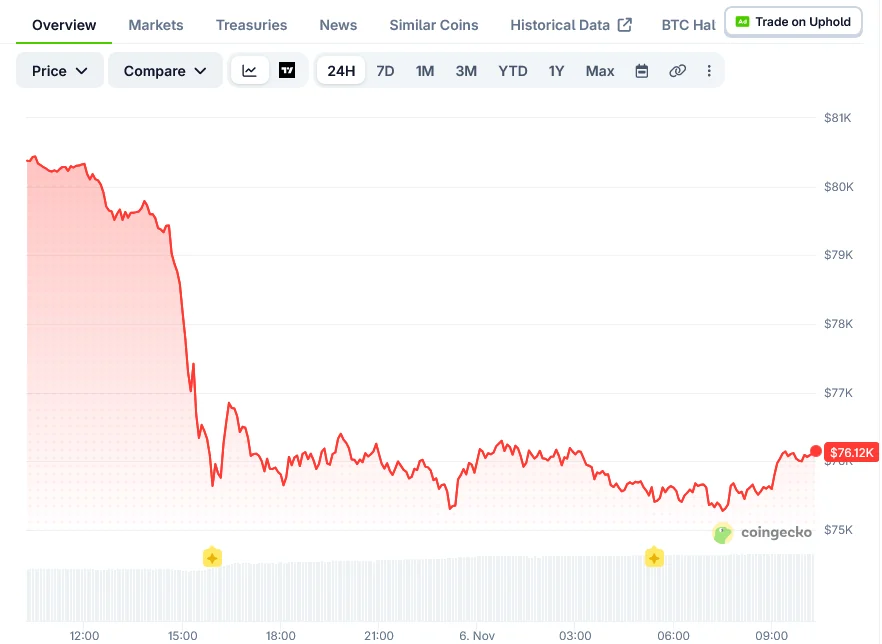
Bitcoin dropped 6% to $75,700 on Thursday, one day after reaching $80,000, as the cryptocurrency's post-election rally faded quickly this week. The reversal came as a sharp selloff in artificial intelligence stocks spread across Wall Street and dragged risk assets lower across markets. Ether, the second-largest cryptocurrency by market value, fell harder than Bitcoin, sliding more than 7% to $2,247, according to The Block.
Leveraged traders absorbed much of the damage. CoinGlass data cited by The Block shows that $1.1 billion in crypto positions were liquidated over a 24-hour period, covering almost 211,000 separate positions across exchanges. The heaviest losses were concentrated in a single four-hour window. During that stretch alone, $879.92 million was wiped out, with $818.90 million of the total coming from long positions that had been betting on higher prices.
These liquidations are not the same as money leaving Bitcoin exchange-traded funds — a distinction that matters during volatile trading sessions. Liquidations are forced exits from borrowed positions triggered when prices move against traders, while ETF flow data tracks cash moving directly into or out of the funds themselves.
ETF Flows Split Between Fidelity and BlackRock
Spot Bitcoin ETFs were already losing money before Thursday's price drop, with redemptions mounting across multiple sessions. Because the funds hold Bitcoin directly, their daily flow figures are widely followed as a gauge of investor demand for the asset. FarSide data shows outflows of $643.2 million on October 30, $398.6 million on November 2, and $115.6 million on November 3. That added up to $1.16 billion leaving the funds over three trading days. Cryptopolitan had earlier reported a single-day outflow of $487 million in October.
The pattern broke on November 4, when the ETFs collectively posted a net inflow of $74.6 million. The two biggest names in the sector, however, moved in opposite directions that day. Fidelity's FBTC took in $236.7 million, while BlackRock's IBIT saw $201.2 million leave the fund.
Tech Stocks Drag Risk Assets Lower
The tech-heavy Nasdaq closed Thursday down 5.5% at 24,315.00. The index now sits 11.9% below its October peak — past the 10% decline conventionally used to define a market correction — while the S&P 500 lost 4.4% and chipmaker Nvidia fell 9.3%. Investors are asking when costly AI projects will begin to pay off, and high borrowing costs along with possible post-election limits on data centers have added to those worries.
“Coming into this earnings season, there were worries that AI spending was too much,” Swissquote analyst Ipek Ozkardeskaya told Reuters.
J.P. Morgan's Michael Cembalest reported an 8% drop in hedge funds' gross long-short exposure and about $4 trillion in AI-related off-balance-sheet commitments — obligations that do not appear on the companies' own balance sheets.
Bitcoin, meanwhile, has been moving more closely with technology stocks. Foundry Labs measured a 0.41 correlation between Bitcoin and the Nasdaq-100 tracker QQQ over a 63-day period, a level generally regarded as a moderate positive relationship, and found that public Bitcoin miners now trade more like AI infrastructure stocks. S&P Global has also observed Bitcoin tracking equities when investors pull back from risk. Still, the link does not prove that the AI selloff was the direct cause of Thursday's Bitcoin drop.
Trading firm Wintermute called Wednesday's rebound an instance of short-lived optimism. The firm named $73,000 and $68,000 as key levels to watch and said it wants to see Bitcoin hold above $80,000 before turning more positive on the asset.
Paul Howard of Wincent pointed to politics as another factor behind the weakness. He said recent Democratic gains in Congress could make it harder to pass the Clarity Act, legislation designed to establish a regulatory framework for digital assets in the United States.
ETF data for November 5 is still incomplete, as several issuers have not yet reported. Those figures will show whether the November 4 inflow marked a genuine return of investor demand or simply a pause in outflows.

