Meta AI Forecasts Solana at $250–$500 by End of 2026, Citing Mispricing and Catalyst Stack
Key Takeaways
- •Meta AI projects Solana could reach $250 to $500 by December 31, 2026, representing a potential 3.4x to 6.8x gain from the current price near $73.50.
- •Firedancer is live on approximately 20% of validators and has achieved one million transactions per second in testing, with full mainnet deployment targeted for the second half of 2026.
- •The Alpenglow consensus upgrade reached testnet on May 11, 2026, and aims to reduce transaction finality from 12 seconds to roughly 150 milliseconds upon its planned Q3 mainnet launch.
- •More than 30 institutions collectively hold $540 million in Solana ETF exposure, with Fidelity's FSOL fund among the notable positions launched in 2026.
- •Stablecoin supply on Solana stands at $14.1 billion against $650 billion in monthly transfer volume, indicating active economic throughput across the network.
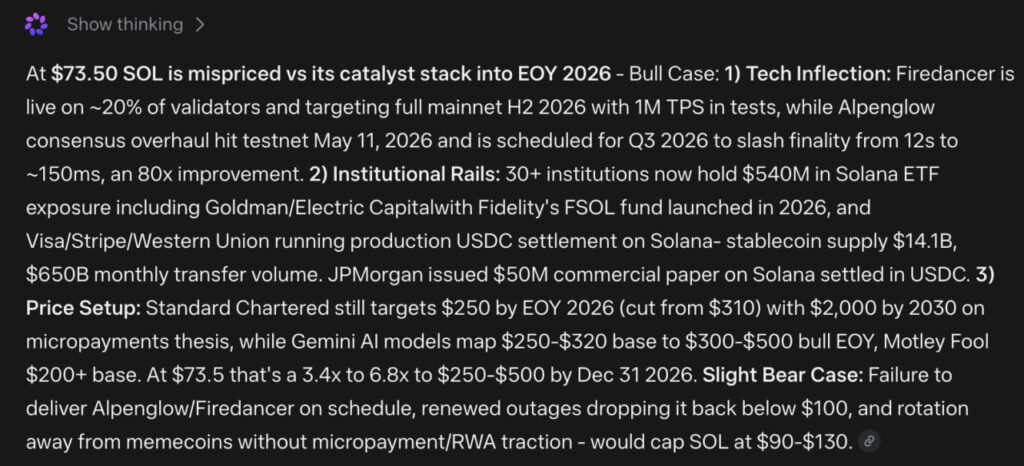
A central claim underpins the entire analytical thesis: mispricing. According to Meta AI, Solana (SOL) is trading well below the level its growing set of catalysts would justify at the current price of $73.50. The projected price range sits between $250 and $500 by December 31, 2026, which would represent a 3.4x to 6.8x increase from current levels. Solana has positioned itself as a leading high-throughput Layer 1 blockchain since its mainnet launch, consistently marketing sub-second settlement and low fees as differentiators against Ethereum, though network reliability issues have periodically undercut that narrative.
Technology Upgrades: Firedancer and Alpenglow
The technological inflection point is the first pillar of the argument. Firedancer, Solana's new validator client, is already live on approximately 20% of validators and is targeting full mainnet deployment in the second half of 2026, having achieved 1 million transactions per second (TPS) in testing environments. Firedancer is being developed by Jump Crypto, and its significance extends beyond raw throughput: a second independent validator client reduces reliance on Solana Labs' original implementation, mitigating the risk that a single software bug could halt the entire network—a vulnerability that contributed to past outages.
Alpenglow represents the second major component of this upgrade cycle. The consensus overhaul reached testnet on May 11, 2026, and is scheduled for Q3 mainnet deployment. It is designed to reduce transaction finality from 12 seconds to approximately 150 milliseconds—an 80x improvement in settlement speed. For context, finality at that level would place Solana competitively alongside or ahead of centralized payment rails for settlement certainty, a threshold often cited as necessary for institutional payment and settlement use cases.
Institutional Adoption and Stablecoin Activity
Institutional infrastructure forms the second pillar of the bullish case. More than 30 institutions now hold a combined $540 million in Solana ETF exposure, including Goldman Sachs and Electric Capital. Fidelity's FSOL fund launched in 2026 alongside these positions. The emergence of spot Solana ETFs mirrors the product trajectory that preceded broader institutional capital allocation in Bitcoin and Ethereum, where ETF approval cycles served as gating events for allocators with mandate restrictions on direct custody.
Major payment companies are already conducting USDC settlement in production on the Solana network. Stablecoin supply on Solana stands at $14.1 billion against $650 billion in monthly transfer volume. That transfer-to-supply ratio signals active circulation rather than idle holdings, a metric track developers and analysts use to gauge real economic throughput as opposed to speculative trading. Separately, JPMorgan issued $50 million in commercial paper settled via USDC, marking one of the more notable instances of a major bank using dollar-backed tokens for traditional instrument settlement.
Bear Case: Execution Risk
The bearish scenario is tied directly to delivery timelines. The primary risk identified is the failure to ship Alpenglow and Firedancer on schedule. Solana's track record includes multiple network halts—most notably an extended outage in February 2023—and critics have argued that the network's architecture trades reliability for speed. In a delayed-delivery scenario, renewed network outages could push SOL back below $100. Additionally, if rotation away from memecoins occurs without meaningful traction in micropayments or real-world asset (RWA) tokenization, the price could be capped between $90 and $130. Memecoin trading has been a significant driver of Solana's transaction volume, raising questions about the durability of network activity if that segment cools.
Price Action and Technical Indicators
The chart has yet to reflect the institutional and technological developments. SOL peaked near $250 in September and has trended lower since. November saw a structural breakdown, with price moving from $190 toward $120. February brought a capitulation decline to the low $70s. Spring trading ranged between $80 and $95. June broke that range, marking a low near $60. July produced a brief bounce to $83 that failed to hold, and price has since drifted back into the low $70s.
The most recent close was $73.57, up 1.29% or $0.94 on the session. The daily range spanned $72.38 to $73.70. Support levels sit at $70, followed by $60 at the June bottom. Resistance runs through $80, $90, and $100.
The Relative Strength Index (RSI) reads 46.40 against a signal line at 44.93. That gap of approximately 1.5 points is narrow, indicating minimal directional pressure. Both lines sit below the midline, with momentum described as neutral to slightly soft.
Meta AI's floor scenario begins at $90, above the current trading price. Q3 is positioned as the period when Alpenglow's delivery will either close the gap between price and fundamentals or widen it.
LiquidChain: A Layer 3 Cross-Chain Solution
The article also highlights LiquidChain, a project addressing cross-chain inefficiencies. The infrastructure connecting Bitcoin, Ethereum, and Solana was built incrementally by separate teams without a shared architecture, resulting in persistent friction—isolated liquidity pools, bridges that fail during congestion, and slippage extracted before transactions reach their destination. Cross-chain bridging has been a persistent attack vector in the crypto industry, with bridge exploits accounting for some of the largest thefts on record, which underscores the demand for alternative interoperability approaches.
LiquidChain operates at Layer 3, positioned above all three networks, aiming to consolidate their isolated liquidity into a unified execution environment. A single deployment would reach Bitcoin, Ethereum, and Solana simultaneously without fragmented codebases or bridging overhead.
The project identifies four specific failure points it aims to address: the Unified Liquidity Layer to eliminate silos, Single-Step Execution to remove multi-transaction cost overhead, Verifiable Settlement to strip out trust assumptions that create counterparty risk, and a Deploy-Once model enabling one codebase to reach all target networks.
The LiquidChain presale is live at $0.01454 per $LIQUID token, with over $900,000 raised as of publication.

