Two Top Transportation Attorneys Assess Whether the Small Carrier Has a Future After Montgomery
Key Takeaways
- •In Montgomery v. Caribe Transport, the Supreme Court ruled 9-0 in May that brokers can be held liable for negligently selecting unsafe carriers, closing the door on early preemption-based dismissals.
- •Rising litigation costs from the ruling are compounding an already hard commercial trucking insurance market, hitting small operators hardest.
- •Broker carrier-selection policies have become formalized, discoverable, and inconsistent across companies, forcing small carriers to qualify under each broker's differing criteria.
- •Attorney Greg Feary said large carriers are already recruiting small fleets to operate under their authority and expects substantial consolidation within a year.
- •Both attorneys advised small carriers to maintain complete compliance files, learn each broker's rejection criteria, and build a documented safety-first culture to remain viable as independents.
A question is hanging over the small carrier world, and two of the most knowledgeable transportation attorneys in the country did not flinch from it when they sat down separately on The Long Haul. The question: does the small carrier — the one-truck owner-operator and the five-truck fleet — still have a viable future as an independent business, or are the forces set in motion by the Supreme Court's Montgomery decision quietly pushing that operator toward extinction as an independent and into the arms of a larger carrier?
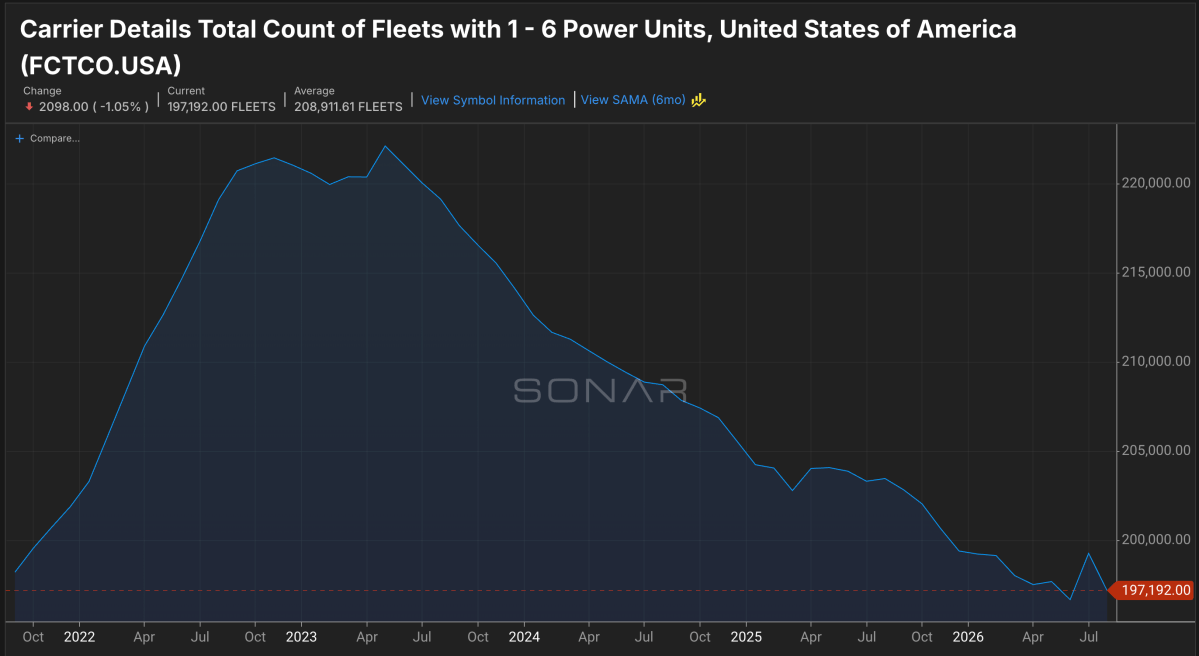
The stakes are outsized because small carriers are not a niche. According to FMCSA figures, the overwhelming majority of registered motor carriers in the United States operate six or fewer trucks, meaning any shift in how brokers and shippers vet carriers touches the bulk of the industry's capacity — and, by extension, freight rates and capacity for the whole supply chain.
Neither attorney sugarcoated it. Brian Nelson, a partner at Taylor Nelson Slattery Bernard in St. Petersburg, Florida, who spent years as general counsel inside a broker, a motor carrier, and a 3PL under one roof, walked through the legal machinery now bearing down on carriers. Greg Feary, president and managing partner of Scopelitis, the firm the biggest fleets in the country call when things go wrong, went further and named the outcome he is already seeing. Together, their two conversations form the clearest picture available of where the small carrier stands — a picture every independent operator needs to see.
What Montgomery Actually Changed
Start with the ruling itself, because everything else flows from it. In Montgomery v. Caribe Transport, decided this May by a unanimous 9-0 Supreme Court, the justices answered a single question: do brokers have a duty to select carriers that operate safely over the roadways? The Court said yes, resolving a years-long split in the lower courts over whether federal transportation law preempted such claims against brokers. As Nelson explained, that put brokers back into what he called the firing squad — they can no longer get a negligent selection lawsuit dismissed early on the grounds that federal law preempts it.
Before May 14, in most of the country, a broker sued after a crash could file a motion to dismiss and often exit the litigation quickly on preemption grounds. Nelson described the old routine: file the answer, file the motion to dismiss, argue there is no valid claim, and get out. That door is now closed. Brokers can no longer rely on that early exit, which means they must go through discovery and potentially all the way to summary judgment. That longer, more expensive path is why insurance companies are raising rates: they know they will have to pay defense costs deeper into every case. It also arrives amid a broader hard market for commercial trucking insurance, where carriers have already been absorbing years of premium increases, so the litigation-driven pressure compounds a cost trend that was already squeezing small operators.
Nelson was careful to note that causation still matters. A plaintiff still has to prove that the specific thing the broker was negligent about — say, selecting a carrier with poor vehicle maintenance — actually caused the crash. But he explained how plaintiffs get around that requirement using what is called the reptile theory. The argument runs that if a carrier is bad at one thing, hours of service for instance, a jury will believe it must be bad at everything, including whatever actually caused the wreck. The practical consequence, Nelson said, is that a carrier can no longer afford to be excellent at four things and poor at one. In his words, you have to take a holistic approach and treat every single thing like it is the most important thing.
The Squeeze Nelson Sees Coming for Carriers
Nelson's central message for small carriers was that Montgomery quietly changed what a carrier is worth to the people who hire it, and it did so in a way that lands hardest on the small operator.
Carrier selection policies, once loose guidelines a dispatcher applied on the fly, have become formalized red-light, green-light systems that are discoverable business records. Every broker now has one, and they differ from one another. That creates a genuine burden: as Nelson put it, a carrier now has to worry not only about 50 different states' rules but about every single broker having a different carrier selection policy, and whether the carrier can qualify under each one. Your salespeople, he said, are now selling your company to brokers week after week, trying to stay qualified enough to keep getting freight. For a five-truck operation without a dedicated compliance department, that vetting burden lands on the same person who is also dispatching, maintaining trucks, and driving.
He also flagged the trap in the ruling's language about conditional carriers. The Court, Nelson said, took the plaintiff's characterization of conditional carriers and dropped it into the opinion without defining or qualifying it, and that language is now so strong and so feared that many brokers are simply stepping back from conditional carriers altogether. He called this a disservice, pointing out the inconsistency: the government itself said in a 2015 settlement that the underlying BASIC scores were unreliable and pulled them from public safety determinations, yet a conditional rating now carries enormous weight while a satisfactory rating means almost nothing. As Nelson put it, either they should both mean a lot or both mean nothing.
He also pointed to a structural unfairness that hits carriers harder than brokers. A broker hit with a judgment can close down and start up again tomorrow, he said, because there is no such thing as a chameleon broker in the regulations. A carrier cannot. The safety record, the reincarnated-carrier rules — all of it follows the carrier. The carrier carries a risk the broker does not: lose big, and you may not be able to start again.
Feary Names the Outcome: Absorption
If Nelson described the machinery, Greg Feary described where it leads, and he was blunt about it. Feary represents the largest carriers in the country, which gives his read particular weight, because he is describing what he sees his own clients preparing to do.
Asked directly whether he sees the small carrier increasingly on the outside looking in while larger carriers absorb the capacity, Feary did not hesitate. "I'm seeing it already," he said. He laid out the scenario from the small carrier's point of view: a five-truck operation with its own authority, getting freight from various sources, watching that freight dry up as brokers decide they are not sure they want to deal with the small carrier anymore. At that point, the small carrier has to think about whether to become a fleet operator under the authority of one of the large carriers — to keep the doors open, keep paying the mortgage, keep food on the table.
He believes this is exactly what the large carriers are planning for. In his words, the large carriers think that is a legitimate option, and they are going to be recruiting these small carriers, these four- and five-truck operations, giving them the option to get their freight a different way under a larger carrier's authority. He expects to see a lot of that happening within the year. A shift of that kind would accelerate a consolidation pattern the industry has seen before — after the freight recession that followed the pandemic-era capacity boom, large carriers gained share as rate pressure and rising costs pushed weaker operators out of the market.
The data point raised on the show sharpened the picture further. Authorities with one to six trucks are declining in a way that looks like the downslope of a mountain, while carriers with 15 or more trucks ticked up slightly. Feary agreed there may be a friction point somewhere around 15 or 20 trucks, where a carrier is big enough to keep getting business, and that as small carriers drop off, the larger ones absorb their freight, recruit their drivers, and gain economies of scale on fuel and insurance. His warning for the small carrier was direct: if they do not find a home with a very large carrier, or at least the next carrier up in size, they may struggle. He would not predict for how long.
Why the Small Carrier Is Structurally Exposed
Both attorneys, from different angles, explained why this pressure lands so unevenly on the small operator, and it comes down to how carriers are actually judged now.
Feary pointed out that the vast majority of carriers in the United States are small carriers, and the vast majority of those have never been rated at all. Less than 10% of carriers carry a safety rating, he said, and if the FMCSA tried to audit and rate every carrier that exists today, it would take an estimated 23 years. That leaves the enormous population of small, unrated carriers in a gray zone, judged not by a clear government rating but by whatever vetting criteria each individual broker chooses to apply. As Feary put it, a small carrier getting freight from five sources today may find tomorrow that only two of them still consider it qualified.
Feary also laid out why shippers and brokers will increasingly prefer the large carrier, and it is not really about safety data alone. Shippers deciding who to do business with, he said, will want larger carriers, larger brokers, older carriers, older brokers — the ones they see as more reliable, more financially secure, backed by technology, and able to stand in front of them if a lawsuit comes. The Montgomery decision, in his assessment, is not going to hurt the large carriers. It is likely to benefit them.
For the owner-operator specifically thinking about getting their own authority, Feary's assessment was the bluntest line in either interview. Between the cost of insurance, which he expects to keep rising, the thinning number of brokers willing to work with a brand-new authority, and rising insurance minimums, he said that if you are starting with one truck, it could be tough sledding — and this may not be the right time to jump into the small carrier market.
What Both Attorneys Say You Can Actually Do
Neither attorney left the small carrier without a path, and their advice, taken together, is the constructive core of both conversations. The picture is hard, but it is not hopeless, and what an operator does now matters.
Nelson's practical guidance centered on control and knowledge. A carrier can only control what it controls: its driver qualification files, its maintenance records, its hiring practices, its paperwork. He stressed that a defensible file is one that is complete and up to date, with nothing past deadline, no missing pre-employment drug test, no skipped driving-history check — because in litigation you do not get gold stars for doing what you were supposed to do, you only get deductions for what is missing. He compared it to competitive cheer, where you start with the maximum score and only lose points, and to team sports where you can make up for a mistake on the next play. A carrier, he said, does not get that luxury. Its paperwork has to be right every time. His single most important step for the operator listening at a truck stop: get a copy of the federal regulations and actually know them, because this is your profession and your business.
Nelson also advised carriers to find out each broker's red lights — the things that will get a carrier rejected — since those are discoverable business records the carrier is entitled to understand, and to start local. Target brokers you can physically visit, he said, because brokers are terrified of cargo theft from carriers they cannot see or touch, and being the carrier down the street who can be looked in the eye is a real advantage in the new environment. And he offered a reminder that cuts against the doom: brokers do not move cargo. They need you, your truck, your drivers, your professionalism. Somebody will use you.
Feary's three things were pitched at the strategic level. First, find out how the sources where you normally get freight actually see you — safe or unsafe — and if they do not have a sense of you, proactively give them the credentials that show you are safe. Second, if you cannot make that work, sit down at the kitchen table and honestly do the math on whether operating as an owner-operator under a larger carrier's authority might actually mean lower costs and more reliable freight in the geographies you want to run. He framed that not as surrender but as a legitimate business calculation. Third, and the point he stressed hardest through the entire conversation, reframe the job itself so that safety comes first and on-time delivery second. A trucking business built around a genuine safety culture, he argued, is the one that survives, because hours of service, safe driving, driver qualification — all of it follows from that culture, and it is exactly what the shipping community and the courts now reward.
The Honest Bottom Line
Put the two conversations together and the message is clear-eyed rather than comforting. The Supreme Court did not pass a law aimed at small carriers, but the environment its ruling created — formalized broker vetting, rising insurance costs, a preference for scale, and a legal system that punishes any single weakness — presses hardest on the operator with the fewest trucks and the thinnest margins. Feary is already watching the consolidation begin, with large carriers preparing to recruit the small ones under their authority, and he was honest that for some, becoming a fleet operator under a bigger carrier may be the rational move.
But neither attorney said the independent small carrier is finished, and that distinction matters. What they said is that the bar has moved, and the small carriers who survive as independents will be the ones who treat compliance and safety not as a cost or an afterthought but as the core of the business — who know their paperwork is airtight, who understand exactly how their freight sources judge them, and who build the kind of documented, safety-first operation that tells the right story before anyone ever sues. As noted in closing one of the conversations, the standard you are measured against is not a handbook; it is fluid, and it could be set by twelve people in a jury box after the worst day of your life. The only defense is an operation that was already telling the right story before any of that happened.
The small carrier's future, in other words, is not guaranteed, and it is not automatically doomed. It now depends, more than it ever has, on the choices the operator makes right now — before the freight tightens further and before the phone call from the plaintiff's attorney ever comes.
Source: FreightWaves

