SK Group Chairman Chey Tae-won Urges Affiliates to Redefine Themselves as AI Companies
Key Takeaways
- •SK Group Chairman Chey Tae-won told subsidiary leaders at the 2026 CEO Seminar that every affiliate must move beyond its traditional business and redefine itself as an AI company connected to a token economy where computing and services are traded as resources.
- •The group's AI flywheel strategy links AI semiconductor capabilities to the expansion of AI factories, with competitive energy supplies and wider service adoption expected to spur additional investment in advanced chips and computing facilities.
- •Chey described open cooperation with global partners as essential in the AI era, noting that no company can accomplish everything on its own.
- •Affiliates are already applying AI in-house: SK hynix is upgrading smart fabs with AI and digital twin technology, SK Innovation improved yields at its Ulsan complex, SK Telecom is automating networks and services, and SK Gas is using AI for market analysis.
- •Executives agreed to continue portfolio rebalancing that restructures inefficient businesses and to allocate capital based on cash-generating capacity, balancing financial stability with future AI investment.
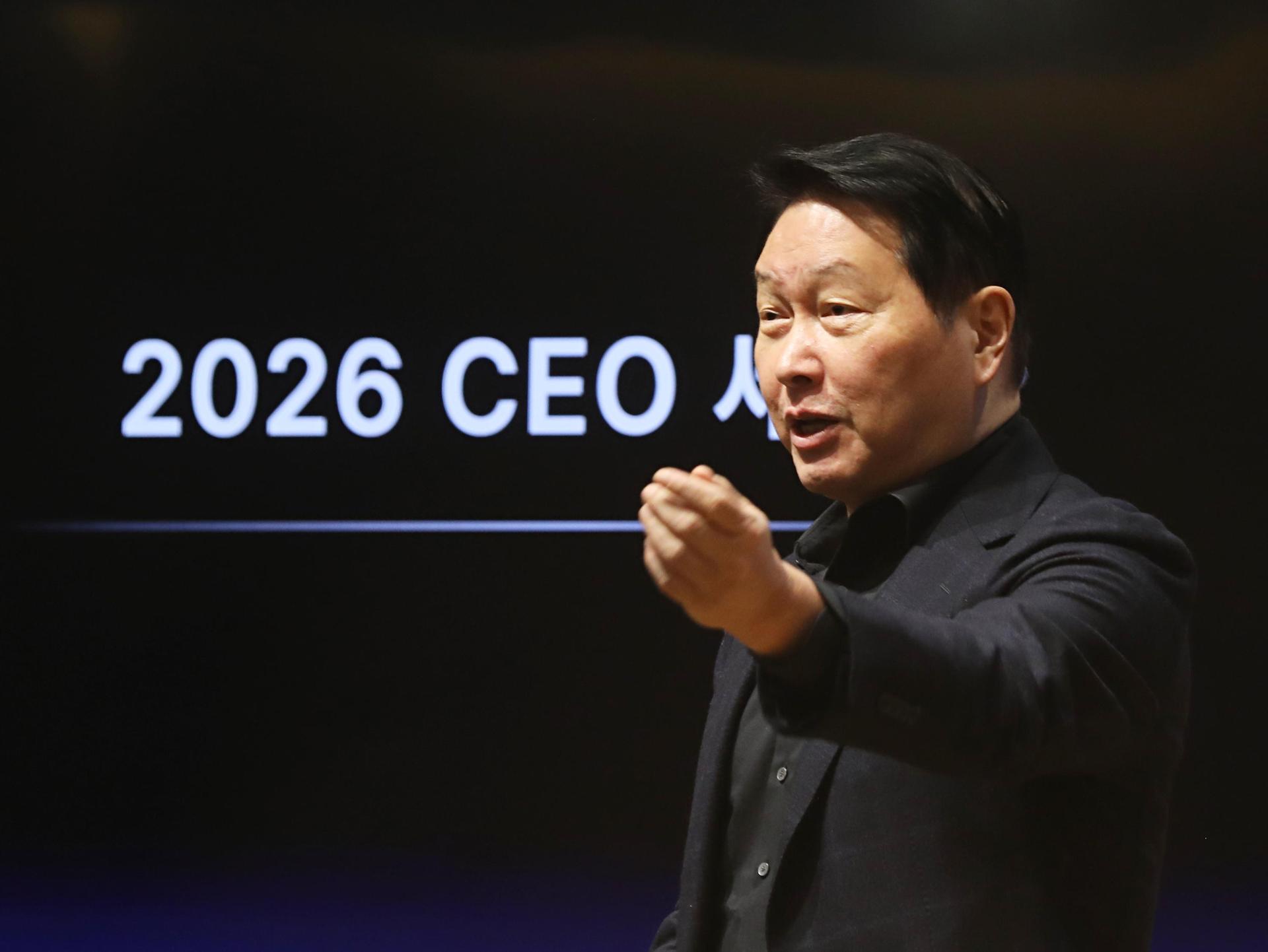
SK Group Chairman Chey Tae-won has called on the leaders of the conglomerate's subsidiaries to redefine themselves as artificial intelligence (AI) companies, expanding beyond chips, infrastructure and energy into AI models and services to build a growth cycle that connects the group's businesses. SK is one of South Korea's largest conglomerates, with businesses spanning semiconductors, energy and telecommunications.
According to SK Group, Chey outlined the strategy at the group's 2026 CEO Seminar, held Thursday to Saturday at the SKMS Research Lab in Icheon, Gyeonggi Province.
During the seminar, Chey stressed the importance of an “AI flywheel” to position SK as a key player in a “token economy,” where AI computing and services are traded as resources.
“We must break out of existing business frameworks and redefine ourselves as AI companies,” Chey said, urging every affiliate to find new roles beyond its traditional business and connect them to AI services and the token economy.
Under the strategy, AI semiconductor capabilities would support the expansion of AI factories — computing facilities that power AI services — meeting growing demand for electricity, energy and AI services. In turn, competitive energy supplies and wider service adoption would spur further investment in AI factories and advanced chips.
“In the AI era, we cannot do everything alone,” he said, describing open cooperation with global partners as essential to strengthening capabilities and accelerating execution.
SK said the group's companies are already applying AI to their operations. SK hynix, the group's semiconductor affiliate, is improving production efficiency by upgrading smart fabs that combine AI and digital twin technology. SK Innovation has improved yields at its Ulsan complex using a “process map” that links equipment and operating data. SK Telecom is using AI-based network and service automation to improve productivity and customer experience. SK Gas has accelerated decision-making by using AI to analyze market conditions and turn operational knowledge into reusable assets. Taken together, the examples point to the in-house AI adoption the chairman now wants extended group-wide.
Executives at the seminar also agreed to continue the group's ongoing “portfolio rebalancing,” which restructures inefficient businesses and strengthens core operations to support the AI strategy.
The group plans to balance financial stability with future investment through capital allocation based on cash-generating capacity, while expanding AI transformation that combines employees' expertise with data to generate earnings and change working methods. Those commitments — the restructuring and the funding framework — offer concrete reference points for tracking how the AI strategy takes hold across the group.
The seminar also examined new business opportunities and potential risks, with executives exchanging ideas about one another's businesses rather than reporting their positions.
This report originally appeared in The Korea Times Business on Nov. 15, 2026: SK chairman calls for AI expansion beyond chips into models, services

