SiBAN Boycotts Global Impact Leaders Summit in South Africa Over Xenophobic Violence Against Nigerians
Key Takeaways
- •SiBAN formally declined to participate in the Global Impact Leaders Summit & Awards 2026, scheduled for 9 August in Cape Town, rejecting both in-person and virtual attendance options.
- •The association cited the mistreatment and safety of Nigerians in South Africa as the primary reason for its decision.
- •Anti-immigrant protests since April in Johannesburg, Pretoria, and Durban resulted in the deaths of at least two Nigerian men and led Nigeria to repatriate hundreds of its citizens.
- •Nigeria's Foreign Minister Bianca Odumegwu-Ojukwu accused South Africa of failing to strongly condemn the violence, referencing Nigeria's historical financial support for the anti-apartheid movement.
- •The boycott raises concerns about whether cross-border pan-African business collaboration can proceed amid ongoing xenophobic tensions in South Africa.
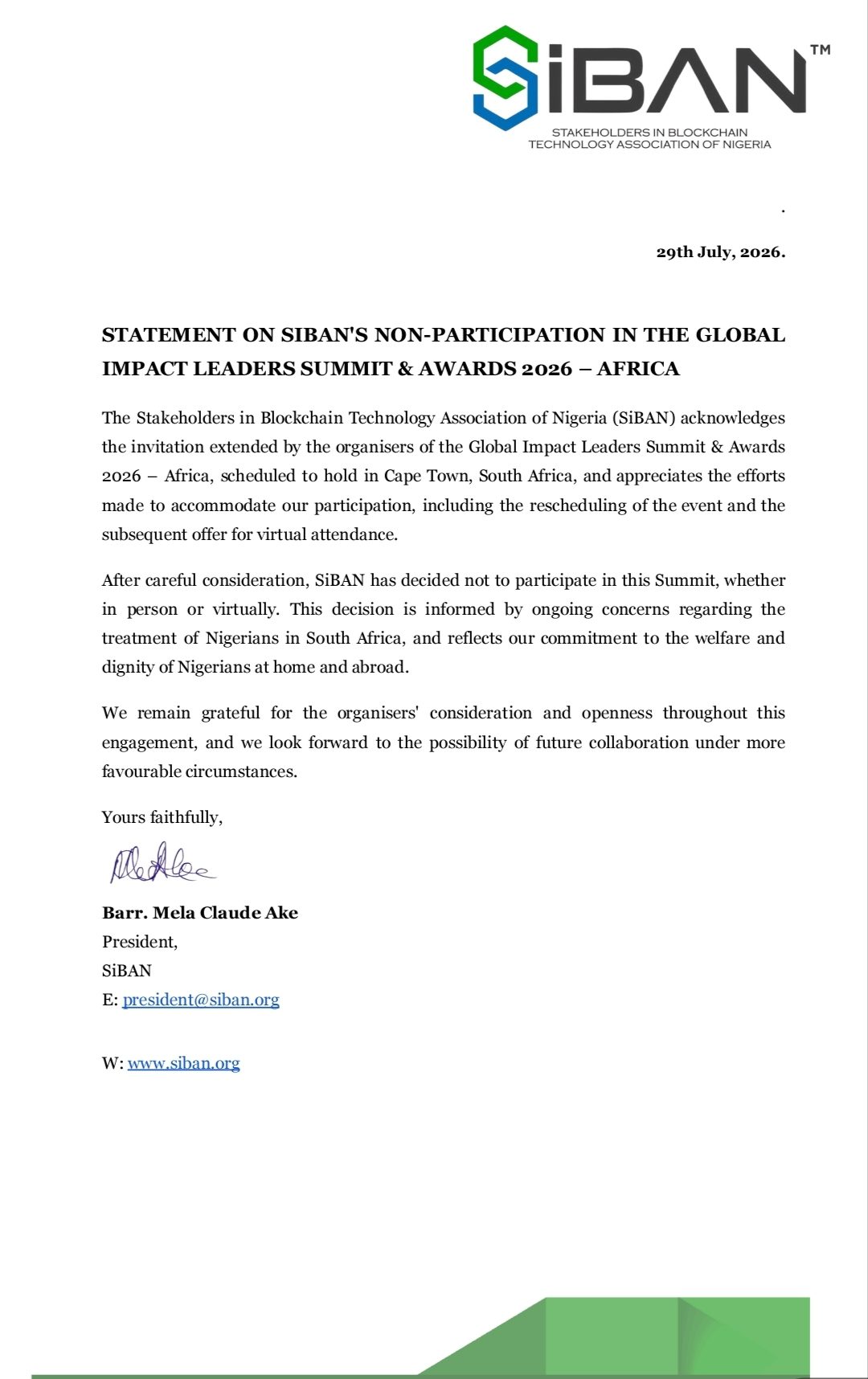
An invitation intended to celebrate African leadership has instead underscored the deteriorating state of Nigeria–South Africa relations in 2026. The Stakeholders in Blockchain Technology Association of Nigeria (SiBAN), a self-regulatory body representing Nigeria's fast-growing blockchain and digital asset industry, has formally declined to participate in the Global Impact Leaders Summit & Awards 2026, Africa, a Cape Town–based event organized by CIO Look, a business magazine and media platform operating under Ciolook Media.
In a statement signed by SiBAN president Barr. Mela Claude Ake and shared with Technext, the association cited the safety and welfare of Nigerians in South Africa as the basis for its decision.
"This decision is informed by ongoing concerns regarding the treatment of Nigerians in South Africa and reflects our commitment to the welfare and dignity of Nigerians at home and abroad," the statement reads. The association confirmed it would not attend "whether in person or virtually."
CIO Look's invitation letter, dated 26 June and signed by director and CEO Manish Bansal, invited SiBAN to an event themed "Leadership Beyond Borders: Shaping Africa's Global Future." The summit was scheduled for 9 August at the DoubleTree by Hilton in Cape Town, convening entrepreneurs, investors, policymakers, and business leaders from more than 20 countries. SiBAN had been invited to nominate members for recognition, with the package including red-carpet photography, an on-stage award and trophy, a leadership video interview, and a complimentary three-page feature in an upcoming CIO Look edition titled "Africa's Most Influential Personalities to Watch in 2026."
The summit's borderless-leadership theme sits uneasily against the reality on the ground. Nigeria and South Africa are Africa's two largest economies, and their bilateral relationship has long been a bellwether for broader pan-African cooperation. When that relationship frictions—as it has through repeated cycles of xenophobic violence—the ripple effects extend into trade, investment flows, and cross-border technology partnerships of the kind SiBAN's members inhabit daily.
In an exclusive statement to Technext, Ake elaborated on the rationale behind the boycott in personal and unequivocal terms.
"As president of SIBAN, it's expected that our focus is on conversations on tech and allied matters," he said. "However, at the fundamental level, tech, industry and business are about human lives, human beings. These things we pursue, the products and technologies we innovate with, are about enriching and enabling the human experience."
Ake confirmed the sequence of events: the original invitation required physical attendance in Cape Town, which SiBAN declined. The organizers then offered a virtual participation option, which the association also turned down.
"We felt that honouring this invite at this time would be most inappropriate considering the news of the mistreatment of Nigerians in South Africa," he said. "We believe that while partnering with businesses in South Africa has undeniable benefits, we cannot build business bridges at the cost of our dignity and humanity."
He added: "We hope that these issues are resolved quickly and decisively. We also hope those affected find justice."
The boycott follows a particularly difficult period for Nigerians in South Africa. Since April, anti-immigrant protests led by groups such as March and March have swept through Johannesburg, Pretoria, and Durban. Human Rights Watch has documented violent attacks on foreign nationals with little apparent police response. At least two Nigerian men died in the unrest in April, prompting Nigeria's government to repatriate hundreds of its citizens amid allegations of xenophobic violence (related coverage). Nigeria's Senate has also weighed in, rejecting proposals to nationalise South African–linked businesses such as MTN and MultiChoice as a retaliatory measure.
By June, the crisis had extended well beyond the Nigerian community. Thousands of Malawians and other African nationals fled to a makeshift camp in Durban following similar threats.
Nigeria's Foreign Minister Bianca Odumegwu-Ojukwu accused Pretoria of failing to forcefully condemn the violence, arguing that the inaction had damaged a bond forged during Nigeria's support for South Africa's anti-apartheid struggle. Nigeria spent an estimated several billion dollars in the 1970s and 1980s supporting the African National Congress and other liberation movements—a historical debt that makes the current breakdown in trust especially charged.
This is not an isolated flashpoint. South Africa has experienced recurring waves of xenophobic violence dating back to 2015 and 2019, both of which disproportionately affected Nigerian nationals. Vigilante movements such as Operation Dudula have perpetuated the pattern over subsequent years.
SiBAN's decision raises a broader question for pan-African business and media organizations hosting events in South Africa: how many other invitations are being quietly declined for the same reasons, without any public statement attached? With the African Continental Free Trade Area advancing in its implementation phases, the ability of organizations to convene across borders without fear is becoming a practical precondition—not just a diplomatic aspiration—for the integrated African economy those summits exist to promote.

