Shinhan Asset Management Tests Won Tokenized Fund on Solana
Key Takeaways
- •Shinhan Asset Management, an affiliate of Shinhan Financial Group, has signed a four-party agreement to test a Korean won-denominated tokenized fund on the Solana blockchain.
- •The pilot's stated objective is to demonstrate that a won-based fund can be issued and managed on-chain, and the arrangement is a test rather than a commercial launch.
- •The specific responsibilities of each participating party and the size of the fund have not been disclosed, and the pilot's scope and timeline remain unpublished.
- •The test reflects growing institutional interest in tokenized financial products in South Korea, following global moves such as BlackRock's 2024 launch of the BUIDL tokenized fund and Franklin Templeton's on-chain government money market fund.
- •South Korea's Virtual Asset User Protection Act took effect in July 2024 and regulators have explored tokenized securities pilots, but the current test does not guarantee commercialization or regulatory approval.
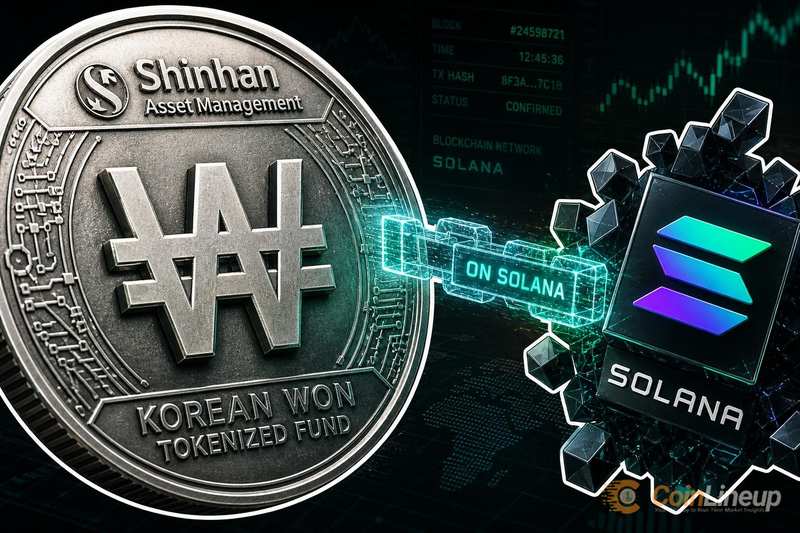
Shinhan Asset Management has signed a four-party agreement to test a Korean won tokenized fund on Solana, marking an early-stage pilot by one of South Korea’s asset managers rather than a live commercial product. Shinhan Asset Management is an affiliate of Shinhan Financial Group, one of South Korea’s largest financial holding companies, which places the test within an established regulated institution rather than a startup effort.
What the four-party agreement is intended to test
The arrangement is a test, not a full commercial launch. It brings together four parties in a coordinated pilot centered on a single product: a Korean won-denominated tokenized fund, according to Solana’s announcement of the agreement. For related coverage, see Fed's Daly Maps Longer Inflation Path, Leaving Bitcoin's Rate Tailwind Conditional.
The four-party structure is significant because it points to shared responsibility among the participants rather than a closed trial run by a single firm. The immediate objective is limited: to show that a won-based fund can be issued and managed on-chain. For related coverage, see FBI Brings Back Alleged $165M Crypto Ponzi Mastermind After Fiji Escape.
Because available information on the agreement is limited, the specific responsibilities of each party and the size of the fund have not been disclosed. The confirmed facts are the agreement itself and its stated purpose.
Why Solana is central to the pilot
The pilot is being conducted on Solana specifically, rather than on a generic or unnamed blockchain. That detail is central to the announcement, since a tokenized fund depends on the underlying network to issue, record and transfer fund units.
Network choice is important in tokenized asset experiments because settlement speed, cost and transparency are determined by the chain on which a fund is built. Broader activity and value locked on the network are tracked publicly on Solana’s DeFi dashboard, but in this case Solana is the infrastructure enabling the pilot, not the main subject of the story.
This remains a fund test rather than a broader Solana market story. The outcome of the pilot will indicate whether a regulated-style fund structure can function on the network, not whether token prices or trading activity will move.
What the move may indicate for tokenized finance in South Korea
An asset manager participating in an on-chain fund pilot suggests growing institutional interest in tokenized financial products. The focus on a won-denominated fund ties the experiment directly to South Korea’s domestic currency and local market, rather than to a dollar or stablecoin proxy. It also fits a global shift that is already live elsewhere: BlackRock launched BUIDL, a tokenized institutional liquidity fund, in 2024, and Franklin Templeton operates an on-chain government money market fund across multiple public blockchains.
The institutional angle is in line with broader moves by regulated firms into digital assets, similar to how brokerages have pursued licensed crypto expansion in other jurisdictions. Balance-sheet experiments can also change sharply once live, as shown when Cosmos Health reported its crypto treasury had fallen 46% by the end of June.
Domestic rulemaking forms the backdrop for any commercial step: South Korea’s Virtual Asset User Protection Act took effect in July 2024, and the country’s financial authorities have explored pilot programs for tokenized securities with banks and brokerages. A pilot, however, does not mean commercialization or regulatory approval will follow, and how securities rules apply to on-chain fund units remains an open question. Tokenized products also sit within evolving tax and compliance scrutiny, an area highlighted when HMRC sent tens of thousands of crypto tax warnings in 2025/26.
For now, the verifiable facts are limited to a four-party agreement, a Korean won tokenized fund, and a test on Solana. Further details on the pilot’s scope and timeline have not been published; the next verifiable signals will be any disclosure of scope, timeline or fund size, and whether other South Korean asset managers announce similar tests.
Additional source references: source document 1.
Disclaimer: This article is for informational purposes only and does not constitute financial or investment advice. Cryptocurrency and digital asset markets carry significant risk. Always do your own research before making decisions.

