How the ‘White Lotus’ Effect Is Reshaping Luxury Travel and Frustrating Locals
Key Takeaways
- •Set-jetting has moved beyond niche fan tourism and is now influencing the luxury travel market.
- •The White Lotus has become a prominent example of screen-inspired travel, with luxury advisors planning high-cost trips to hotels featured in the series.
- •A University of Montana report said Yellowstone helped motivate 2.1 million visits to Montana in 2021, generating more than $730 million in revenue.
- •Thailand’s Department of International Trade Promotion said tourism in Thailand has risen 300% since the country received The White Lotus exposure.
- •The rise of screen-driven tourism has also brought concerns about overcrowding, price gouging and the impact of social media on destinations.
A sharply dressed Frenchman suddenly groaned and collapsed on the boat pier for Bendor Island in the South of France.
Every season of HBO’s upscale mystery series The White Lotus opens with a death. So the scene felt oddly fitting: the commotion on the dock was unfolding while the show’s next season was being filmed nearby in St.-Tropez and Cannes, with a likely release in 2027. For a moment, the tragicomic universe of the series seemed to have drifted down the coast to Bandol, a village better known for rosé and retirees.
The man soon sat up and appeared to recover. By then, however, the moment had already invited imagined plotlines worthy of the show: a parasol tipped like a scalpel, or arsenic slipped into an afternoon pastis.
As the boat to the White Lotus–style island resort Zannier Île de Bendor pulled away from the marina, the red flash of ambulances cut across the blue-and-peach palette of the Côte d’Azur. The scene raised a self-aware question: what role does a travel journalist play in this kind of story? Perhaps the fussy observer preoccupied with pillow firmness and robe fabrics.
Film and television have long influenced behavior, and travel may be one of the places where that influence is most visible. In recent years, shows and movies have helped redirect tourism patterns around the world. Paddington went to Peru, and families followed on Belmond’s luxury train, the Andean Explorer. Emily in Paris renewed attention on Paris. HBO’s Game of Thrones sent fans to Dubrovnik, Croatia, where the walled old city stood in for King’s Landing; crowds became so large that the government allowed local municipalities to limit cruise and vehicle traffic and restrict alcohol sales.
The trend is no longer confined to package tours or niche fan pilgrimages. It is also changing the luxury travel market. Once, travelers jet-setted. Now, many are set-jetting.
The practice of traveling to high-end filming locations did not begin with The White Lotus, but the series, whose previous seasons were set in Maui, Sicily, and Thailand, has become one of its most prominent examples. “[The White Lotus] is definitely a conversation that comes up,” said Jessica Eknaian, a Philadelphia-based advisor with the luxury travel agency Fora. Eknaian recently planned a $75,000 Thailand trip for a family of four to hotels used in the show. “It adds a fantasy element to the vacation,” she said.
After a pause, acknowledging that the show often satirizes the obliviousness of wealth, Eknaian added: “I don’t know that they want to be like these characters.”
For destinations and tourism businesses, set-jetting can be highly lucrative. A University of Montana report found that the neo-Western drama Yellowstone at least partly motivated 2.1 million travelers to visit Montana in 2021, generating more than $730 million in revenue. Tourism in Thailand has risen 300% since receiving the White Lotus treatment, according to Thailand’s Department of International Trade Promotion.
That appeal is especially powerful in luxury travel because the product is not only a room or itinerary, but a sense of access: to a view, a table, a villa, or a recognizable frame from a show. For hotels and advisors, screen exposure can turn a location into shorthand for a mood before a traveler ever arrives.
The boom has also brought less welcome consequences, including overtourism and price gouging. Some luxury properties in areas associated with Game of Thrones have tried to distance themselves from the series. Hotel Katarina, in the Croatian seafront town of Orebić, is one example. “While Dubrovnik continues to feel the long tail of Game of Thrones, travelers come to us for the Adriatic as it truly is, not the version shaped by global pop culture,” said general manager Olga Krizmanić.
Earlier this summer, one of Eknaian’s clients staying in Taormina, Sicily—where such concerns intensified after season two of The White Lotus—sent a beachside photo of tourists crowded into a motorboat marked “White Lotus Tours.”
Striking screen locations have inspired travel for generations, of course. What distinguishes today’s version from the set-jetting sparked by Roman Holiday or Murder on the Orient Express is speed, amplified by social media. “I’d like to say it’s because people are inspired by what they are seeing on TV—in the way that David Attenborough or The English Patient inspired me when I was younger to travel. But I think this is about the need for Instagram-TikTok hits,” said Jules Perowne, founder of a travel-focused communications firm with offices on three continents. “I actually think it destroys destinations.”
Social media has accelerated what once might have been a slower-forming desire to visit places seen on screen. Still, the impulse is understandable, said Jimmy Carroll, cofounder of Pelorus Travel. The company’s offerings include a three-night adventure built around drama and deception based on Peacock’s Emmy-winning reality show The Traitors, priced at $157,500 for 12 guests. Set-jetting resonates, Carroll said, “because it allows people to imagine themselves inside the story rather than simply watching it unfold.”
The Traitors, along with the time-travel romance Outlander, has helped fuel demand for lavish castle stays in the Scottish Highlands. Fans of The Traitors are especially eager to visit Ardross Castle, where the show is filmed. A nightly price of $7,300 has circulated online, though the figure is unconfirmed. Demand is high enough that the estate’s website says: “Before you contact us, please note, we have no availability whatsoever for 2026 nor 2027.” Reddit users have responded by sharing backdoor directions and satellite maps.
On the Côte d’Azur, the atmosphere at Zannier Île de Bendor seemed suited to a mystery. Founded in 1950 by liquor magnate Paul Ricard, the island retreat was once a getaway for Josephine Baker and Salvador Dalí. Sailboats, yachts, and even the occasional submersible moved through the turquoise shallows around the island. During a complimentary stay, the guest list had the feel of an Agatha Christie ensemble: a WASPy couple with an anxious greyhound; three outgoing Australian empty nesters; and fashion influencers Laura and Nicolas Herbert.
At the resort’s pool, which curves out over the Mediterranean, it was easy to imagine the setting as an actual season of The White Lotus, complete with the suspicion that one of the guests might not survive the story.
Then a large bumblebee drifted in from the lavender and oleander groves and landed on a magazine. Attempts to blow it away failed as it lingered over a Tiffany advertisement. The thought arose that the writer had never been stung by a bee and had no reason to believe an allergy existed. In a White Lotus frame of mind, however, even that could feel like a plot twist.
Iconic screen destinations that inspired generations of tourists
1942: Casablanca
The classic romance was not filmed in Morocco, but that did not stop travelers from visiting. Interest in the fictional Rick’s Café endured for decades, and in 2004, the daughter of an American diplomat opened a real café with that name.
1953: Roman Holiday
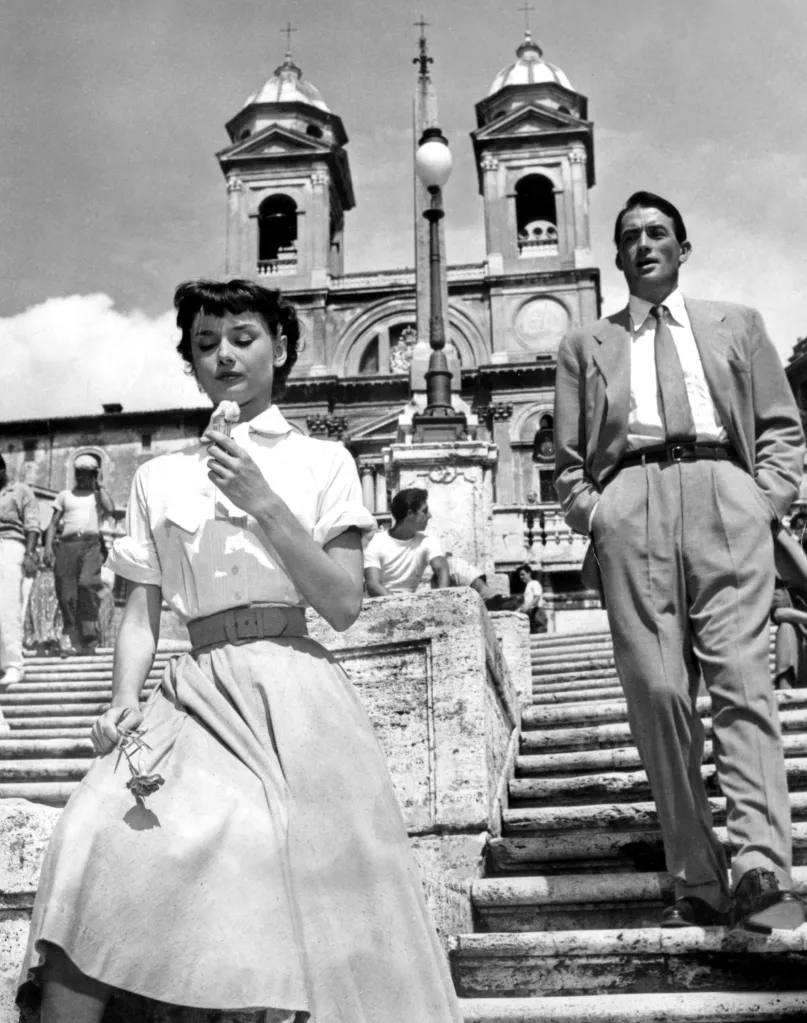
Rome’s appeal was already enduring, but the film gained additional power from Audrey Hepburn and Gregory Peck’s chemistry and comic timing, set against the city in black and white. The San Pietro Suite at the Hassler Roma is tied to the film’s history because Hepburn stayed there during production.
1977–86: The Love Boat
Although the cruise-set series was mostly filmed on soundstages, it introduced Acapulco, Sydney, and other destinations to American living rooms. The Love Boat helped prepare the way for later yacht and cruise television, including Below Deck.
2000: The Beach
A quarter century before The White Lotus went to Southeast Asia, this desert-island thriller brought backpacking culture to the big screen and gave many viewers an early look at Thailand’s beaches.
2003: Lost in Translation
Tokyo functions almost like a third lead in Sofia Coppola’s Oscar-winning film. The Park Hyatt, where much of the movie was filmed, recently reopened after a major renovation.
Every James Bond movie, 1962–2021
Few franchises have made travel appear as glamorous or stylish as Ian Fleming’s 007 stories. The films have been shot in locations from Jamaica to Norway to Monte Carlo. In Monte Carlo, the Hôtel Métropole sells a Bond package that includes custom tailoring, a helicopter tour, and martinis—shaken, not stirred.
This article appears in the August/September 2026 issue of Fortune under the headline “A vacation as fabulous as your favorite show.”
This story was originally featured on Fortune.com.

