Unification minister seeks to drop 'main enemy' label for North Korea
Key Takeaways
- •Unification Minister Chung Dong-young proposed eliminating the "main enemy" label for North Korea, arguing that less hostile language would support peaceful coexistence and help resume inter-Korean talks.
- •The Ministry of National Defense opposed Chung's proposal as it prepares the 2026 Defense White Paper, which is widely expected to retain the designation of North Korea as an "enemy."
- •Chung indicated the Lee administration would abandon the previous government's unification-by-absorption policy in favor of a new framework charting a middle course between conservative deterrence and progressive engagement.
- •North Korean leader Kim Jong-un declared inter-Korean relations as those between two hostile states in December 2023 and formally labeled South Korea the "most hostile state" in March.
- •President Lee Jae Myung expressed caution regarding Chung's suggestion to refer to North Korea by its official name, warning that even well-intentioned gestures could provoke political backlash and undermine stability.
Unification minister pushes to drop 'main enemy' label for North Korea
Published Aug. 5, 2026, 3:41 p.m. KST
Defense ministry disagrees
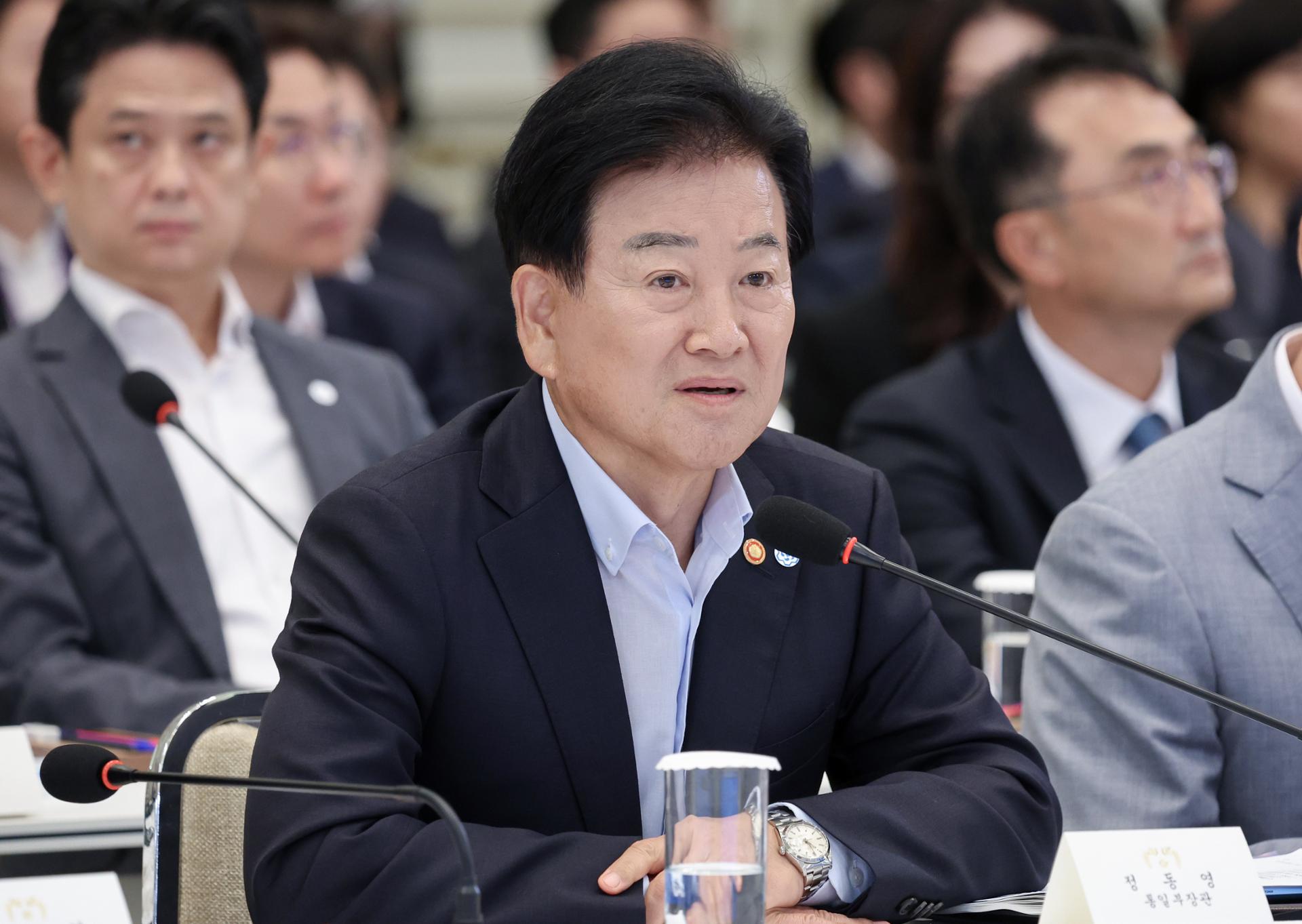
Unification Minister Chung Dong-young proposed dropping the designation of North Korea as South Korea's "main enemy" in order to resume talks with Pyongyang, a move that drew pushback from the defense ministry during a policy briefing to President Lee Jae Myung on Wednesday.
"Recognizing each other by name is the crucial first step. We must cease hostile, hate-filled language toward one another, such as designating a 'main enemy,'" Chung said during the briefing. "The unification ministry will move away from the previous administration's policy of unification by absorption and advance discussions on a new unification framework."
The "unification by absorption" approach Chung referenced — modeled on Germany's reunification, in which one system absorbs the other — had been a cornerstone of the Yoon administration's North Korea policy. Chung's call for a "new unification framework" signals the Lee government's intent to chart a middle course between the conservative emphasis on deterrence and the progressive engagement pursued under Moon Jae-in, though the specifics of that framework have yet to be detailed.
Chung had previously expanded on his position at a press briefing on Tuesday.
"Using the term 'main enemy' is inappropriate when we are pursuing peaceful coexistence on the Korean Peninsula. The expression 'threat,' which was used under the Roh Moo-hyun and Moon Jae-in administrations, is far more suitable. I believe the term 'enemy' used by the Yoon Suk Yeol administration was inappropriate," he said.
"We must bring an end to this scary status quo where the commander-in-chief labels North Korea as our 'main enemy.'"
He added that the ministry would take proactive steps to reduce tensions and work toward a nuclear-free Korean Peninsula.
The "main enemy" wording had also been discussed at previous security-related meetings, but the Ministry of National Defense opposed Chung's proposal. His push comes as the defense ministry prepares the 2026 biennial Defense White Paper, the first under the Lee administration, with close attention on how it will characterize North Korea. The White Paper functions as Seoul's official security assessment, making its terminology choices a closely watched signal of the government's posture toward Pyongyang.
The 2022 edition, published under the Yoon administration, designated the North Korean regime and its military as "our enemy." Between 1995 and 2004, the white paper used the term "main enemy" before the Roh Moo-hyun administration replaced it with "threat" in 2004. The Lee Myung-bak and Park Geun-hye administrations later reinstated language describing the North Korean regime and military as "our enemy." This year's edition is widely expected to retain the "enemy" wording.
The debate comes against the backdrop of North Korea's own shift in rhetoric. In December 2023, North Korean leader Kim Jong-un declared inter-Korean relations to be those between "two states hostile to each other," effectively abandoning the goal of unification. More recently, Kim formally labeled South Korea as the "most hostile state" in March.
Chung also suggested calling North Korea by its official name — the Democratic People's Republic of Korea (DPRK), or "Joson" in its shortened Korean form — to help foster a conciliatory mood. The president responded cautiously, warning that the move could spark political conflict.
Chung did not use the term Joson during the briefing itself, though he has done so publicly on multiple occasions.
"Calling North Korea by its official name is controversial. While I'm certain this was proposed in good faith, it recently sparked debate, and you faced severe backlash after you called the North as the DPRK," Lee said.
"Even when an idea is driven by good intentions and high ideals, if the phrasing gets seized upon and caught up in political strife, it can lead to an outcome far worse than originally intended. It leaves me questioning whether acting on our good intentions is ultimately a net positive for peace and stability on the Korean Peninsula."

