Senate Sets September 15 Procedural Vote on CLARITY Act as Trump Administration Reaffirms Support
Key Takeaways
- •The Senate's September 15 cloture vote requires 60 votes to advance the CLARITY Act, making Democratic support essential even if all Republicans back the measure.
- •TD Cowen analyst Jaret Seiberg estimates a 75% chance of failure, citing unresolved ethics and anti-money-laundering disputes as key obstacles to passage.
- •The Trump administration has expressed full commitment to passing the bill in September, with the White House indicating it will maintain negotiations leading up to the vote.
- •The SEC and CFTC are advancing parallel digital asset rulemaking initiatives that could become the de facto regulatory framework if Congress fails to pass the legislation.
- •Trump Media & Technology Group's announcement of a crypto treasury strategy overhaul adds complexity to the ethics debate, as the president's business interests remain financially exposed to the markets the bill seeks to regulate.
The U.S. Senate is set to hold a key procedural vote on the CLARITY Act on September 15 at 2:15 PM ET, following Senate Majority Leader John Thune's filing of cloture on the motion to proceed before the chamber's August recess. The vote, scheduled one day after senators return to Washington, will determine whether the chamber can limit debate and advance the digital asset market-structure bill toward full floor consideration. Cloture is the Senate's primary mechanism for ending extended debate and requires a three-fifths supermajority—60 votes—making bipartisan cooperation essential in a closely divided chamber.
Since the CLARITY Act update, the bill's path has drawn significant attention. The cloture motion requires 60 votes, meaning Republicans will need Democratic support even if all voting members of their conference back the measure. The Senate Banking Committee advanced the CLARITY Act in May 2026 through a 15-9 bipartisan vote, but lawmakers now face a compressed legislative calendar ahead of the November midterm elections. If the full Senate passes a version differing from the House's, the two chambers would need to reconcile their text—either through amendments or a conference committee—before sending a unified bill to the president's desk.
TD Cowen Sees Difficult Path Ahead
TD Cowen analyst Jaret Seiberg assigns the CLARITY Act a 25% chance of becoming law and a 75% chance of failure. His failure scenarios include a failed follow-up cloture vote, no September vote at all, or Senate action stalling after the first procedural step. Seiberg cited ongoing disputes over ethics rules and anti-money-laundering provisions as factors that could influence the September 15 vote and subsequent Senate negotiations. The assessment underscores how narrow the legislative window is: with the House having passed its version over a year ago, prolonged Senate delays risk pushing final action past the midterm elections, when the balance of power in either chamber could shift.
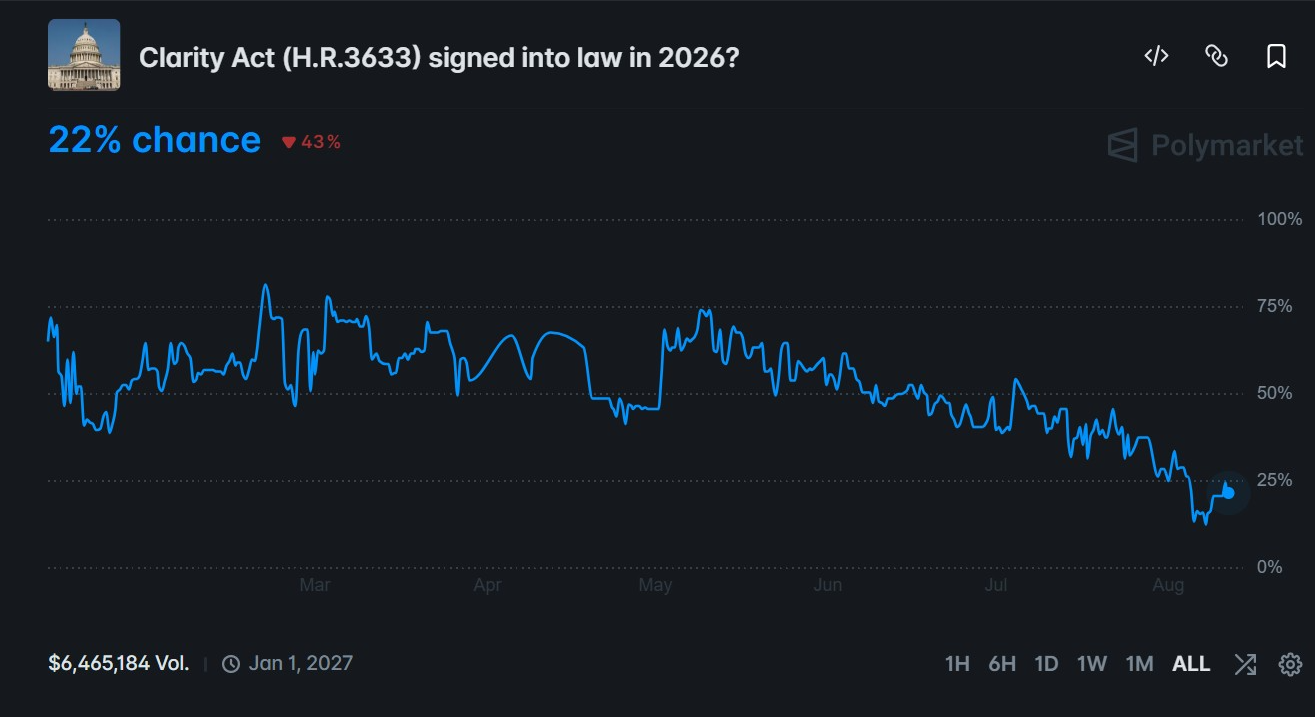
Polymarket data showed a 22% probability that the CLARITY Act will become law in 2026, down 43% from earlier levels. The prediction market has recorded approximately $6.47 million in trading volume, with odds declining sharply since July.
Trump Administration Presses for September Passage
Patrick Witt, executive director of the President's Council of Advisors for Digital Assets, stated that the administration is "fully committed" to passing the CLARITY Act in September. He urged Democrats to continue working with Republicans on the legislation and indicated that the White House will maintain negotiations leading up to the vote.
Witt argued that Congress must enact durable digital asset rules, linking the bill to law-enforcement capabilities, U.S. financial-market leadership, and international competitiveness. His remarks followed the Senate's decision to delay the vote, which frustrated several Republican supporters who had expected action before the recess.
Ethics and Banking Concerns Remain Unresolved
Lawmakers remain divided over ethics provisions tied to President Donald Trump's crypto business interests. Democrats have sought stronger restrictions, while a bipartisan counteroffer would give state attorneys general a role in enforcement. Trump has stated that he does not oppose a blind trust for family crypto businesses but objects to rules that specifically target him. The ethics dispute carries broader stakes: passage of federal market-structure rules without resolving these concerns could leave the legislation vulnerable to political attacks during the campaign season.
Community banks have also raised concerns about stablecoin rewards and potential deposit competition. Senator Cynthia Lummis has dismissed those claims, citing FDIC data for the first quarter showing domestic deposits rose 2.1%, marking a seventh consecutive quarterly increase.
Anti-money-laundering rules remain part of the negotiations. Some lawmakers are demanding stronger Bank Secrecy Act protections before they will support final passage. These issues could shape amendment votes if the Senate clears the initial cloture motion in September.
Legislative Timeline and Regulatory Parallel Tracks
The CLARITY Act would establish a federal market structure for digital assets, dividing oversight between the Securities and Exchange Commission (SEC) and the Commodity Futures Trading Commission (CFTC). The House passed H.R. 3633 in July 2025. The Senate Banking Committee advanced the bill in May 2026, and Lummis released merged committee text in July, followed by updated Senate text on July 22. Her office said the draft combines work from both committees and reflects bipartisan negotiations.
The Senate now has limited floor time to resolve outstanding disputes before campaign activity intensifies in the fall. The September 15 vote will not send the bill directly to the president; rather, it will test whether supporters can secure enough votes to advance to the next stage of Senate debate. If cloture succeeds, senators can proceed to amendments and another vote to end debate before final passage.
Meanwhile, regulators are continuing their own digital asset initiatives alongside the congressional negotiations. The SEC could move to issue its own rules and has scheduled an August 14 meeting to consider a proposed framework for certain crypto investment contract offerings. The CFTC has also announced an August 20 meeting of its Innovation Advisory Committee, with participants from both crypto and traditional finance firms. Should Congress fail to pass the CLARITY Act, these agency-level frameworks could become the de facto rules governing digital asset markets, though they would lack the statutory authority and durability of legislation enacted by Congress.
Trump Media Overhauls Crypto Treasury Strategy
In a related development, Trump Media & Technology Group announced plans to overhaul its crypto treasury strategy on August 10, alongside quarterly results showing a $238.1 million second-quarter loss. The company cited digital asset volatility and balance-sheet management as motivations for the shift.
The revised approach keeps Bitcoin at the center of Trump Media's capital strategy despite significant paper losses, while moving the company toward active treasury management through options, lending, and other yield-generating arrangements. The announcement adds another dimension to the ethics debate surrounding the CLARITY Act, as the president's family and business interests remain financially exposed to the very digital asset markets the legislation seeks to regulate.

