Can Domestic Savings Cover the Country's Increasing Investment Needs?
Key Takeaways
- •Gross domestic savings grew 8.6% to P643 billion in the second quarter of 2026.
- •Investments reached P1.74 trillion, or 23.2% of GDP, leaving a gap of about P1.1 trillion.
- •A savings-investment deficit occurs when investment exceeds savings, requiring borrowing to fund the shortfall.
- •Foreign financing of the gap mirrors the current account deficit and relies on continued investor confidence.
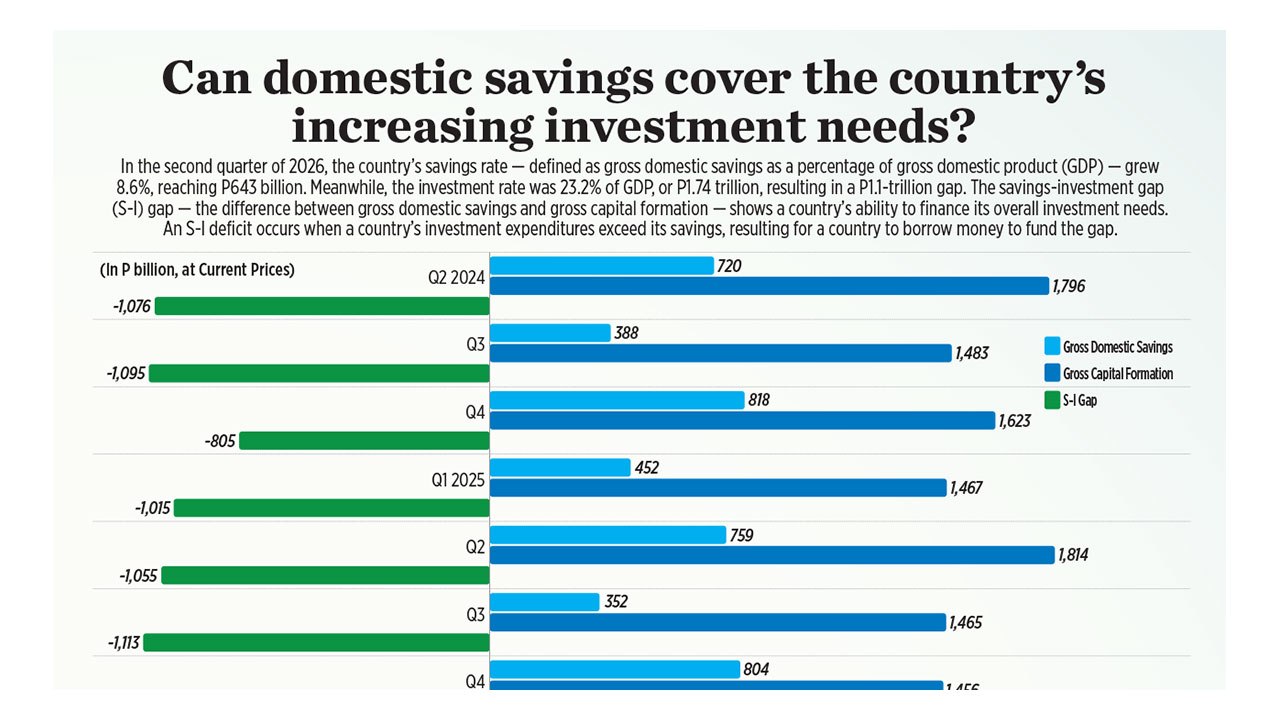
In the second quarter of 2026, the country's savings rate — defined as gross domestic savings as a percentage of gross domestic product (GDP) — grew 8.6%, reaching P643 billion. Over the same period, the investment rate stood at 23.2% of GDP, equivalent to P1.74 trillion, leaving a gap of roughly P1.1 trillion.
The savings-investment (S-I) gap — the difference between gross domestic savings and gross capital formation — indicates a country's ability to finance its overall investment needs. An S-I deficit arises when a country's investment expenditures exceed its savings, forcing the country to borrow money to fund the shortfall.
When that shortfall is financed from abroad, it mirrors the current account deficit in the balance of payments: by definition, a country investing more than it saves draws on foreign capital, whether through loans, portfolio inflows, or foreign direct investment. Sustaining such inflows depends on investor confidence, and a persistent gap can expose the economy to shifts in global financing conditions. How policymakers respond — through measures to lift domestic savings, attract stable long-term capital, or recalibrate public investment plans — will shape how the P1.1 trillion gap evolves in coming quarters.
