Argentine Bitcoiners Unveil “The Genesis of Satoshi Nakamoto” Monument in Buenos Aires
Key Takeaways
- •The monument was unveiled on October 29 at Polo Dot in Buenos Aires during the Open Fest at LABITCONF 2026, organized by Bitcoin.ar through the fifth edition of the Premio B·Arte.
- •The 2.40-meter cube, made of stainless steel and glass by engineer Ricardo Alonso and architect Celeste Difabio Videla, a couple from Bariloche who won the competition, uses five faces to explain Bitcoin's history and philosophy.
- •Its design elements reference the halving mechanism that reduces the block reward every four years until 21 million bitcoins are issued, the opening words of the 2008 white paper, and the genesis block's embedded Times headline about bank bailouts.
- •The inauguration featured remarks led by Rodolfo Andragnes, co-founder of Bitcoin.ar and LABITCONF, along with a musical performance by Mayumaná.
- •Financed by Fundación Bitcoin Iberoamérica and coordinated by Aída Pippo, the project is intended to become a lasting educational resource where schools, universities, families, and visitors can learn about Bitcoin in person.
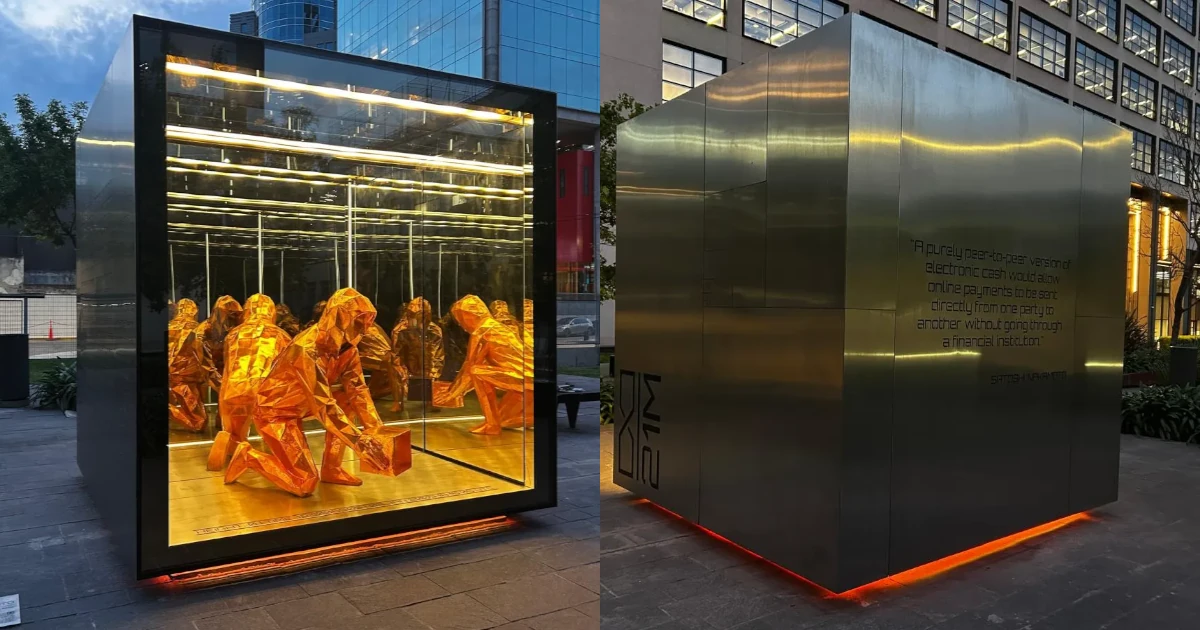
“The Genesis of Satoshi Nakamoto,” a 2.4-meter multidimensional cube dedicated to Bitcoin’s pseudonymous creator, was unveiled on October 29 at Polo Dot in Buenos Aires. The presentation formed part of the Open Fest at LABITCONF 2026 and was organized by Bitcoin.ar through the fifth edition of the Premio B·Arte.
The artwork combines art, technology, and education in a presentation of Bitcoin’s origins, operation, and underlying principles. The inauguration included remarks and explanations led by Rodolfo Andragnes, co-founder of Bitcoin.ar and LABITCONF, as well as a musical performance by Mayumaná, according to an announcement by the organization.
The monument is dedicated to Satoshi Nakamoto, the person—or group of people—behind the creation of Bitcoin whose identity remains unknown. It was conceived not only as a tribute, but also as an artistic and educational experience. Its five faces—four lateral sides and an upper surface—present different elements intended to explain Bitcoin’s history and philosophy.
Five faces exploring Bitcoin’s history and principles
Each face of the monument provides an entry point into a different aspect of Bitcoin. One representation focuses on Satoshi Nakamoto’s anonymity and the collective nature of the technology. After Bitcoin was launched, it continued to develop through the work of thousands of people distributed around the world. Reflections and repeated geometric forms on the artwork evoke a network that replicates and expands.
Another side addresses Bitcoin’s programmed scarcity through a cube that successively divides into halves in a Fibonacci sequence. The design refers to the halving, the mechanism that approximately every four years cuts in half the reward miners receive for validating blocks and regulates the issuance of new bitcoins.
The reward began at 50 bitcoins per block and is reduced by half approximately every four years for roughly 130 years. The process is intended to continue until 21 million bitcoins have been emitted and the block reward reaches zero. The supply limit is an iconic feature of the cryptocurrency and is presented in the work as central to Bitcoin’s qualities as hard money.
The monument also incorporates the opening words of Bitcoin’s foundational document, the white paper published by Satoshi Nakamoto on October 31, 2008. The Bitcoin white paper proposed the possibility of making electronic payments directly between people without relying on a financial institution. The work presents that concept as one of Bitcoin’s foundational principles.
Another face reproduces information from the genesis block, the first block of the Bitcoin blockchain, created on January 3, 2009. Among its elements is a reference to the headline from The Times newspaper that Satoshi incorporated into the block. The embedded text, “Chancellor on brink of second bailout for banks,” pointed to the newspaper’s coverage of British government plans for a second rescue of the country’s banks during the financial crisis of that era. The reference places Bitcoin’s birth in a specific historical context and connects the network’s beginning to the events of its time.
The upper surface features two expressions associated with Bitcoin: “Don’t trust, verify” and “Vires in numeris.” The first encourages people to check information for themselves rather than accept it solely on trust. The second is Latin for “strength in numbers.” In the context of the artwork, it refers both to the collective protection of privacy and to the strength of a monetary system built and defended by cryptography rather than by authority or military power.
The monument is designed to be experienced from multiple angles rather than viewed as a conventional sculpture. Visitors are invited to walk around it, examine its different surfaces, and discover the concepts represented in each section. “The intention is to bring Bitcoin closer to those who are already part of its community, but also to awaken the curiosity of those who do not yet know its history,” the project’s presentation states.
A collective project linking art, technology, and education
The monument was created by Ricardo Alonso, an engineer, and Celeste Difabio Videla, an architect. The artists, who are a couple from Bariloche, won the fifth edition of the Premio B·Arte. The work measures 2.40 meters in width, length, and height and is made from stainless steel and glass.
Teams and collaborators from different parts of Argentina participated in its construction. The process brought together multiple trades, materials, and techniques. Aída Pippo, a visual artist, researcher of new technologies applied to art, and member of the Bitcoin.ar Board of Directors, led the project and coordinated its production and assembly.
“It gives me great pride to feel that this is something we can leave in our city and in our country,” Andragnes said during the presentation. He highlighted the value of a collective initiative intended to create a cultural and educational legacy.
The creators said they wanted the work to serve as a meeting point for the Bitcoin community while also providing an entry point for people who are unfamiliar with the technology. “You don’t always have the possibility of leaving something for posterity,” they said when describing the experience of seeing the monument completed and installed in Buenos Aires.
Through the inauguration, Bitcoin.ar said it hopes the monument will become a permanent city resource for schools, universities, families, and visitors. The space is intended to help people learn about Bitcoin’s history, explore its principles, and begin discussions about money and technology.
The project’s organizers also said the work could develop through educational activities and new experiences, allowing it to remain in Buenos Aires as a legacy for future generations. How those activities take shape around the monument will help determine whether it settles into the lasting civic role its organizers describe. The project was financed by Fundación Bitcoin Iberoamérica and is intended to bring Bitcoin’s history and principles into public and cultural spaces beyond screens and specialized environments. For a technology whose founding documents and milestones live mainly online, the project aims to give Bitcoin’s story a physical address where passersby, students, and families can encounter it in person.
The original article was published by Bitcoin Magazine and written by Juan Galt.

